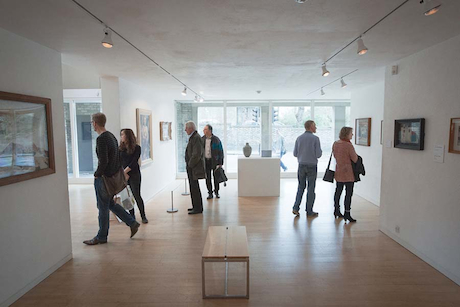
During the Kettle’s Yard exhibition
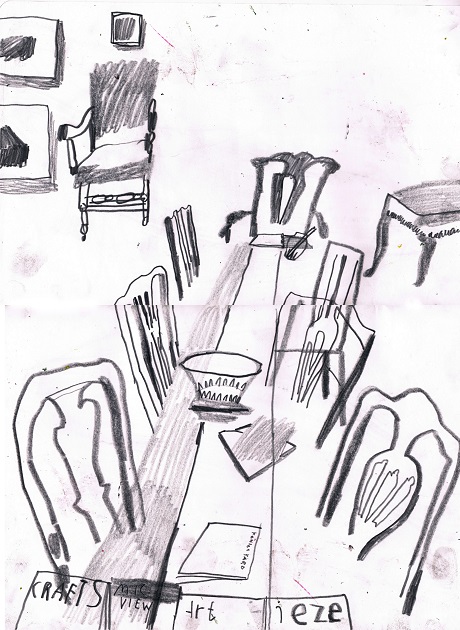
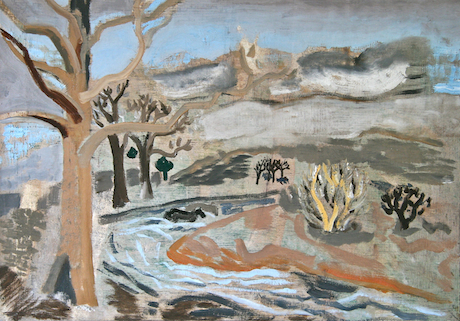
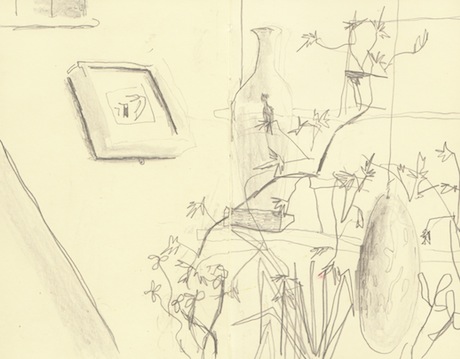
Art & Life
Circuit Cambridge invited people to share their artworks inspired by the landscapes of Ben Nicholson, Winifred Nicholson, Alfred Wallis and Christopher Wood. Circuit received some great responses, click above to see a selection of the artworks submitted via
and
.
Gustav Metzger: Lift Off! Lecture
/ Wednesday 18th June
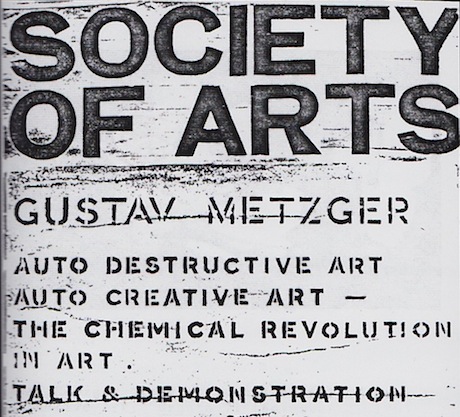
If an image is worth a thousand words, what about an image destroyed that only survives in text? I recently attended a lecture at Kettle’s Yard by
Mathieu Copeland
, a curator of
Gustav Metzger’s
work, who bubbles with enthusiasm for it. His interest lies particularly in the relationship between Metzger’s artwork and the texts which accompanied them – his manifestos. And it got me thinking about how artists have used these two mediums to shape their legacies. For me, the starkest comparison comes from
Albrecht Durer
. Both Durer and Metzger, artists from Nuremberg, were working in periods when the end of the world was thought to be impending. Durer defied this fear by modelling his 1500
Self-portrait
on Christ and inscribing it “I, Albrecht Dürer from Nuremberg, painted myself with eternal colours”. By contrast, Gustav Metzger invented the term ‘auto-destructive art’ and at his
at the South Bank, London in 1961 he sprayed acid onto sheets of nylon and smashed panes of glass as a protest against nuclear arms. While Durer embraced the market, Metzger purposefully destroyed any traces of his demonstrations so that they would never acquire commercial value. But although Metzger’s art was ephemeral, he still had posterity in mind when he wrote his manifestos. So just like Durer with his treatises on geometry, proportion and painting, Metzger sought to influence the art of later generations, even though he feared they might never come.
An artist can never shape their legacy entirely by themselves. Gustav Metzger rejected galleries as well as the market, yet his most famous pieces have recently been reconstructed and he is the subject of repeated exhibitions. It seems to me that his work speaks a message too powerful to let go up in smoke.
The next lecture in the
Gustav Metzger: LIFT OFF!
Lecture series is ‘Automata in History: the Kinetic Arts of the Enlightenment’ with Simon Schaffer on the 3rd of July, 7-8pm.
Read more.
The Ingram Collection of Modern British and Contemporary Art is one of this country’s foremost and most significant collections of Modern British Art. It contains almost 600 paintings and sculptures of which 450 are by the most important artists of the Modern British era, amongst these Elisabeth Frink, Barbara Hepworth and Eduardo Paolozzi. It has been put together since 2002 by media entrepreneur and philanthropist Chris Ingram. A new and growing element to The Collection is Chris’ interest in contemporary art and emerging artists.
You started collecting Modern British Art in 2002. Why did you choose this particular field?
I discovered Modern British Art quite late in the day. I was just starting to attend auction house viewings and soon realised I really liked Modern British. It was undervalued and I found out that I would be able to build a very good collection. It was also fortuitous timing because I had just sold my business for a good price so I was able to make the idea happen. I got on with it!
Has your taste changed over time?
My taste is still heavily figurative but I would agree that it has shifted slightly – only at the edges. The core work hasnʼt changed. Iʼm moving away from the ʻcomfortableʼ to the edgy – some would say dark – but the major point with everything I buy is that I have to be able to look at it again and again. It has to have something that keeps drawing me in. A more significant shift for me is that Iʼm getting more interested in contemporary art, particularly in young talent and what they are doing. Also the way that outsiders and disadvantaged groups paint and draw.
What purchases really stick out in your mind as wonderful/exciting additions to The Collection?
Iʼll certainly never forget buying Dame Elisabeth Frinkʼs ʻWalking Madonnaʼ – because it was a pursuit! I fell in love with her at Salisbury Cathedral and desperately wanted her. However, there are only 3 casts, one of which is in the Cathedral. When one came up at auction I went crazy on the bidding and ended up going way over my limit – £100,000 over! And I still didnʼt get it! At that point I was the world record underbidder for a Modern British piece (scant comfort!). My lesson was that I couldnʼt control myself at auction and since then my curator has always bid on my behalf. The ʻWalking Madonnaʼ was very much a pursuit of a woman and when I bought the 3rd cast it was an unforgettable moment for me.
Have you made any mistakes in your collecting life?
The Telegraph did a profile on me in which it listed the world record prices I had paid for artists such as Keith Vaughan and John Craxton. So maybe some might say I had overpaid but they seemed like modest prices at the time. I tend to decide pretty quickly if I like something or not; there are only 2 or 3 things I regret buying which I realise now I bought in too much of a rush. But in a collection of 600 pieces thatʼs not too bad!
Do you think its a certain type of Englishman who collects Modern British?
Yes I do. I think you certainly have to be independently minded. Modern British is a bit quirky, and it can be dark and edgy – youʼve got to like that. Sometimes Iʼve bought some contemporary pieces that amuse me just to jolly things up! The great thing about Modern British is that there are still so many great artists to discover.
Were you aware of Jim Ede and his collection?
I find it fascinating what Jim Ede achieved. He was certainly ahead of his time. Before I began collecting in 2002 I was only vaguely aware of him. Of course since then – being a bit of an obsessive- I have read around the period a lot and keep coming across Jim Ede.
Do you think collectors are important for our cultural life/heritage?
Absolutely. On a basic level collectors who support artists enable to them to make a living from art. Itʼs there throughout history – collectors as patrons and benefactors. Beyond that, Iʼm a collector who wants to share the enjoyment of these works with as many people as possible. I mean, whose cultural life is it? If collectors lock their collections away people canʼt get pleasure from them. I realize a lot of collectors donʼt think this way though so I am unusual in that respect.
What are your hopes for The Ingram Collection of Modern British and Contemporary Art?
The major principle is for as many people to enjoy it as possible. This is through touring exhibitions and getting the collection into places where it will have a broader and wider appreciation. London would certainly be on that list. I also want to use the reputation of the collection to build up and help young contemporary talent. So watch this space!
Do you have any advice for other collectors?
The golden rule is only buy what you like and enjoy. Regardless of what people tell you and whatʼs fashionable. Always start with what you like. As in any walk of life you need to study and learn – practice makes perfect! So build up a bit of expertise. Of course you can have an eclectic collection, but if you focus in you become more of an expert, you learn the ins and outs more. It really becomes a collection then.
Illustration Series: Illuminating Spaces
/ Tuesday 27th May
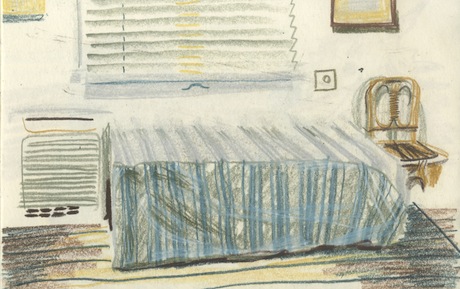
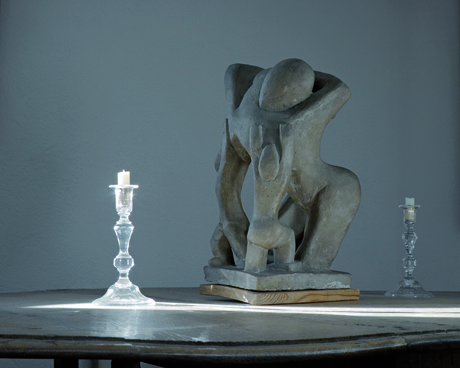
The light in Kettle’s Yard is always moving through the house, illuminating spaces, revealing objects and artworks, changing the conversations they have with each other, creating the illusion that things in the house are full of energy, moving and changing colour and form. You could visit Kettle’s Yard a thousand times and you’d always have something new to take away from it.
Illustration & text by Johann Rohl
To see more work by Illustration Students from the Cambridge School of Art, visit the
Cambridge School of Art Degree Show 2014
at the Ruskin Gallery from 13 – 22 June.
For
Museums at Night
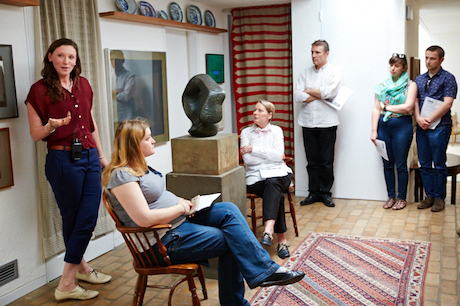
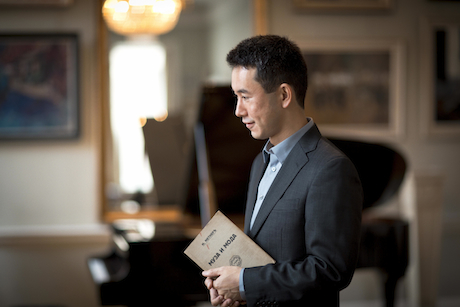
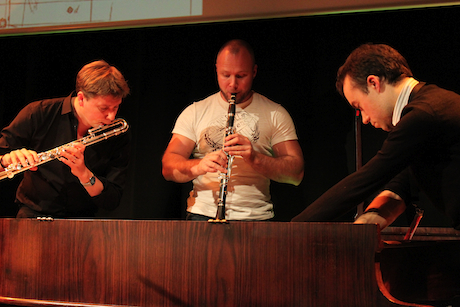
2014 Kettle’s Yard hosted an evening of short talks about the collection, live music, a pop up shop and bar.
These beautiful images come courtesy of photographer
Josh Murfitt
; ‘I’m a freelance photographer who is naturally drawn to the arts, working to document artworks and local art events, and supporting and promoting artists’ projects through photography. One of the things I like about Kettle’s Yard is the way natural light ‘collaborates’ with the space and the subtle arrangements around the house, lending transient accentuations at different times of the day and year’.
Last chance to see Art & Life
/ Tuesday 29th April
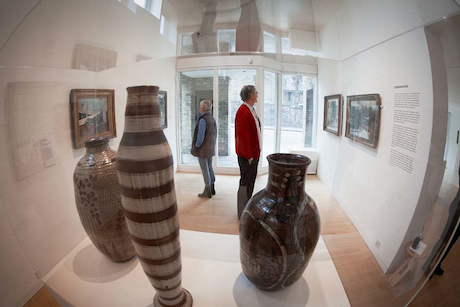
There’s just over a week left of our current exhibition
Art & Life
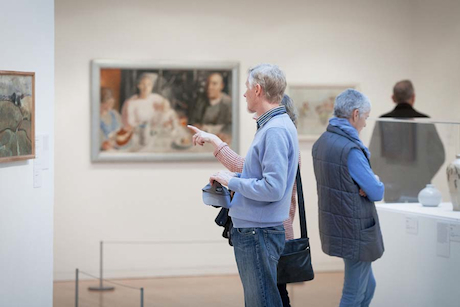
, if you haven’t been to see it yet head down to the show before it closes on 11 May. Curated by Ben & Winifred Nicholson’s grandson Jovan Nicholson, the show provides an insight into how they collaborated with each other and drew inspiration from their friends and fellow artists Christopher Wood, Alfred Wallis and William Staite Murray.
The show has had some wonderful reviews:
“‘Art and Life 1920-1931′…is as important an exhibition in its way as Tate Modern’s recent ‘Paul Klee-Making Visible’, and more digestible.’ (
Apollo
, April 2014)
‘A group of aspiring, like-minded artists, who worked and exhibited together, shared the aim of producing forms of art that were experimental and innovative.’ (
The New York Times
, March 2014)
‘At the Kettle’s Yard show…the felicitous hanging constantly makes us aware of the links between all these artists.’(
The Financial Times
, March 2014)
Almost 15,000 people have seen the exhibition so far and we’ve also been delighted with the visitor feedback:
‘Just back from a lovely afternoon at Kettle’s Yard. The new exhibition there is an absolute treat.’ (Dr James Fox, via twitter, 6.4.14)
‘Beautiful paintings by Winifred Nicholson in ‘Art & Life’ at Kettle’s Yard-great exhibition. Feel inspired to paint still life!’ (Sarah Allbrook, via twitter, 4.3.14)
‘I recommend a visit to Art & Life at Kettle’s Yard. Interesting stories behind the pieces & there is nothing like getting really close to art.’ (Faith Caton-Barber, via twitter, 16.04.14)
Don’t miss the last two Art & Life events coming up; a
Lunchtime talk
on the 8th of May by our Assistant Curator Guy Haywood on Ben Nicholson’s ‘Cornwall’ and on the 9th of May join us for a
Practice Session
exploring line and colour through dry point printing.
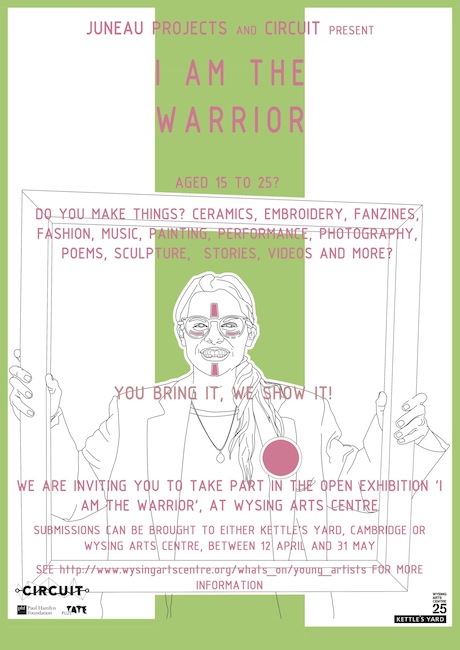
Kettle’s Yard and Wysing’s Circuit group have been working with Juneau Projects to put together an open exhibition for 15 to 25 year olds called I Am The Warrior. It will be running alongside the new exhibition Hey, I’m Mr. Poetic at
Wysing Arts Centre
. Members of Circuit have been designing and making the display structures, painting, filming, developing marketing materials, and generally preparing for the opening on the 12th April. I am the Warrior is open to all 15-25 year olds to submit anything they have made, whether it be ceramics, collage, costumes, carving, embroidery, fanzines, fashion, games, masks, music, painting, performance, photography, poems, sculpture, songs, stories or videos.
For more information click
here
. You can also follow Circuit on Facebook by searching for
.
Illustration Series: Javanese Puppet
/ Thursday 10th April
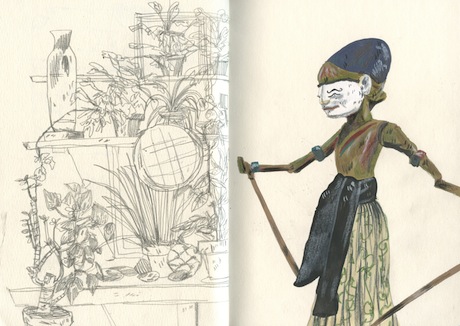
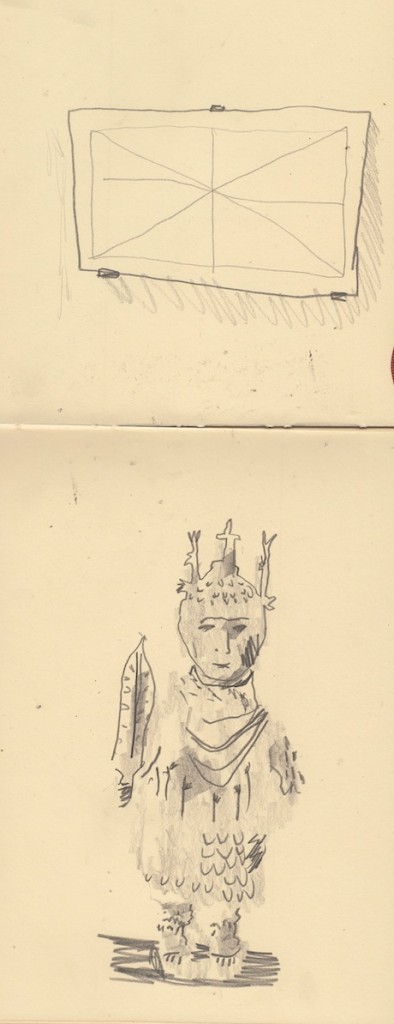
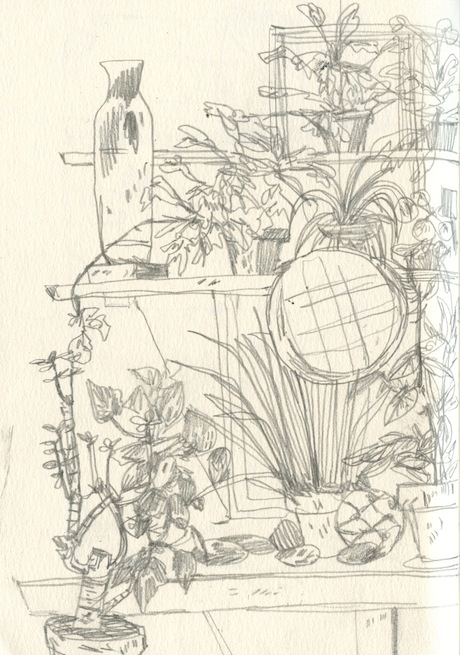
The first drawing I did was of the plants that are in a sort of ‘transition area’ of the house. I just really enjoyed the light there and how some of the plants were growing down onto other shelves and into the space of other plants.
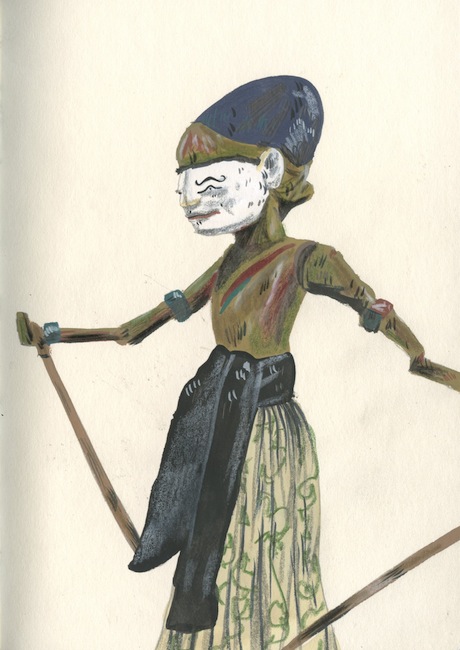
The Javanese puppet on the right page caught my attention as soon as I walked into the room – it is right there in front of you, almost like a strange gesticulating butler welcoming you. I also enjoyed the strange features painted delicately onto it’s face.
Interview with composer Kate Honey
/ Tuesday 8th April
We interview composer Kate Honey ahead of the world premiere of her new composition at Kettle’s Yard this April.
Kate Honey (born 1991) is a Cambridge-based composer and music teacher. She read music at the University of Cambridge, where she was taught composition by Richard Causton. She graduated in 2013 with the
Arthur Bliss Prize in Composition
. In August 2013 she studied Advanced Composition at Dartington International Summer School with Francesco Antonioni. Her compositions have been performed by Tom Poster, the Britten Sinfonia, Robinson College Chapel Choir and the Halesowen Orchestra, among other ensembles. She has a keen interest in multimedia and socially engaged music.
Are you looking forward to the premiere of your composition at Kettle’s Yard?
Yes, very much so. It’s a privilege to work with these enormously talented players. Every live performance is a great learning experience for a composer.
Tell us about your composition.
‘Stay Together, Learn the Flowers, Go Light’ took a long time to write. Like my previous piece ‘Ecopoem’, it was originally a quasi-programmatic piece with environmental themes. As I realised that the large-scale conception was too ambitious for the time I had available, I converted the piece into five bagatelles. I would consider the piece musically complete without a programme now. The title is taken from a poem by Gary Snyder, and is advice to the human population who will face increased economic, political and ecological instability on a global scale.
Who or what inspires your music?
I enjoy sounds for their own sake, and pay attention to the sounds that greet me everyday: the mains hum, the pitch of the microwave, the blackbird in the garden, aeroplanes. Composers whose music I love include Tippett, John McCabe, Nielsen, Britten, Messiaen, Nono. I’m not sure what my main musical influences are.
What’s on your playlist?
Currently lots of talks by a Buddhist monk called Rev. Master Daizui MacPhillamy. And a rapper called Angel Haze. And a Weather Report album.
What are your plans for the future?
I’d like to write for orchestra at some point, and I’m hoping to write a large-scale choral piece next. In the more distant future I’m weighing up a part-time PhD studying socially/environmentally engaged music, or else composition study at a conservatoire. I’m also hoping to volunteer for Global Power Shift, an international climate change engagement movement.
Kate Honey’s new work will be performed as part of our
New Music
series by Peter Sheppard Skaerved, violin & Roderick Chadwick, piano on 27 April.
Alfred Wallis, Schooner and Icebergs, 1928
Ben Nicholson, c.1930, Cornish Port
Florence Gildea, student blogger
Art & Life Lecture Series: Modernity and the English Tradition
/ Monday 17th March
This blog has been prompted by
’ lecture on ‘Ben Nicholson: Modernity and the English Tradition’, but rather than poorly try to summarise an expert’s nuanced understanding of primitivism, and fall promptly flat on my face, I shall try to relate it to something I am far more familiar with: Kettle’s Yard itself. I had always imagined Kettle’s Yard and
The Museum of Cambridge
to be something of uncomfortable bed-fellows, only sharing visitors subject to a case of the well-while-we’re-heres. One, a quaint step back into the folkloric past; the other, a place of timeless contemplation whose life seemed more rooted in the changing light of a day than in the hubbub of particular political and socio-economic changes. Yet Stephens argued that English primitivism was closely tied into nostalgia for a very English tradition. It might make sense, therefore, to see Kettles’ Yard and its neighbour as differing responses to the same sort of anxiety, wrought principally by the industrialisation of Britain but accelerated by the First World War. Both represent a rejection of the anonymity and mindless violence of the machine. But while folklorists grasped desperately at a fading past, to preserve traditions threatened by an incoming tidal wave of ‘modernity’, artists like
Ben Nicholson
sought to strip the essence of the ‘English tradition’ of its upper middle-class embellishments, and unite it with new forms of art, a new spirituality and a new lifestyle. I think this was best summed up by the interior of the Nicholson’s Cumberland home: a whitewashed stone cottage with its ancient flagstones and iron range also accommodating a
Mondrian
. But the overlap between the work of folklorists at the turn of the century and the English primitives seems most notable in the figure of
Alfred Wallis
. For just as the former believed they could find human caretakers of an almost primeval way of life, so did Wallis’ patrons trust that in him there was embodied the quintessence of the rural life that was under attack. Both museums, then, represent a search for a timelessness, however different their answers might initially seem.
The next
lecture
in the series is ‘Abstract Matter: William Staite Murray’s stoneware pottery’, 24 March, 7-8pm, with a special opening of the gallery and shop before the talk at 6pm.
£8/£6 Friends of Kettles Yard, book
here
, or call
The Learning Team at Kettle’s Yard are delighted to share
Light
– a new Learning Resource for Kettle’s Yard. Light is the first of three learning resources that outline key themes of the Kettle’s Yard collection. We hope it will support teachers and educators to engage students with Kettle’s Yard and to plan sessions both on-site and in the classroom.
Light includes contextual information about the importance of light in regard to Jim Ede’s thinking for Kettle’s Yard, as well as highlighting individual artworks in the collection in which artists utilised and manipulated the fall of light and shadows to create their artworks. The resource also includes cross-curricular information on artworks, as well as contemporary responses to light.
All feedback is welcomed and completion of our
online survey
would be much appreciated as it will help us make the next two resources, Nature and Space, even better. Light was generously funded by the National Lottery through the Heritage Lottery Fund and we thank them for their continued support of our work. If you would like a hard copy of light, please email
and we will send you a resource.
We are also holding a Teachers Private View of our next exhibition
Art and Life: 1920-1931
on Tuesday 25
th
February. This will be the official launch of Light and will serve as an opportunity to learn more about our future resources, as well as enjoying a guided tour of the show. The evening is free of charge, but please book your place by contacting Lucy Wheeler on
or emailing
Hiroaki Takenouchi Concert
/ Thursday 20th February
Back in 2004, when composer
Jeremy Dale Roberts
celebrated his 70th birthday, one of his most recent pieces was Oggetti, a cycle of piano pieces in homage to the Italian artist
Giorgio Morandi
. I took Oggetti as the starting point for an article I wrote in The Guardian that year surveying his output as a whole. I was fascinated by how the dignity and mute eloquence of Morandi’s objects – bottles, jugs and pitchers disposed as if in a family photograph – was reflected in understated yet powerful music that somehow managed to force the listener into a slower pace of listening. The piece seemed to translate into music some comments by Karen Wilkins: “For anyone who pays attention, the microcosm of Morandi’s tablecloth becomes vast, the space between objects immense, pregnant, and expressive … The austere gives way to the seductive.” (The whole article can still be read
online
).
Ten years on, as Dale Roberts celebrates his 80th, it’s a great pleasure to be able to revisit this piece (on Sunday 2nd March at 12.15pm), amongst several others – new and old – through the course of the Kettle’s Yard New Music Series. As a programmer, it’s also particularly good to be able to put on performances where works are played by the musicians for whom they were written: having given the world premiere of Oggetti and made the first recording of the work, Hiroaki Takenouchi (an consummate musician whose playing has been praised by such unlikely bedfellows as Helmut Lachenmann and Sir Roger Norrington) can give a uniquely authoritative account of the piece, which he himself has helped to shape.
The Italian theme of the 2nd March programme is also reflected in works by Dallapiccola (Morandi’s contemporary) and Castiglioni, whilst music by Dallapiccola’s pupil Edwin Roxburgh (for many years Dale Robert’s teaching colleague at the Royal College of Music) and Cambridge’s very own John Hopkins complete the programme.
Pre-concert talk from 11.30am – Giorgio Morandi and Music: Jeremy Dale Roberts discusses links between visual arts and composition, in conversation with artist Bob White.
Read the full programme
here
. Sunday 2 March, tickets £8 (£5), buy
online
or call
Notre Dame de la Garde
Marseille
The hotel breakfast
MuCEM
Villa Méditerrannée
IMG_2247
Louise Bourgeois sculpture
Wine tasting
Lunch
Aubagne
Villa Noailles
Rosemary Cullum
Destination Marseille for the Friends of Kettle’s Yard
/ Tuesday 18th February
Each year, the
Friends
are presented with an enticing range of events and trips, organised especially for them both in the UK and abroad. Last autumn, architects Rolfe Kentish and Jane Sanders led a hugely successful Friends’ visit to Marseille. Many starry modern buildings were seen and the chance to experience the architecture, landscape, food and wine of southern France in the company of like-minded people was an integral part of the trip. Rosemary Cullum takes up the story…
No airport queues for us. Travelling by train on the Eurostar and TGV was a key attraction of the trip. On arrival in Marseille, Rolfe led us to a sun-filled terrace with a stunning panoramic view of the city bathed in golden light. In the distance perched on a pinnacle, an exquisite church– Notre Dame de la Garde which we couldn’t wait to explore.
The first evening’s walk down to the Old Port revealed a vibrant city with fascinating street sculptures, controversial architecture, harbour-side restaurants, the buzz of traffic, people of all nationalities, a working city plus much more.
Day two
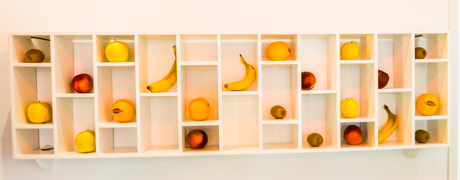
began with the delights of hotel breakfast. Intriguing was the fruit arranged as an installation so one was hesitant to disturb the image.
Our first visit was to
MuCEM
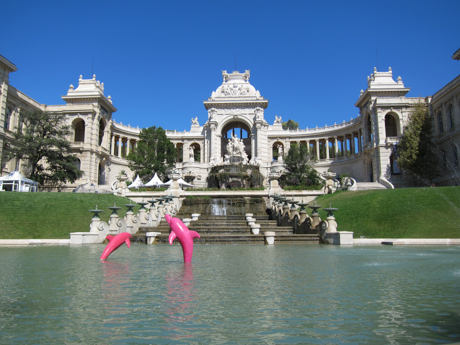
- the first Museum of European and Mediterranean Civilisations. The main building was clad in an outer ‘skin’ – a concrete tracery of symbolic foliage shapes. The museum houses a permanent exhibition of historical everyday objects relating to Mediterranean civilisations – all this and then the delights of the Fort St-Jean reached by a suspended walkway, overlooking the magical ‘Vieux Port’. The inspiring and innovative architecture of the development included a breath-taking cantilevered building, the Villa Méditerrannée, resembling a diving board. In the afternoon some took a boat trip round the beautiful Calanques (‘fjords’) and others visited the Palais Longchamp for the De Van Gogh à Bonnard exhibition.
Next day
saw a visit to the
Chateau la Coste Sculpture Park
and vineyard an oasis of peace and serenity near Aix. Large stretches of water reflected the sky, while swifts dipped and wheeled over works by Alexander Calder and Louise Bourgeois. A two hour walk in the warmth and silence of the French countryside, took us round the fascinating site specific sculptures by artists including Tracey Emin, Richard Serra, Sean Scully, and Andy Goldsworthy. They had all responded to, and interpreted, the magnificent site in different ways.
Wine tasting was followed by another wonderful group meal – typically French –outside at a long snow white cloth covered table. After lunch there were more beautiful paintings in Aix at the Musée Granet for the ‘De Cezanne à Matisse’ exhibition.
Other highlights of the trip included
an inside view of Corbusier’s Unité d’Habitation. Having a guided tour by a ‘real life’ resident enabled the full impact of Corbusier’s design to be appreciated. And then a drive along the Corniche with wonderful romantic sea views, towards our next destination, Aubagne.
Here we saw a very enjoyable Picasso ceramic exhibition. The French fruit and vegetable market in the town was irresistible – aromas of sun-warmed peaches and nectarines, vivid colours of peppers and aubergines, strings of purple flushed garlic…lunch was wine drenched and unforgettable.
On then to Hyeres for a visit to the Villa Noailles – an early modernist villa of beautiful proportions.
The star of our trip was Marseille itself, European Capital of Culture 2013 – full of golden light – an outstanding destination. Quite simply – a glorious time was had by all. How lucky we are to be Friends of Kettle’s Yard.
Kettle’s Yard Illustration Series
/ Wednesday 5th February
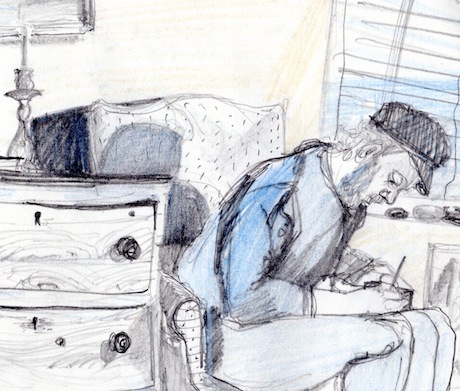
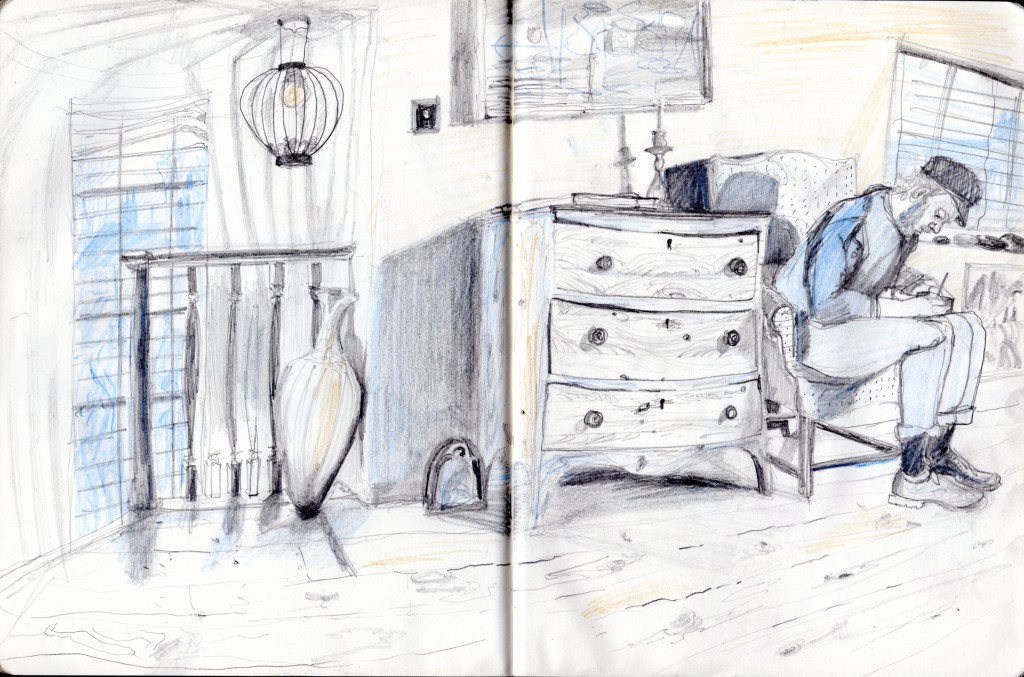
The winter light cast strong black shadows in all the corners of the room and the objects, whilst this man sat writing. The space was calm with concentration as I drew and he wrote, responding to the room in our different ways.
Katie Paterson wins South Bank Sky Arts Visual Art Award
/ Tuesday 28th January
Yesterday Katie Paterson won the South Bank Sky Arts Visual Art Award, in part for her exhibition at Kettle’s Yard
last year
. We are thrilled – for Katie and because our show was able to play a role in her success. I first encountered Katie’s work standing in a sweltering airport queue. I was reading a newspaper article about a young artist exhibiting in the Slade School of Art MA exhibition. Instead of welcoming her visitors she was camping in Iceland. According to the piece, I could ring a mobile phone number and I would hear the sound – live – of the largest glacier in Europe melting. Katie was in Iceland to ensure the microphone stayed secure, 15 metres beneath the ice. I love ambitious artists and this seemed at the most extreme end. I rang the number and joined around 8000 people around the world who listened over those few weeks to the sound of cracking and rushing water – the shocking noise in your ear of a glacier melting. It was like hearing an animal dying. I felt I was experiencing an art work of rare originality and imagination. Katie’s work was powerfully concerned with climate change, but it also acutely exposed our place in geological time and questioned the uses of technology. Since then Katie has made many other
remarkable pieces
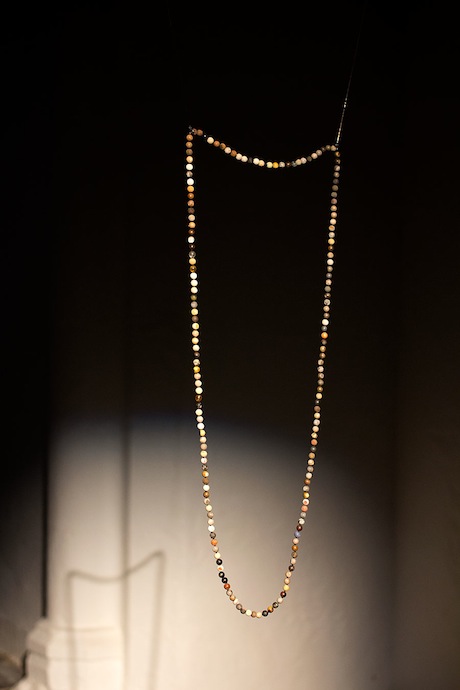
that reignite our sense of awe at the natural world. She considers and questions the value of our momentary place and time in a world already billions of years old. For her Cambridge exhibition, Katie exhibited three earlier works in the Gallery and an astonishing new piece ‘Fossil Necklace’ which was suspended in St. Peter’s Church, next door to Kettle’s Yard. In the form of 170 beads, ‘Fossil Necklace’ does nothing less than chart the evolution of life on the planet. This inspiring piece is currently on show in
‘Foreign Bodies / Common Ground’
at the
Wellcome Collection
until 9th February. For this stunning work alone, Katie deserved the prize. Go and see it.
Note: ‘Fossil Necklace’ was created in response to a residency at the Wellcome Trust Sanger Institute, a research campus just outside Cambridge. Kettle’s Yard proposed Katie for a Sanger Institute residency focused on global health and agreed to make an exhibition with the artist – so the work and issues would receive a wider audience.
Katie Paterson’s residency at the Wellcome Trust Sanger Institute was one of 6 international residencies which made up Wellcome Collection’s
Art in Global Health
project.
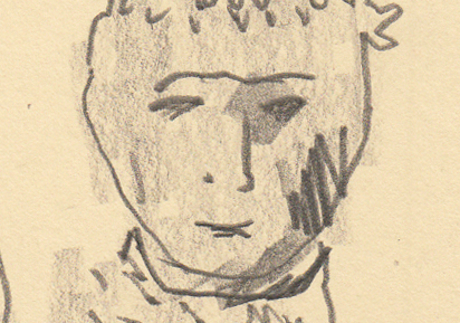
This January sees the launch of the Illustration Series. The Series will showcase sketches of Kettle’s Yard House & Gallery by Illustration students from the
Cambridge School of Art
. We look forward to seeing their new work over the coming months and hope it inspires our visitors to seek out the hidden corners and treasures of Kettle’s Yard.
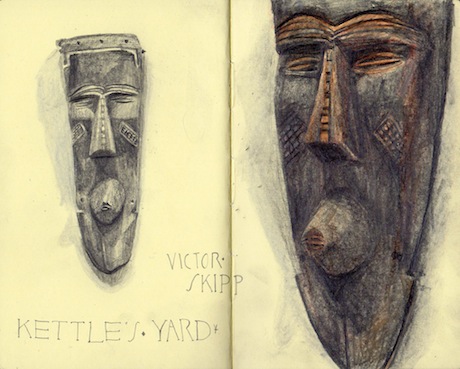
The juxtaposition of the sophisticated carving placed under the basic form of Bob Law’s shape gave an insight into Skipp’s compositions.
Illustration & text by Toby Rampton
A Lasting Legacy
: The House and Collection of Victor Skipp is on until 26 January 2014
Return of New Music Concerts
/ Tuesday 17th December
The 2014 New Music series is programmed by
Richard Causton
in his first year as Kettle’s Yard New Music Associate. Causton “is one of the finest of the new generation of British composers” (The Guardian) and Lecturer in Musical Composition at the University of Cambridge.
This year’s programme is based around several distinct themes: Italian 20
th
century music is explored throughout the season with “the top-notch chamber ensemble
Chroma
” (The Guardian), kicking things off with an Italian programme featuring Donatoni, Castiglioni, Vacchi, as well as Causton’s award winning
Phoenix
and a new work by Andrew Thomas, the first of three newly commissioned works in the season. Cambridge third year student Kate Honey has also composed a substantial new work which will be performed by
Peter Sheppard Skaerved
, violin &
Roderick Chadwick
, piano (kindly supported by the
PRS for Music Foundation
).
The music of
Jeremy Dale Roberts
, one of the unsung heroes of British New Music, is also celebrated through the series. Before the solo piano recital from
Hiro Takenouchi
Dale Roberts will give a pre-concert talk. In this concert Dale Roberts’
Oggetti
for piano (an homage to the Italian artist Giorgio Morandi) is presented alongside music by Morandi’s contemporary Luigi Dallapiccola and Dallapiccola’s pupil Edwin Roxburgh. This reflects how the theme of lineage, with composers’ works presented alongside those of their teachers, is key to this New Music series.
The Kreutzer String Quartet
(with cellist Bridget MacRae) will also be performing a vibrant String Quartet by Dale Roberts. This piece draws its inspiration from the art of Edvard Munch along with Virginia Woolf, Marina Tsvetayeva and Janacek
s
.
For the Michael Harrison Memorial concert we are pleased to have
Anton Lukoszevieze
, cello (a former New Music Associate) &
Mark Knoop
, piano. The programme presents the world premieres of new works especially written as tributes to the late Michael Harrison by each of the composers he appointed as Kettle’s Yard New Music Associates.
The series also presents works outside the classical mainstream including the electronic music pioneer
Trevor Wishart
with a selection of his electroacoustic works. A composer who is “not afraid to take risks in her music” (International Record Review),
Errollyn Wallen
will perform a selection of her own compositions for the final concert in the series. Wallen, MBE, was recently the recipient of an Ivor Novello Award.
Victor Skipp Exhibition Review
/ Wednesday 20th November
I have a confession. Since the first series of Grand Designs, I have been prejudging the contents of homes with UPVC windows. Victor Skipp’s collection, formerly housed behind these bugbears of mine, should challenge all of us traditionalist wooden-frame-and-single-panes to not judge a book by its cover, even if that cover is apparently transparent.
Like Kettle’s Yard,
Victor Skipp’s home in Suffolk
- into which we get an insight from Candida Richardson’s film ‘The Taj Mahal of Hopton’ – appears utterly unprovocative. Almost, dare I say it, boxish. You would hardly suspect that it was once home to the most eclectic of collections, from avant-garde art, to seventeenth-century Indian miniatures; African masks to
Lucy Rie
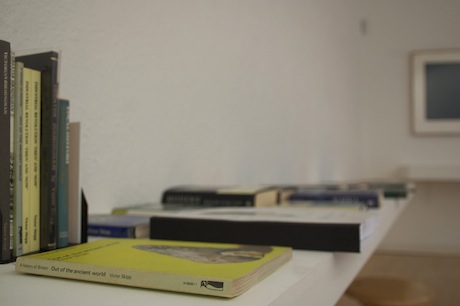
pottery. The inspiration that Skipp drew from Kettle’s Yard is clear: staircases serving as bookshelves and objects divided by centuries and hemispheres on one windowsill. That familiar, ethereal sense of light is encountered here too, and a shot of a plastic carton of semi-skimmed milk reminds us that, like that of the Edes, this collection was inextricable from its owner’s life.
Throughout the exhibition, I was struck most by how both Skipp as philosopher, historian and collector, and the artists he collected were all in their individual ways, and using different lenses, trying to master the art of capturing. In some cases, the target was a tiny piece of a larger whole, or, in the case of
Bob Law’s
field-landscapes, “the universe”. In his
The Last of the Black Donkeys
, the painting captures the viewer’s reflection, entirely without the artist’s interpretation. For Skipp, both the Turkoman-patterned rugs and
Linda Karshan’s
drawings- positioned alongside each other, represented snapshots of patterns which might go on forever. The arrangement of lines in Karshan’s drawings echo the frame of a camera screen highlighting the selectivity of a composition. The blank space between them draws our attention to the capturing rather than the captured. And of course, it is now Skipp being portrayed by Kettle’s Yard, through Richardson’s film which represents his life through his material environment, the pieces displayed, and the way they are positioned.
To look at art through one man’s collection is in fact an extremely interesting lens- rather than arranged thematically or by period, in just a couple of rooms, we get a snapshot of cultures across millennia and continents. Our appetites are stimulated, if not satiated; we explore, even if we cannot conclude. The very bricolage of subjects and origins, of course, will lead to an equally diverse range of experiences, seen through a variety of viewpoints. But as I draw to a close my own highly selective verbal picture, I wonder if this use of different lenses, this zooming in and out, was something which struck a personal chord with Skipp as a historian. As a man who wrote on the ancient world, industrial Birmingham, and an eighteenth-century labourer’s family, I suppose he knew very well that which zoom we choose affects the picture that we get.