Return of New Music Concerts
/ Tuesday 17th December
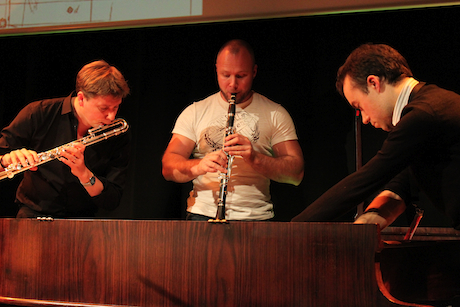
The 2014 New Music series is programmed by
Richard Causton
in his first year as Kettle’s Yard New Music Associate. Causton “is one of the finest of the new generation of British composers” (The Guardian) and Lecturer in Musical Composition at the University of Cambridge.
This year’s programme is based around several distinct themes: Italian 20
th
century music is explored throughout the season with “the top-notch chamber ensemble
Chroma
” (The Guardian), kicking things off with an Italian programme featuring Donatoni, Castiglioni, Vacchi, as well as Causton’s award winning
Phoenix
and a new work by Andrew Thomas, the first of three newly commissioned works in the season. Cambridge third year student Kate Honey has also composed a substantial new work which will be performed by
Peter Sheppard Skaerved
, violin &
Roderick Chadwick
, piano (kindly supported by the
PRS for Music Foundation
).
The music of
Jeremy Dale Roberts
, one of the unsung heroes of British New Music, is also celebrated through the series. Before the solo piano recital from
Hiro Takenouchi
Dale Roberts will give a pre-concert talk. In this concert Dale Roberts’
Oggetti
for piano (an homage to the Italian artist Giorgio Morandi) is presented alongside music by Morandi’s contemporary Luigi Dallapiccola and Dallapiccola’s pupil Edwin Roxburgh. This reflects how the theme of lineage, with composers’ works presented alongside those of their teachers, is key to this New Music series.
The Kreutzer String Quartet
(with cellist Bridget MacRae) will also be performing a vibrant String Quartet by Dale Roberts. This piece draws its inspiration from the art of Edvard Munch along with Virginia Woolf, Marina Tsvetayeva and Janacek
s
.
For the Michael Harrison Memorial concert we are pleased to have
Anton Lukoszevieze
, cello (a former New Music Associate) &
Mark Knoop
, piano. The programme presents the world premieres of new works especially written as tributes to the late Michael Harrison by each of the composers he appointed as Kettle’s Yard New Music Associates.
The series also presents works outside the classical mainstream including the electronic music pioneer
Trevor Wishart
with a selection of his electroacoustic works. A composer who is “not afraid to take risks in her music” (International Record Review),
Errollyn Wallen
will perform a selection of her own compositions for the final concert in the series. Wallen, MBE, was recently the recipient of an Ivor Novello Award.
Victor Skipp Exhibition Review
/ Wednesday 20th November
I have a confession. Since the first series of Grand Designs, I have been prejudging the contents of homes with UPVC windows. Victor Skipp’s collection, formerly housed behind these bugbears of mine, should challenge all of us traditionalist wooden-frame-and-single-panes to not judge a book by its cover, even if that cover is apparently transparent.
Like Kettle’s Yard,
Victor Skipp’s home in Suffolk
- into which we get an insight from Candida Richardson’s film ‘The Taj Mahal of Hopton’ – appears utterly unprovocative. Almost, dare I say it, boxish. You would hardly suspect that it was once home to the most eclectic of collections, from avant-garde art, to seventeenth-century Indian miniatures; African masks to
Lucy Rie
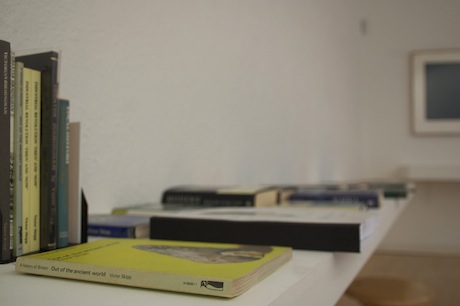
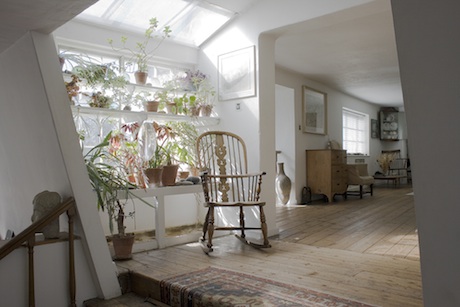
pottery. The inspiration that Skipp drew from Kettle’s Yard is clear: staircases serving as bookshelves and objects divided by centuries and hemispheres on one windowsill. That familiar, ethereal sense of light is encountered here too, and a shot of a plastic carton of semi-skimmed milk reminds us that, like that of the Edes, this collection was inextricable from its owner’s life.
Throughout the exhibition, I was struck most by how both Skipp as philosopher, historian and collector, and the artists he collected were all in their individual ways, and using different lenses, trying to master the art of capturing. In some cases, the target was a tiny piece of a larger whole, or, in the case of
Bob Law’s
field-landscapes, “the universe”. In his
The Last of the Black Donkeys
, the painting captures the viewer’s reflection, entirely without the artist’s interpretation. For Skipp, both the Turkoman-patterned rugs and
Linda Karshan’s
drawings- positioned alongside each other, represented snapshots of patterns which might go on forever. The arrangement of lines in Karshan’s drawings echo the frame of a camera screen highlighting the selectivity of a composition. The blank space between them draws our attention to the capturing rather than the captured. And of course, it is now Skipp being portrayed by Kettle’s Yard, through Richardson’s film which represents his life through his material environment, the pieces displayed, and the way they are positioned.
To look at art through one man’s collection is in fact an extremely interesting lens- rather than arranged thematically or by period, in just a couple of rooms, we get a snapshot of cultures across millennia and continents. Our appetites are stimulated, if not satiated; we explore, even if we cannot conclude. The very bricolage of subjects and origins, of course, will lead to an equally diverse range of experiences, seen through a variety of viewpoints. But as I draw to a close my own highly selective verbal picture, I wonder if this use of different lenses, this zooming in and out, was something which struck a personal chord with Skipp as a historian. As a man who wrote on the ancient world, industrial Birmingham, and an eighteenth-century labourer’s family, I suppose he knew very well that which zoom we choose affects the picture that we get.
Animating Kettle’s Yard
/ Kettle's Yard volunteer Dave Pescod / Wednesday 6th November
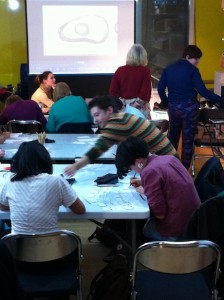
This month I volunteered to help out at a Big Draw Practice Session lead by animator Karolina Glusiec, which was organized by Lucy Wheeler and Rosie O’Donovan. A very appropriate workshop as Karolina loves drawing, immediately evident in her notebook films on her
blog
. I first saw Karolina’s work at the Royal College of Art in 2011, sensitive hand drawn films with intelligent wit, that evoke the traditions of Polish animation by
Jan Lenica
and others offering social commentary, the forefathers of Monty Python and South Park.
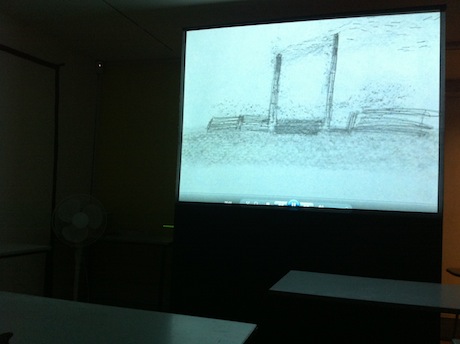
Her film
has a subtle narrative written by Karolina that chimes with our times in its monochrome style. This deservedly won her the Jerwood Drawing Prize 2012 and brings an honest use of multi media in a world of indulgent special effects. Drinks were provided as the mixed crowd of thirty watched more films, including indie music promos Karolina made for a Polish record company. Then everyone toured the house making a small sequence of drawings, like the iconic lemon moving round the pewter plate, or pebbles creating new patterns or just abstracted inspirations. Karolina put the drawings on her laptop and programmed them into short film loops, premiered in front of everyone with loud applause and critical debate. More drinks and questions, before everyone left as initiated animators, and highly animated from a very enjoyable workshop.
The Practice Sessions are monthly informal evenings of art-making and bite-sized tours and talks, each month offering a different combination of artforms and ideas for you to sample over a drink.
See details of the next Practice Sessions below:
29
th
November, 6-8pm- join us to take part in building a collective environment inspired by Victor Skipp’s house interior.
24
th
January, 6-8pm – Join us for talks about the collection, music and an exploration of Helen Ede’s place in the house.
A student’s view of Kettle’s Yard House
/ Friday 1st November
Imagine your grandmother founded Habitat (hint: she’s the type to wear organic cotton draped over one shoulder, amber jewellery and make her own bread and lentil casseroles). Then imagine you went to visit her and one morning she popped out for a pint of milk, leaving you alone in her abode (hint: cool Habitat-founding grandmothers don’t have homes with Staffordshire dogs, floral curtains, or smell of musk). And there you have Kettle’s Yard. Okay, so why bother with the grandma metaphor at all if the house is chintz-free and there aren’t embarrassing photos of you as an awkward toothy eight year old scattered about? Kettle’s Yard has, for me at least, that sense of being almost home, but that better than home feeling, kind of like when you visit Grandma.
Almost home
because the eclecticism, the house-plants, the littering of chairs and the very much on-limits bathroom means there isn’t any intimidation or awe when drifting around Kettle’s Yard. Jim Ede is still very much here- the invigilators speak of him warmly as if he were just out for his lunch break- but he’s not on a pedestal. You don’t need to applaud his eye for the up-and-comer, or rush back home to Google an art collector you had never heard of and feel a complete ignoramus in the process. In fact, unlike most private houses-turned museums, Kettle’s Yard is refreshingly free of memorialisation. And Kettle’s Yard is
better than home
because, like Grandma’s, it’s both real and removed from reality. There is something totally soothing about its undulating floorboards, the seamless join between wall and ceiling, and the stillness that leads you to really focus on the lines and textures that in any other setting you would just rush by. And like Grandma, it takes a good deal of the menace out of deadlines, and dissertations, and to-dos. Kettle’s Yard invites you to stop, to breathe, and to ponder.
Florence Gildea is a third year student reading History at Pembroke College. She has longed to work surrounded by beautiful objects ever since she realised owning her own stately home was somewhat optimistic.
The house and permanent collection at Kettle’s Yard can now be enjoyed for longer hours: Tuesday-Sunday 12-5pm. Gallery opening hours remain Tuesday-Sunday 11.30am-5pm.
Bobbing corks & ash clouds: the perils and pleasures of planning the chamber series
/ Monday 21st October
Have you ever played ‘bobbing corks’? Take a tub of water and drop in some corks. Now try keeping them submerged. No sooner do you think you have succeeded when they ‘bob’ back up.
Arranging a chamber series of 15 concerts and matching musicians’ availability with specific Thursdays in university term time can feel like this. One moment an artist is booked, then something changes: their other tour dates shift, or their accompanist is no longer available, or another date (already allocated to another performer) might suit them better.
Eventually, somehow, the corks are tamed and you have a series of concerts to take to the Kettle’s Yard Music Committee. Now, I have set up plenty of concerts before, for festivals, orchestral series, one-off events and so on. But this is my first time programming the series at Kettle’s Yard with its great history and discerning audiences. So it is a relief to me when the Committee gives it the nod.
I have tried to stay true to what has been established here by retaining a mix of established artists (like the pianist
Kathy Stott
, and the
Kungsbacka Trio
), and inviting artists back with a local connection (such as the tenor
James Gilchrist
who studied here).
But the aspect of music at Kettle’s Yard I really love is the opportunity to invite artists who are not yet household names but, in my view, really ought to be. There are so many to recommend this year. This term alone, we have the
Orbis Trio
from the Czech Republic who open the series tonight (17 Oct) with music – such as Dvorak’s ‘Dumky’ trio – that is so evocative of their homeland. The violinist
Hyeyoon Park
(24 Oct), pianist
Francesco Piemontesi
(7 Nov), the
Escher Quartet
(14 Nov) and this year’s resident artists, the
Heath Quartet
(28 Nov and dates next February and May) have all been hailed as stars to watch.
But I know I can’t settle. From illness to volcanic ash clouds, many things can crop up at the last minute to spoil one’s carefully laid plans.
Those corks may keep on bobbing.
To see the full Chamber Concerts Programme or buy tickets click
here
.