The Learning Team at Kettle’s Yard are delighted to share
Light
– a new Learning Resource for Kettle’s Yard. Light is the first of three learning resources that outline key themes of the Kettle’s Yard collection. We hope it will support teachers and educators to engage students with Kettle’s Yard and to plan sessions both on-site and in the classroom.
Light includes contextual information about the importance of light in regard to Jim Ede’s thinking for Kettle’s Yard, as well as highlighting individual artworks in the collection in which artists utilised and manipulated the fall of light and shadows to create their artworks. The resource also includes cross-curricular information on artworks, as well as contemporary responses to light.
All feedback is welcomed and completion of our
online survey
would be much appreciated as it will help us make the next two resources, Nature and Space, even better. Light was generously funded by the National Lottery through the Heritage Lottery Fund and we thank them for their continued support of our work. If you would like a hard copy of light, please email
and we will send you a resource.
We are also holding a Teachers Private View of our next exhibition
Art and Life: 1920-1931
on Tuesday 25
th
February. This will be the official launch of Light and will serve as an opportunity to learn more about our future resources, as well as enjoying a guided tour of the show. The evening is free of charge, but please book your place by contacting Lucy Wheeler on
or emailing
Hiroaki Takenouchi Concert
/ Thursday 20th February
Back in 2004, when composer
Jeremy Dale Roberts
celebrated his 70th birthday, one of his most recent pieces was Oggetti, a cycle of piano pieces in homage to the Italian artist
Giorgio Morandi
. I took Oggetti as the starting point for an article I wrote in The Guardian that year surveying his output as a whole. I was fascinated by how the dignity and mute eloquence of Morandi’s objects – bottles, jugs and pitchers disposed as if in a family photograph – was reflected in understated yet powerful music that somehow managed to force the listener into a slower pace of listening. The piece seemed to translate into music some comments by Karen Wilkins: “For anyone who pays attention, the microcosm of Morandi’s tablecloth becomes vast, the space between objects immense, pregnant, and expressive … The austere gives way to the seductive.” (The whole article can still be read
online
).
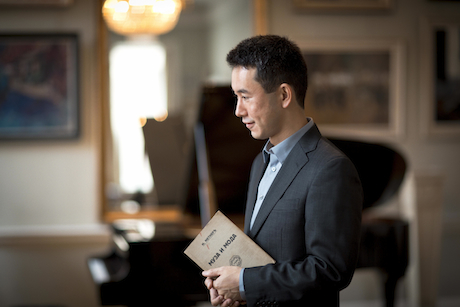
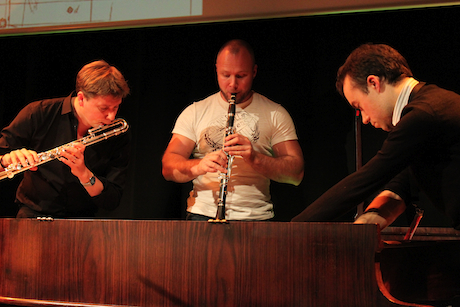
Ten years on, as Dale Roberts celebrates his 80th, it’s a great pleasure to be able to revisit this piece (on Sunday 2nd March at 12.15pm), amongst several others – new and old – through the course of the Kettle’s Yard New Music Series. As a programmer, it’s also particularly good to be able to put on performances where works are played by the musicians for whom they were written: having given the world premiere of Oggetti and made the first recording of the work, Hiroaki Takenouchi (an consummate musician whose playing has been praised by such unlikely bedfellows as Helmut Lachenmann and Sir Roger Norrington) can give a uniquely authoritative account of the piece, which he himself has helped to shape.
The Italian theme of the 2nd March programme is also reflected in works by Dallapiccola (Morandi’s contemporary) and Castiglioni, whilst music by Dallapiccola’s pupil Edwin Roxburgh (for many years Dale Robert’s teaching colleague at the Royal College of Music) and Cambridge’s very own John Hopkins complete the programme.
Pre-concert talk from 11.30am – Giorgio Morandi and Music: Jeremy Dale Roberts discusses links between visual arts and composition, in conversation with artist Bob White.
Read the full programme
here
. Sunday 2 March, tickets £8 (£5), buy
online
or call
Notre Dame de la Garde
Marseille
The hotel breakfast
MuCEM
Villa Méditerrannée
IMG_2247
Louise Bourgeois sculpture
Wine tasting
Lunch
Aubagne
Villa Noailles
Rosemary Cullum
Destination Marseille for the Friends of Kettle’s Yard
/ Tuesday 18th February
Each year, the
Friends
are presented with an enticing range of events and trips, organised especially for them both in the UK and abroad. Last autumn, architects Rolfe Kentish and Jane Sanders led a hugely successful Friends’ visit to Marseille. Many starry modern buildings were seen and the chance to experience the architecture, landscape, food and wine of southern France in the company of like-minded people was an integral part of the trip. Rosemary Cullum takes up the story…
No airport queues for us. Travelling by train on the Eurostar and TGV was a key attraction of the trip. On arrival in Marseille, Rolfe led us to a sun-filled terrace with a stunning panoramic view of the city bathed in golden light. In the distance perched on a pinnacle, an exquisite church– Notre Dame de la Garde which we couldn’t wait to explore.
The first evening’s walk down to the Old Port revealed a vibrant city with fascinating street sculptures, controversial architecture, harbour-side restaurants, the buzz of traffic, people of all nationalities, a working city plus much more.
Day two
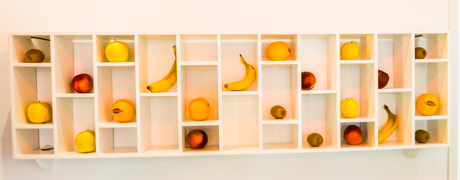
began with the delights of hotel breakfast. Intriguing was the fruit arranged as an installation so one was hesitant to disturb the image.
Our first visit was to
MuCEM
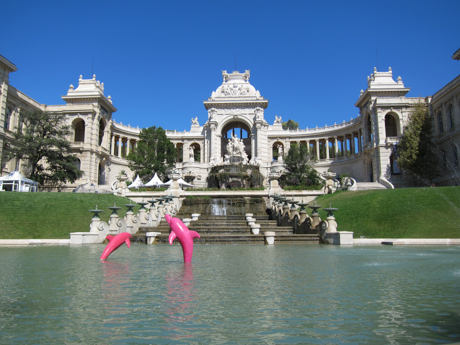
- the first Museum of European and Mediterranean Civilisations. The main building was clad in an outer ‘skin’ – a concrete tracery of symbolic foliage shapes. The museum houses a permanent exhibition of historical everyday objects relating to Mediterranean civilisations – all this and then the delights of the Fort St-Jean reached by a suspended walkway, overlooking the magical ‘Vieux Port’. The inspiring and innovative architecture of the development included a breath-taking cantilevered building, the Villa Méditerrannée, resembling a diving board. In the afternoon some took a boat trip round the beautiful Calanques (‘fjords’) and others visited the Palais Longchamp for the De Van Gogh à Bonnard exhibition.
Next day
saw a visit to the
Chateau la Coste Sculpture Park
and vineyard an oasis of peace and serenity near Aix. Large stretches of water reflected the sky, while swifts dipped and wheeled over works by Alexander Calder and Louise Bourgeois. A two hour walk in the warmth and silence of the French countryside, took us round the fascinating site specific sculptures by artists including Tracey Emin, Richard Serra, Sean Scully, and Andy Goldsworthy. They had all responded to, and interpreted, the magnificent site in different ways.
Wine tasting was followed by another wonderful group meal – typically French –outside at a long snow white cloth covered table. After lunch there were more beautiful paintings in Aix at the Musée Granet for the ‘De Cezanne à Matisse’ exhibition.
Other highlights of the trip included
an inside view of Corbusier’s Unité d’Habitation. Having a guided tour by a ‘real life’ resident enabled the full impact of Corbusier’s design to be appreciated. And then a drive along the Corniche with wonderful romantic sea views, towards our next destination, Aubagne.
Here we saw a very enjoyable Picasso ceramic exhibition. The French fruit and vegetable market in the town was irresistible – aromas of sun-warmed peaches and nectarines, vivid colours of peppers and aubergines, strings of purple flushed garlic…lunch was wine drenched and unforgettable.
On then to Hyeres for a visit to the Villa Noailles – an early modernist villa of beautiful proportions.
The star of our trip was Marseille itself, European Capital of Culture 2013 – full of golden light – an outstanding destination. Quite simply – a glorious time was had by all. How lucky we are to be Friends of Kettle’s Yard.
Kettle’s Yard Illustration Series
/ Wednesday 5th February
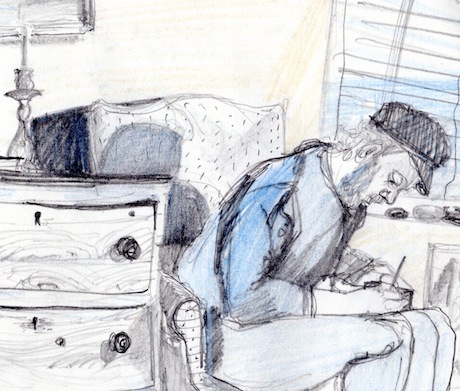
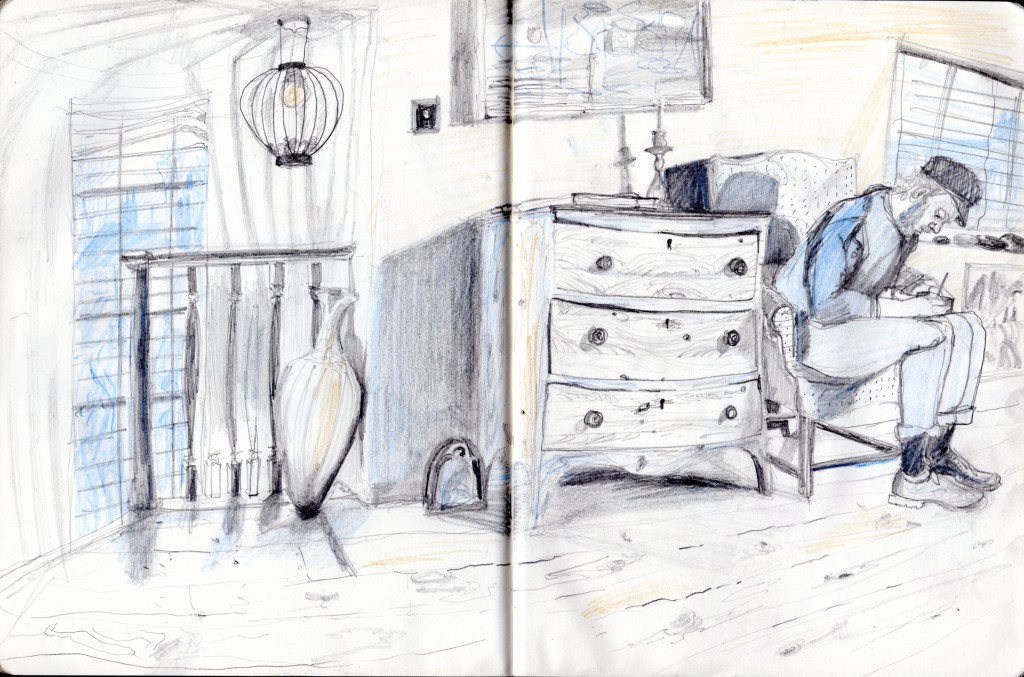
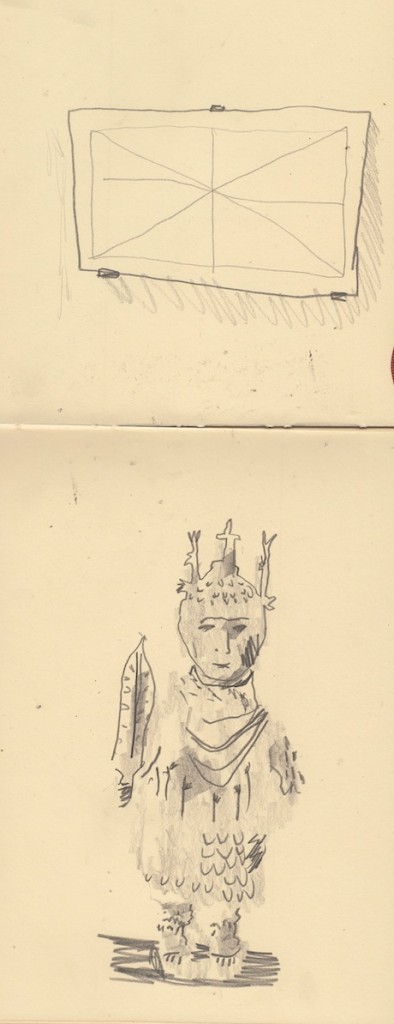
The winter light cast strong black shadows in all the corners of the room and the objects, whilst this man sat writing. The space was calm with concentration as I drew and he wrote, responding to the room in our different ways.
Katie Paterson wins South Bank Sky Arts Visual Art Award
/ Tuesday 28th January
Yesterday Katie Paterson won the South Bank Sky Arts Visual Art Award, in part for her exhibition at Kettle’s Yard
last year
. We are thrilled – for Katie and because our show was able to play a role in her success. I first encountered Katie’s work standing in a sweltering airport queue. I was reading a newspaper article about a young artist exhibiting in the Slade School of Art MA exhibition. Instead of welcoming her visitors she was camping in Iceland. According to the piece, I could ring a mobile phone number and I would hear the sound – live – of the largest glacier in Europe melting. Katie was in Iceland to ensure the microphone stayed secure, 15 metres beneath the ice. I love ambitious artists and this seemed at the most extreme end. I rang the number and joined around 8000 people around the world who listened over those few weeks to the sound of cracking and rushing water – the shocking noise in your ear of a glacier melting. It was like hearing an animal dying. I felt I was experiencing an art work of rare originality and imagination. Katie’s work was powerfully concerned with climate change, but it also acutely exposed our place in geological time and questioned the uses of technology. Since then Katie has made many other
remarkable pieces
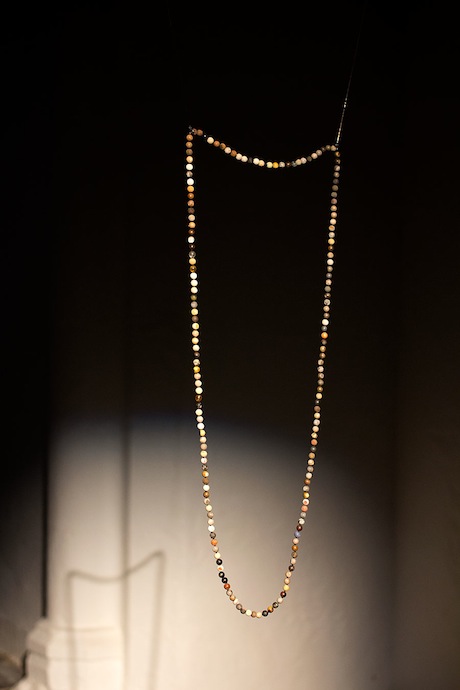
that reignite our sense of awe at the natural world. She considers and questions the value of our momentary place and time in a world already billions of years old. For her Cambridge exhibition, Katie exhibited three earlier works in the Gallery and an astonishing new piece ‘Fossil Necklace’ which was suspended in St. Peter’s Church, next door to Kettle’s Yard. In the form of 170 beads, ‘Fossil Necklace’ does nothing less than chart the evolution of life on the planet. This inspiring piece is currently on show in
‘Foreign Bodies / Common Ground’
at the
Wellcome Collection
until 9th February. For this stunning work alone, Katie deserved the prize. Go and see it.
Note: ‘Fossil Necklace’ was created in response to a residency at the Wellcome Trust Sanger Institute, a research campus just outside Cambridge. Kettle’s Yard proposed Katie for a Sanger Institute residency focused on global health and agreed to make an exhibition with the artist – so the work and issues would receive a wider audience.
Katie Paterson’s residency at the Wellcome Trust Sanger Institute was one of 6 international residencies which made up Wellcome Collection’s
Art in Global Health
project.
This January sees the launch of the Illustration Series. The Series will showcase sketches of Kettle’s Yard House & Gallery by Illustration students from the
Cambridge School of Art
. We look forward to seeing their new work over the coming months and hope it inspires our visitors to seek out the hidden corners and treasures of Kettle’s Yard.
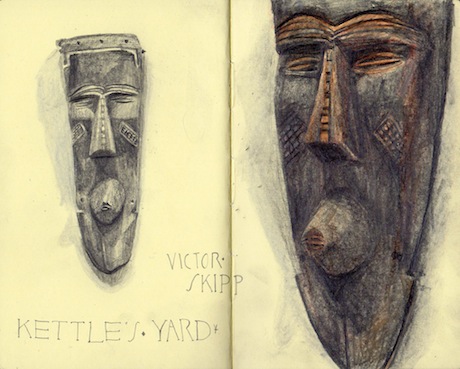
The juxtaposition of the sophisticated carving placed under the basic form of Bob Law’s shape gave an insight into Skipp’s compositions.
Illustration & text by Toby Rampton
A Lasting Legacy
: The House and Collection of Victor Skipp is on until 26 January 2014
Return of New Music Concerts
/ Tuesday 17th December
The 2014 New Music series is programmed by
Richard Causton
in his first year as Kettle’s Yard New Music Associate. Causton “is one of the finest of the new generation of British composers” (The Guardian) and Lecturer in Musical Composition at the University of Cambridge.
This year’s programme is based around several distinct themes: Italian 20
th
century music is explored throughout the season with “the top-notch chamber ensemble
Chroma
” (The Guardian), kicking things off with an Italian programme featuring Donatoni, Castiglioni, Vacchi, as well as Causton’s award winning
Phoenix
and a new work by Andrew Thomas, the first of three newly commissioned works in the season. Cambridge third year student Kate Honey has also composed a substantial new work which will be performed by
Peter Sheppard Skaerved
, violin &
Roderick Chadwick
, piano (kindly supported by the
PRS for Music Foundation
).
The music of
Jeremy Dale Roberts
, one of the unsung heroes of British New Music, is also celebrated through the series. Before the solo piano recital from
Hiro Takenouchi
Dale Roberts will give a pre-concert talk. In this concert Dale Roberts’
Oggetti
for piano (an homage to the Italian artist Giorgio Morandi) is presented alongside music by Morandi’s contemporary Luigi Dallapiccola and Dallapiccola’s pupil Edwin Roxburgh. This reflects how the theme of lineage, with composers’ works presented alongside those of their teachers, is key to this New Music series.
The Kreutzer String Quartet
(with cellist Bridget MacRae) will also be performing a vibrant String Quartet by Dale Roberts. This piece draws its inspiration from the art of Edvard Munch along with Virginia Woolf, Marina Tsvetayeva and Janacek
s
.
For the Michael Harrison Memorial concert we are pleased to have
Anton Lukoszevieze
, cello (a former New Music Associate) &
Mark Knoop
, piano. The programme presents the world premieres of new works especially written as tributes to the late Michael Harrison by each of the composers he appointed as Kettle’s Yard New Music Associates.
The series also presents works outside the classical mainstream including the electronic music pioneer
Trevor Wishart
with a selection of his electroacoustic works. A composer who is “not afraid to take risks in her music” (International Record Review),
Errollyn Wallen
will perform a selection of her own compositions for the final concert in the series. Wallen, MBE, was recently the recipient of an Ivor Novello Award.
Victor Skipp Exhibition Review
/ Wednesday 20th November
I have a confession. Since the first series of Grand Designs, I have been prejudging the contents of homes with UPVC windows. Victor Skipp’s collection, formerly housed behind these bugbears of mine, should challenge all of us traditionalist wooden-frame-and-single-panes to not judge a book by its cover, even if that cover is apparently transparent.
Like Kettle’s Yard,
Victor Skipp’s home in Suffolk
- into which we get an insight from Candida Richardson’s film ‘The Taj Mahal of Hopton’ – appears utterly unprovocative. Almost, dare I say it, boxish. You would hardly suspect that it was once home to the most eclectic of collections, from avant-garde art, to seventeenth-century Indian miniatures; African masks to
Lucy Rie
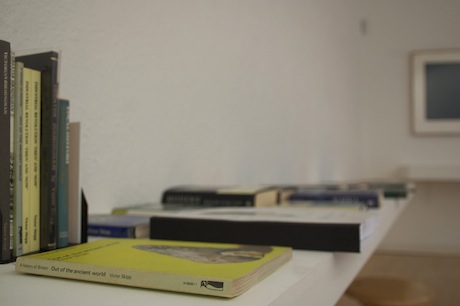
pottery. The inspiration that Skipp drew from Kettle’s Yard is clear: staircases serving as bookshelves and objects divided by centuries and hemispheres on one windowsill. That familiar, ethereal sense of light is encountered here too, and a shot of a plastic carton of semi-skimmed milk reminds us that, like that of the Edes, this collection was inextricable from its owner’s life.
Throughout the exhibition, I was struck most by how both Skipp as philosopher, historian and collector, and the artists he collected were all in their individual ways, and using different lenses, trying to master the art of capturing. In some cases, the target was a tiny piece of a larger whole, or, in the case of
Bob Law’s
field-landscapes, “the universe”. In his
The Last of the Black Donkeys
, the painting captures the viewer’s reflection, entirely without the artist’s interpretation. For Skipp, both the Turkoman-patterned rugs and
Linda Karshan’s
drawings- positioned alongside each other, represented snapshots of patterns which might go on forever. The arrangement of lines in Karshan’s drawings echo the frame of a camera screen highlighting the selectivity of a composition. The blank space between them draws our attention to the capturing rather than the captured. And of course, it is now Skipp being portrayed by Kettle’s Yard, through Richardson’s film which represents his life through his material environment, the pieces displayed, and the way they are positioned.
To look at art through one man’s collection is in fact an extremely interesting lens- rather than arranged thematically or by period, in just a couple of rooms, we get a snapshot of cultures across millennia and continents. Our appetites are stimulated, if not satiated; we explore, even if we cannot conclude. The very bricolage of subjects and origins, of course, will lead to an equally diverse range of experiences, seen through a variety of viewpoints. But as I draw to a close my own highly selective verbal picture, I wonder if this use of different lenses, this zooming in and out, was something which struck a personal chord with Skipp as a historian. As a man who wrote on the ancient world, industrial Birmingham, and an eighteenth-century labourer’s family, I suppose he knew very well that which zoom we choose affects the picture that we get.

 or emailing