
Archaeology / Roman Rubbish / Wednesday 14th March
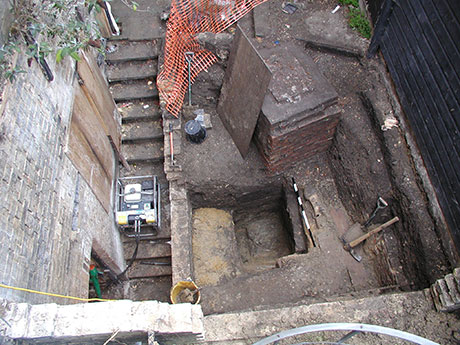
Before the new building works could fully go ahead the Cambridge Archaeological Unit dug a few test pits. This was one of the planning requirements for the new development; it was flagged up because Castle Hill is known to have been important in the Roman period. There was a settlement on the hill with roads linking it to the river and elsewhere. The area was also important during the Saxon and medieval periods. With this knowledge behind us we had to work underneath buildings and in small spaces to see what had happened exactly on the spot of No’s 4-5 Castle Street. Logistically this was challenging and on occasion very wet (with rising ground water) but still provided some interesting results.
Water has always been a feature of the site- even in the Roman period. Between the 2nd- 4th centuries a cobbled surface was created, possibly to try to alleviate the damp ground problem. Changes in the natural geology traps the ground water at this level. This would have caused a line of springs that the Romans could have exploited as their water source, although there is no proof of that at the moment. There are no signs of Roman buildings under 4-5 Castle Street, sensible people- they lived higher up the slopes out of the water.
Archaeologists dig in layers and look for stratigraphy. The test pits that we dug in the yard contained a sequence of soils that looked typical of medieval (and later) back yard activities. This included an oven and layers of garden soil. The remains of a 17th century cellared building was also discovered and must have been pulled down to build the present day buildings!
Artefacts
Several pottery fragments were found, from a number of different objects, and it is these that were primarily used to date the site. Most of the pots had been produced locally although some had come from much further afield, Peterborough and Gaul (France!).
Several animal bones were also found, some with butchery marks and teeth marks from dogs. Most of the bones came from sheep or goats but cattle and pig bones were also found. This is also normal for domestic rubbish, presumably from the settlement up the hill. The Romans were quite like us- they made lots of rubbish and left litter.
Hayley Roberts
