Null Object: Gustav Metzger thinks about nothing
/ Wednesday 8th January
London Fieldworks
discuss their new artwork now on display at the Ruskin Gallery
How did ‘London Fieldworks’ come about?
Our paths crossed professionally as artists involved in performance/live art in the mid 90’s. We realized we had shared interests, which included interrogating the artist-audience dichotomy, and questioning the authenticity of mediated experience, especially experience of place. From there we instigated a couple of collaborative, cross-disciplinary projects: Gastarbyter (1997), with the electro-acoustic, New Zealand based composer Dugal McKinnon, an immersive gallery installation that invited connection between channels of perception–a symbiosis of the visual, tactile and aural; and Syzygy (1999), a telematic artwork made with a temporary collective of artists on Sanda Island, Southern Hebrides that transmitted weather and biometric data across a mobile phone network. We formalized our practice as London Fieldworks (LFW) in 2000 and continued our collaboration with the Polaria project (2001), a phenomenological exploration of nature that employed fieldwork data from NE Greenland to create a physiological interface to drive a gallery installation. These early works were seminal to the development of a notion of ecology as a complex inter-working of social, natural, and technological worlds. Ensuing projects, including Little Earth (2005), Spacebaby (2006), Hibernator (2006) and Super Kingdom (2008) created speculative works of fiction out of a mix of ecological, scientific and pop-cultural narratives, exploring themes of suspended animation, technology, fantasy and death.
What was the starting point for this piece?
The concept and technological means underpinning Null Object have been in development for a number of years, and initially came out of an interest in brain-machine interfaces and the burgeoning role of databases across society, linking the psychophysics of the visual neuroscientist and experimental psychologist, Bela Julesz with modern industrial manufacturing technology. The piece is motivated by a concern with the mechanisation of vision and industrialisation of perception through the desire to mass communicate: who chooses what we see and how we see it, and how this affects our thinking about the world, notions of society and the solitary self.
Why did you choose to work with Gustav Metzger on this project?
In 1995 we saw Gustav’s show Damaged Nature at Workfortheeyetodo in London and bought a copy of his book Damaged Nature and Auto-Destructive Art and became interested in his work. Our association with Gustav started in 1998 when he visited our Gastarbyter installation at the ICA and a friendship developed over the following years especially since 2002 when he became a part of the Hackney based artist community in which we all now live. Gustav was present at a research meeting we hosted in 2011 at our space in Hackney, which included conversation around the re-imagining of
Event One,
the first exhibition by the Computer Arts Society (CAS) in 1969 at the RCA, London. One of Gustav’s important yet unrealized projects Five Screens with Computer was proposed for Event One. CAS has proved to be remarkably prescient in recognising the long-term impact that the computer would have on society, and it is significant that Gustav, as a representative of the 60’s avant-garde was the inaugural editor of PAGE, the CAS journal. Thinking about his early involvement with computers in art, his auto-destructive manifesto and commitment to concepts of emptiness prompted the idea for the Null Object project, and soon after the meeting we asked Gustav if he would be a central participant in the work.
Collaboration appears to be central to your work, what was it like to collaborate with Gustav Metzger?
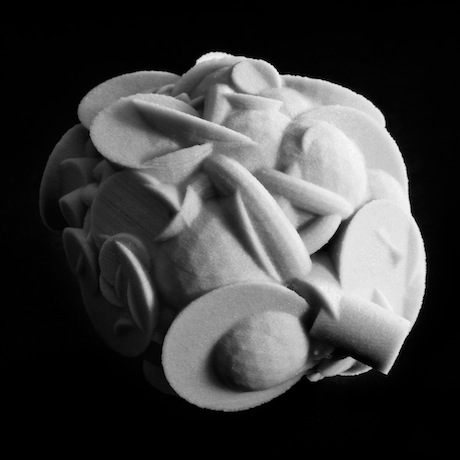
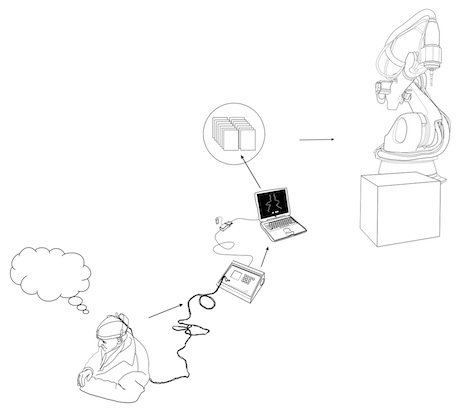
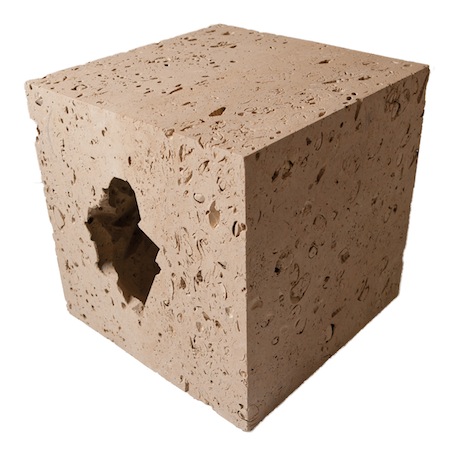
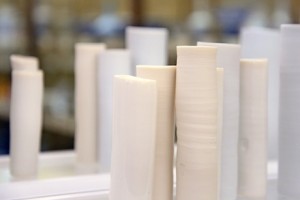
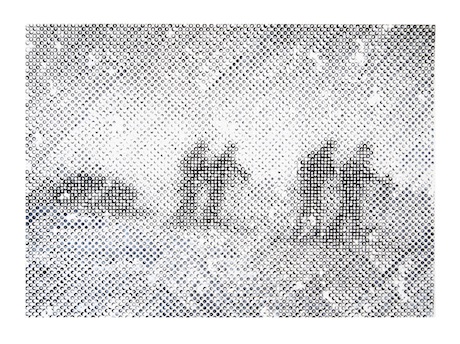
We wanted to explore the concept of ‘nothing’ as a productive category and asked Gustav to participate in the work as a ‘neurophysiological trigger’, proposing a central but passive role. We connected him, over several sessions in the studio, to a digital EEG machine, while in the act of attempting to think about nothing. On the surface he appeared to be completely passive, but the notion of passivity is questionable here. Internally he was producing brain signals as a kind of residue from the struggle to cognitively disengage; our setup allowed us to capture these signals and to mobilize them in a stream of production via interaction with our analysis software and database. In effect, Gustav’s willful participation created existence out of absence in the form of a virtual positive object (pictured in this blog), which we used to create the voidance in the block of Portland stone. There was an appreciation that this exploration of making within the context of the information age and the economy of attention, was resonant with Gustav’s historic body of work around destruction and creativity and the impact of science and technology on society.
What is a Null Object?
Coming from computer programming, the null object is essentially a paradox, a nothing, which is a something. The concept of the null object is useful to programmers because it does nothing and has no default behaviour, but can be referenced and made to stand in for other things.
The installation utilises data collected from hundreds of participants over many years, could you briefly describe the different stages of this artwork including its latest manifestation at the Ruskin Gallery.
Null Object used the “Looking at Primitives” database to generate the Positive Object which in turn created the void in the stone, the Null Object. The database was made with the help of numerous willing participants in a variety of venues from 1999-2012, in the UK, Europe and USA. The database contains 3d primitive shapes, used in the construction of a series of random-dot autostereograms alongside participants’ EEG files recorded whilst perceiving the 3d shapes within the autostereograms. A Science Museum Big Ideas commission in 2005, led to a further conceptual development to integrate architectural principles into the project software to generate a building – a
Thought Pavilion
. It was proposed to produce objects as building components via a plaster based 3d printing technology; each object constituting a building block within a larger accumulated architecture. To date Thought Pavilion remains an unrealized project. The idea had been that Thought Pavilion would employ an additive manufacturing process, but with Gustav as a central participant, there was a new context, allowing for the imagining of a subtractive process, an excavation or voidance, connecting the concepts of the threshold of thought with the removal of material.
I was really interested in how the installation contrasts the immediacy of technological time with that of geological time, was this the reason behind your choice of material- Portland stone?
Because we were working with evanescent material and manufacturing technique that would happen over a period of days, we decided to juxtapose this with something born from a geological timescale. The collision of timescales, materials and processes manifested for us an expression of contemporary, ecological anxiety. We decided to use Portland Roach, a relatively hard stone full of fossils; the tiny voids were set against the large, manufactured central void created from Gustav’s neurophysiological signals. Further to the final choice of material, we liked the associations that the Portland, a form of limestone, continued to create for us: it has been used to build notable buildings of authority; it was used in an early stone carving by Gustav Metzger–a reclining figure clearly inspired by Henry Moore, Eric Gill and Jacob Epstein; seminal cultural artifacts from prehistory were created from the same kind of limestone.
“[…] like those time-factored notations inscribed on stone, antler, bone, or ivory, shining electronic images continue to trace a route of evanescence on an increasingly thinner support.” (Barbara Maria Stafford, Echo Objects).
The accompanying film for the installation describes your ‘poetic application of technology’ including electroencephalograph (EEG) recordings and 3D printing. Do you find these mediums inspiring or is there an ambivalence going on, particularly in the context of Metzger’s activism?
The neurophysiological responses and geometric information contained within the database and its interaction with Gustav’s brainwave data produced instructions for an industrial robot to create a sculpture. In effect, a solid block of stone has been rendered hollow as a consequence of an artist thinking about nothing. Because of a paradoxical humour that runs through the work this sounds like a technologically enabled magic trick, drawing on the scientific study of illusions that suggests the brain generates what it perceives, unless we make strong efforts to the contrary. We are in fact making reference to the New Scientist, September 2000 which announced the immanent arrival of 3d printing on its front cover with the line: Imagine an Object and it will appear. We had been working with digital biomonitors and software for some time when we saw the possibility of hooking these digital devices up and literally bringing an object into existence through some kind of brainwave analysis. Mindful of the neurobiologist, William Calvin’s recognition that the science and technology of mind may move far more quickly then we can create consensus for; creating another level of stratification between “The Enhanced and The Rest”, we became interested in the ethics around this kind of augmentation. As a projection of a technological future, the work demonstrates ambivalence, sitting between a kind of techno optimism, and a post-human nightmare. It could go either way.
Why did you choose to make a work centered around a void, thinking about ‘nothing’?
Simply because it is such an elementary and simple idea, yet at the same time elusive, paradoxical–verging on fraudulent. “How can we get hold of the immaterial, how can we push it around, how can it be pushed? This is what it is talking about, the immaterial, the fantasy. It is all a fantasy: just take one pull at reality, and the whole thing collapses. Add something to it, and it is another world.” (Gustav Metzger, 2013)
In 2014 Kettle’s Yard will stage a solo exhibition of Metzger’s work, what do you think makes his work relevant to contemporary audiences?
In the context of contemporary society that seems to go along with whatever gets thrown at it, avoiding horrific narratives through acts of distraction and denial, Gustav Metzger is an anti-establishmentarian who has produced powerful words and images of dissent. His body of work is just as relevant today because of its intensive engagement with history, its critique of capitalist consumer society and of science and technology.
Lucy Theobald, Press Coordinator, Fitzwilliam Museum
Edmund de Waal at the Fitzwilliam Museum
/ Thursday 12th December
During his time as an undergraduate in Cambridge,
Edmund de Waal
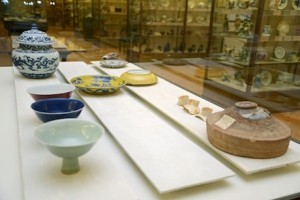
was inspired by the ceramics he saw at the Fitzwilliam and Kettles Yard. The Fitzwilliam’s vast vitrines of porcelain were life-changing for him; his current intervention here tells their stories, following porcelain’s evolution from China to Europe.
This crystal white millennium-old material has been the basis for the finest ceramic wares in history; the blue and white patterns of Ming Dynasty vases, the gold laced delicacy of intricate Meissen, and Victorian high-tea would not have been the same without china teacups. But this beautiful, tactile material has a dark and chequered history. It was one of the greatest treasures of the Chinese Emperors and for centuries its trade secrets were jealously guarded.
The centre and birthplace of porcelain production in China was Jingdezhen. The city had rich deposits of kaolin, the white mineral clay essential for creating dazzling ceramics. In the Song Dynasty (960–1279 AD) the city came under Imperial control; as the official supplier of the Emperors, huge orders of porcelain were demanded to adorn their palaces and vast porcelain jars created to awe and impress. ‘Rejects’ were smashed and the shards can still be seen today. During the Ming Dynasty (1368–1644) the pure white ceramic began to emerge in Europe, traded through the Silk Road and over-sea through Portuguese and then Dutch merchants. Paper thin and mirror bright, it was immediately coveted by princes and magnates across Europe and a race began to see who could uncover the secret to its production.
In the 1700s in China, European espionage was underway in the ever more industrious city of Jingdezhen. From under the very noses of the master potters a French Jesuit priest, Francois Xavier d’Entrecolles, travelled to Jingdezhen, under the guise of counseling recent converts. Through them in 1712 he discovered the secrets to Chinese porcelain production.
Today porcelain is still a major industry in China, and in the past three centuries its European manufacture has continued to evolve. In his intervention Edmund de Waal has created a dialogue between his own contemporary pieces and historic porcelain works. Some of the incredible stories from the past are alluded to in letters, writing and through the pieces themselves.
But above all you are invited to simply appreciate the beauty and poetry of porcelain in all its forms; its stillness and never ending shades of white.
Foreign Bodies, Common Ground, Wellcome Collection’s new exhibition
/ Monday 9th December
Wellcome Collection
opened with the aim to explore the links and build bridges between medicine, art and society. The museum is part of Henry Wellcome’s incredible legacy to the world. Henry Wellcome was an American pharmacist, businessman, collector and philanthropist among other things. He came to Great Britain in 1880 to establish a pharmaceutical company with his fellow countryman Silas Burroughs. Very quickly Burroughs Wellcome & Co was the only company to manufacture pharmaceuticals in Great Britain which ensured the company a strong commercial success. From 1895, after Silas Burroughs death, Wellcome was the sole owner of the company, and strong of its commercial success, he started traveling around the world to promote his products and on these occasions collected various objects related to medicine, health, and well being. In the 1930s his collection was 5 times bigger than the Louvre!
Wellcome died in 1936 and stipulated in his will that he wanted the entire share capital of his pharmaceutical company to be held in a trust and the income from the company to be invested into medical research.
The Wellcome Trust
was born. Since then the Trust has always been self sufficient and is now investing around £600m annually in medical research. Wellcome Collection opened in 2007 as the public face of the Wellcome Trust and a house for Henry Wellcome’s Collection- part of it at least! Wellcome Collection is a place where contemporary medical research and art coexist and work together to engage with the public about issues of our society.
In that sense,
Foreign Bodies, Common Ground
- the new temporary exhibition is a very ‘Wellcomy’ exhibition. The idea for the exhibition was born from Wellcome Collection’s desire to engage and inform the public about the medical research that the Wellcome Trust funds. This is how the
Art in Global Health
project saw the light. Six artist residencies have been set up in six Wellcome Trust funded research centres around the globe: Kenya, Malawi, South Africa, Thailand, Vietnam and the UK. The artists spent six months in their residencies with the wide brief to explore the medical research carried out by the centre both from the scientists and local community points of view, and to produce works to illustrate their findings and experience. The Art in Global Health project aimed to bring closer the worlds of science and art, too often considered as incompatible. The artists worked as bridges between the health researchers and the community being researched on, often complete strangers or ‘foreigners’ to each other.
For instance,
Miriam Syowia Kyambi and James Muriuki
, who did their residency in Kenya, were interested in exploring the dynamic between the researchers and the ‘researched’ on, understanding how both communities perceive and work with each other. One of the outcomes of their residency is the
Pata Picha
studio.
Pata Picha
means ‘get the picture’ in Swahili. For their research, Miriam and James met with scientists from the KEMRI (Kenya Medical Research Institute) and members of the local community. Through these conversations they identified Education/ Beliefs/ Context/ Exploration/ Money and Power to be important elements to the health research and aspects that influence the relationship between the researchers and the local community. The
Pata Picha
studio is a visual representation of these findings. Members of the community where invited to come into the studio and to have their picture taken with items that represent the five areas identified by Miriam’s and James’ research, including altered lab coats. The aim is for the local community to explore the scientists’ world and come out of their routine to create a better understanding of both communities. The
Pata Picha
studio has been installed at Wellcome Collection where visitors can have their pictures taken at specific times.
Another artwork produced as part of the Art in Global Health project is
Katie Patterson’s Fossil Necklace
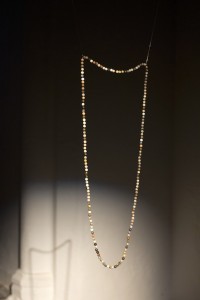
exhibited at the Kettle’s Yard gallery in early 2013. The necklace is the result of Katie’s six months residency at the Sanger Institute in Cambridge where she immersed herself in genomic research. The Fossil Necklace with its 170 beads documents the apparition and development of life on Earth.
The variety of artworks displayed in the Foreign Bodies- Common Ground exhibition equals the variety of destinations and situations where the artists were sent to. It is a very powerful exhibition offering a fascinating insight into the reality of medical research.
Foreign Bodies, Common Ground
runs until 9 February 2014. The
Pata Picha
studio is open Tue- Sun from 2.30pm to 3.30 pm and also from 7.30pm to 8.30pm on Thursdays.
Arbury is Where we Live….Now!
/ Friday 6th December
Kettle’s Yard is partnering with Club United, a youth club based at the Meadows Community Centre, Arbury, to enable young people to document their community through photography.
During the school holidays Club United have been working with artists Rob Birch and Hilary Cox. Inspired by the 1980s project,
Arbury is Where we Live
, the group explored how Arbury has changed throughout the years, meeting neighbours and discovering what people like about living in the area.
Interviewing members of the Lawn Green Bowling Club at the Meadows Community Centre
“
I’ve joined a photography club at school. I want to find out about how you become a photographer
.” Larissa, Club United member.
In October, Club United visited Kettle’s Yard and were inspired by the light, the natural objects and patterns within the house. The group created beautiful responses to what they had seen using found objects from around the community centre.
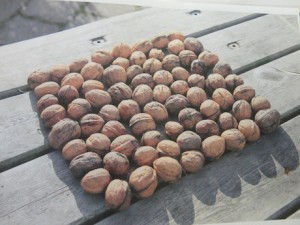
Walnuts in a square by Larissa, responding to natural objects and form at Kettle’s Yard
Photographer Katherine Green met with the Club United girls group to talk to them about photography. Katherine’s work explores the bonds of community and often evolves through conversation and discussion. Katherine will work with the girls and support them to improve their photographic skills.
“
Courtney has not stopped talking about Kettle’s Yard since visiting it at Castle Hill Open Day.”
Amy Chapman, Young People’s Worker, Cambridge City North Locality.
Courtney documenting Kettle’s Yard at Castle Hill Open Day 2013
Arbury is Where we Live…Now
is part of an on-going relationship between Kettle’s Yard and neighbouring communities in north Cambridge.
The stars are out: Open evenings at the Institute of Astronomy
/ Monday 28th October
Sophy Rickett’s Objects in the Field was the outcome of regular visits to the Institute of Astronomy as an Associate Artist. Rickett met retired fellow Dr Willstrop and produced a series of large-scale photographs from negatives produced from the
Three Mirror Telescope
designed and built by Dr Willstrop. Such scientific and artistic collaborations offer a fantastic stimulus for artists but also provide new ways of seeing and understanding scientific ideas. At the Venice Biennale this year’s entry from Wales is entitled ‘The Starry Messenger’ as another artist Bedwyr Williams has taken his inspiration from Astronomy, but in particular the amateur hobbyist kind, with his
observatory installation.
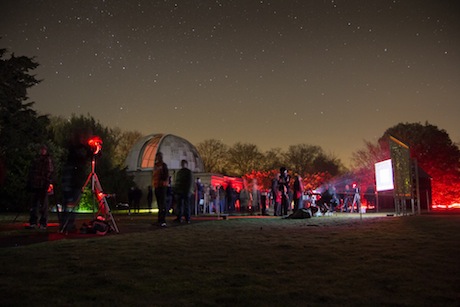
Keen to understand more about the inspiration behind such projects I decided to visit the Institute of Astronomy at the University of Cambridge. The Institute hold public open evenings every week which are perfect if you’re looking for something different to do on a crisp autumn night or hoping to learn more about the sky above.
The public open evenings begin with a half hour talk followed by a chance to look through the telescopes. When I arrived the lecture theatre was packed with people of all ages and we settled in for a rapid run through of the greenhouse effect starting from 500 million years ago, as the speaker told us, Astronomers ‘like to take the long view’. The talk was by
Robin Catchpole
on ‘The Sun and climate change’, which introduced the audience to how ice cores are used to measure the climate of the past. The main focus of the talk was sun spots (dark cooler spots on the surface of the sun caused by magnetic activity), which gave Catchpole the opportunity to show us some mesmerising videos of
sun spots and solar flares
.
On the night I visited there was a little cloud but it cleared up so viewing went ahead… though on nights where viewing is not possible there’ll be tea and entertainments from the Cambridge Astronomical Society. Currently the institute only has one historical telescope open for use as the larger Northumberland telescope is being refurbished, though it should be open soon with a brand new dome. On the evening there were small telescopes out and the Cambridge Astronomical Association provide a floorshow with commentary on the observatory lawns relaying live images from three modern telescopes. My highlight was looking through the Thorrowgood telescope (built in 1864) to get a glimpse of the exceptionally bright star Vega.
There’s just one week left to see Sophy Rickett’s Objects in the Field and she’ll be at Kettle’s Yard to give a
free lunchtime talk
on Thursday 31
st
of October.
Public open nights at the Institute of Astronomy are held every Wednesday till the end of March. The talk begins at 7.15 followed by an opportunity to observe if the weather is clear. Entrance is free, find out more
here
.
Sculpture as witness at Jesus College
/ The Director's Blog / Thursday 11th July
I was recently asked to open
‘Sculpture in the Close, 2013′
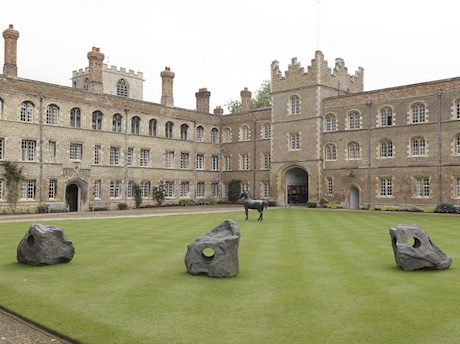
, a superb display of recent work by five international artists in the grounds and buildings of
Jesus College
. All the works have political or social reverberations that demand our active attention. It was great to be asked to speak, as I have known one of the artists for twenty-five years –
Miroslaw Balka
.
I first met him in the winter of 1988 at his parent’s house at Otwock; about 30 minutes drive from Warsaw. Miroslaw took Maria Morzuch (my collaborator from the
Museum Sztuki
in Lodz) and I out of the kitchen door of a modest terraced house, down the small garden path, to a large shed. Inside, in the half-light, we could see a number of rough plaster sculptures of the human body – one appeared to be swimming, another was suspended on the wall, but was missing its head. Later Maria told me that Otwock was the site of Nazi crimes against the Jewish population in the War. It was clear to me that this tall, rather serious young artist was searching how to say something important through sculpture. His work seeks to acknowledge the traumatic history of 20th century Poland; what this history might mean in the present.
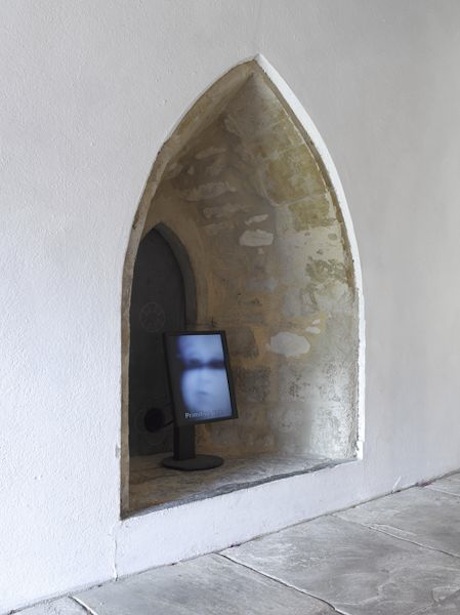
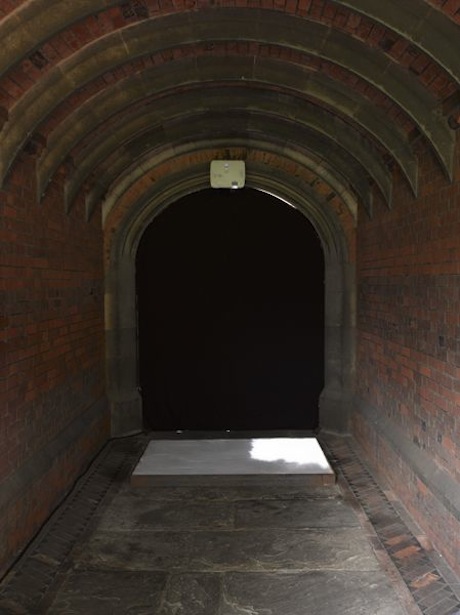
His subsequent work, exhibited around the globe to considerable acclaim, has continued to challenge us about the meaning that materials and images can evoke. At Jesus College he has three works – all remarkable. Two are videos but he rightly considers them sculptures. They are physical in their presence.
Miroslaw Balka, Primitive (2008)
Miroslaw Balka, 170 x 126 x 10 / T. Turn (2004)
Also at Jesus College don’t miss the American artist Theater Gates’ ‘My Labour is my Protest’. As you walk from the College entrance round to a second court, there on the immaculate lawn is a 1960′s US fire truck. The real thing. Incongruous doesn’t quite describe it!
Theaster Gates, My Labour is My Protest (2012)
Though it strikes me that behind the peaceful walls of College courts in Cambridge are researchers addressing many of the most urgent social, human and political issues of our time. As in Balka’s work there is a lot of history here. This is one of the fire trucks used as a weapon – with its high pressure hose – against civil rights protestors in Birmingham, Alabama in 1963. Gates recalls this moment but also reclaims it: the truck is daubed with black tar. Nearby a related, and moving, film is showing. As Rod Mengham, the curator of this special exhibition notes in the catalogue, Life Magazine published images of the peaceful protestors taking the full force of a fire hose cannonade under the famous caption: ‘They fight a fire that won’t go out’. Jesus College has been organising Sculpture in the Close every two years since 1988. This edition is unmissable if you want to experience the ambition and depth of sculpture now.
- Andrew Nairne
This year the exhibition features the work of Miroslaw Balka, Theaster Gates, Harland Miller, Damian Ortega and Doris Salcedo.
The exhibition is free to visit and open daily from 24 June until 22 September (11am – 8pm) at Jesus College, entrance off Jesus Lane. Programmes are available from the Porters’ Lodge.
Paul Coldwell
/ Re-Imagining Scott, Objects & Journeys / Friday 14th June
British artist
Paul Coldwell
staged the intervention,
I called while you were out,
in the Kettle’s Yard house in 2008-2009. Through June and July this year he is exhibiting work at
The Polar Museum
, a fellow
University of Cambridge Museum
. Using printmaking and sculpture, Coldwell re-imagines aspects of Captain Robert Falcon Scott’s final expedition to construct images and objects that explore the sense of loss felt around the world at the news of Scott’s death. Here Paul tells us about his work in these two projects.
In 2008, I was delighted to be invited by the late Michael Harrison to make some work to be placed into the house at Kettle’s Yard. Over a period of a year I visited Cambridge on a regular basis and began absorbing myself in the house, the collection and getting to know the people that worked there. I like to slowly infiltrate and Michael was generous in giving me time and space within which my ideas could gradually evolve. It is a privilege to get to know a new place and I found it stirred thoughts that had been just under the surface, waiting for an opportunity to be explored.
On my walks from the station to Kettle’s Yard I would pass Scott Polar Research Institute (SPRI) and out of curiosity I began to visit the museum. In 2012, I approached Heather Lane, Librarian and Keeper with a proposal to research their archive on Captain Robert Falcon Scott’s final expedition and present the results in an exhibition. SPRI Archives contain a great wealth of material on the Heroic Era of Antarctic exploration, from personal journals and sledging notebooks to meteorological logs and watercolours. In particular, the physical objects in the archive enabled me to sense the physical nature of the enterprise, while albums of press cuttings, kept by Kathleen Scott and then given to her son Peter, provided me with an insight into the manner in which the journey to the pole captured popular imagination.
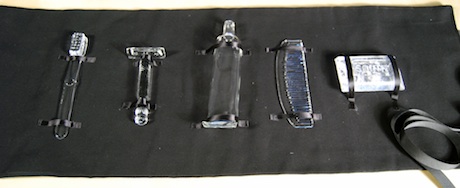
Implements for a journey Toothbrush - Razor - Toothpaste - Comb - Soap Glass, resin and cotton, 2013 approx. 26cm x 70cm
Both these projects have proved to be very productive encounters for me, but have also presented very different problems and challenges. Kettle’s Yard is the visual masterwork of Jim Ede and I felt a degree of trepidation in disturbing what is otherwise a sealed fixed environment. The contents of the house are predominantly artworks so, as another artist, one has to be sensitive in finding spaces to occupy. SPRI on the other hand is a working scientific institution and one needs to have confidence to feel that an artistic interpretation of the archive material and the inherent stories can make a contribution to knowledge and understanding.
Working from collections and archives means that I can look outside of myself and immerse myself in other stories, events and characters. Paradoxically, it is through this that I believe I am able to make work, which confronts my own fears and anxieties, and through that, share these experience with others.
Sound art served in a sour dough bun
/ The Frontroom / Thursday 18th April
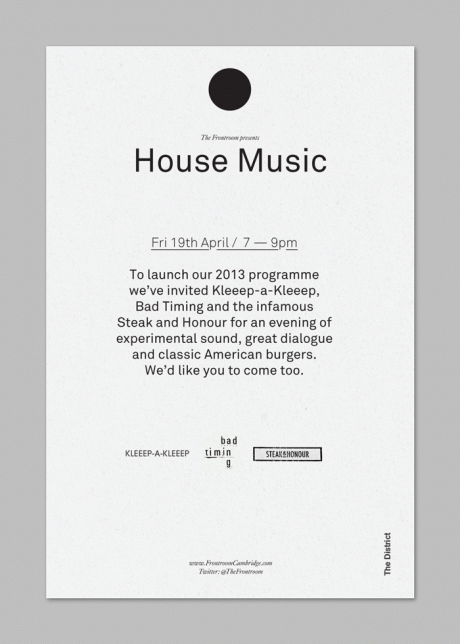
To launch their 2013 programme the good people at The Frontroom have invited Kleeep-a-Kleeep, Bad Timing and the infamous Steak and Honour for an evening of experimental sound, great dialogue and classic American burgers. You’d all be very welcome too. Friday 19th April 7-9pm
Excavating the present
/ Issam Kourbaj / Tuesday 26th March
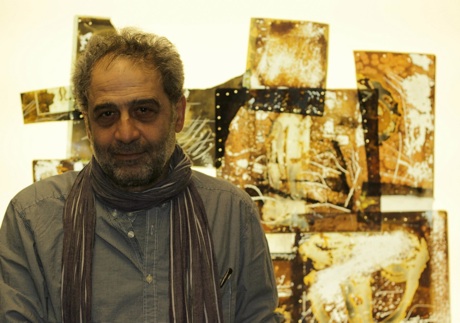
Issam Kourbaj
‘s exhibition ‘
Excavating the Present’
is on at the SIXONESIX Gallery, part of
Changing Spaces,
until Sunday 7 April. It is an exhibition in collaboration with the
Oxfam Syria Crisis Appeal.
Here he tells us more about his series of work in the exhibition.
We are a landscape of all we have seen.
—Isamu Noguchi
We had only one book in our house, and it was kept in the attic. It was called The Science of
Anatomy and Physiology of the Human Body
. It belonged to my sister, then a qualified nurse. As a schoolboy, I remember climbing up to the dark attic and losing – or rather finding – myself in the drawings, in the hidden and intricate wonders of the human viscera.
My mother was very generous. Though she had hardly had any form of schooling, she taught me by holding my hand in her hand; together, we “drew” the twenty-eight letters of the alphabet. She made me understand that letters are not just parts of a word or fragments of language, but a drawing too.
My mother had learnt the art of survival from her mother. My Lebanese grandmother had had her form of surviving the mountains’ cold nights by stitching a thick quilt out of the family’s worn-out clothes. Though I barely knew her (she died before I was able to hold a pencil), her legacy the ‘quilt’, formed my early nightscape. It was my first encounter with abstract form.
My uncle Suleiman, my mother’s brother, who I had never met, formed with his resourcefulness my early vision. He had discovered, in a time of hardship, an unusual source of income. During the French mandate in Syria, many bombs were left unexploded. My uncle found a way to make spoons and coffee pots out of them. Until one day he met his last breath, and found a bomb that did explode.
My city, was named Swaida (Little black town) because it was built from black volcanic stone. Located in the mountains south of Damascus, known for its wealth of vineyards since Roman times, It is home to the ruins of many ancient civilizations. My little black town was a hotbed of Syria’s revolt against the French in the summer of 1925.
The smell of the orange skin burning on the top of the stove marked the transition from one year to another: this was our New Year’s Eve ritual. We all sat round the stove, the kerosene lamp burned and story-telling began. My father had many stories to tell, for he had spent most of his life away, fighting against the French.
In Cambridge, I was privileged to have my first studio behind the Round Church and ADC theatre. My studio was an old snooker room, with no heating. At that time, I was studying theatre design in London, and I created a set for the Olivier Theatre based on the Epic of Gilgamesh –
Gilga the hero, he who saw everything.
While Gilgamesh looked for immortality, I was busy excavating in the ADC theatre skip. There I found many discarded theatre sets and props, which, I am sure, my Uncle Suleiman would have regarded as unexploded bombs.
I went to Mexico to learn about colour from the Mayans, and then on to Cuba. I started making sculptures out of old chairs. I had been told stories about Cubans who made boats out of their furniture so as to sail to Miami. Unfortunately, many did not survive the waves.
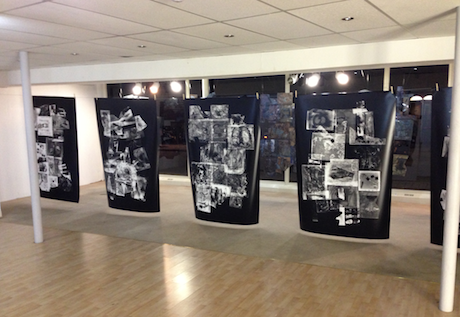
My preoccupation with light began by accident, and in a small way. In 2003, at the time of the Iraq war, I worked on a project called Palimpsest, etching on hospital and veterinary X-ray plates. This project led me to search for further possibilities that light could offer. In the dark attic of my studio at Christ’s College, a knot-hole in the boarded-up window projected a live image of the street and its people and vehicles onto the ceiling. Its discovery made me begin research on a device at that time entirely unknown to me, the pinhole camera, and its natural extension, the Camera Obscura. I conceived a project called
Last Light/First Light
, relying solely on light-sources, lenses and mirrors.
Since then, I started my experiments with camera-less photography, using light, chemicals and two or three dimensional surfaces; photography at its rudiments. The series,
Excavating the Present
, is a palimpsest of two different kinds of camera-less photograms. One is X-ray assemblages; though manipulated, they are essentially a photogram, produced by invisible, highly-penetrating electromagnetic radiation, on Mylar plastic coated with light sensitive emulsion. In turn, the X-ray films became “found negatives” and are used to generate the second kind of photogram – produced by visible light on light sensitive black-and-white paper in a darkroom.
The ritual in which archaeologists bring human traces to life is in many ways a reenactment of the burial process, but in reverse. What is unearthed acts as evidence of what shaped the past. Syrians are involuntary archaeologists now, trying to find bits of their martyrs to bury them. We are voluntarily and with courage, excavating our present, searching for light not stained by fear and blood.
In making this series as a tribute to Syrian mothers, I thought of my sister’s book in the attic; my mother’s hand holding mine; my grandmother’s stitching. When the 24 photograms – one for each month of my people’s collective suffering – were ready, I saw the inhuman condition that the courageous women, children and men are going through in my country. I fear for the future of their past and of their present; of the things they daily see; and the landscapes they might become.
Alfred Wallis Tour
/ Time and Tide, Great Yarmouth / Tuesday 19th March
Today saw a selection of our Alfred Wallis paintings leaving for further afield – to the
Time and Tide Museum
, Great Yarmouth. Jim Ede’s wonderful collection of Alfred Wallis works are on tour having
previously been exhibited
at the
Art Exchange
, University of Essex in January and February 2013 and in a
Kettle’s Yard exhibition
in 2012. We are so pleased to be able to share these fantastic paintings with other museums around the region and hope you enjoy visiting their exhibition of Jim’s collection.
The exhibition at Time and Tide opens on 30 March – 8 September 2013.
After that we will see Alfred Wallis’ work visit
The City Gallery
, Vivacity Arts in Peterborough from 20 September to 17 November 2013.
Let us know in the comments below what your favourite Alfred Wallis painting from the Kettle’s Yard collection is. We will choose a someone’s suggestion to feature as a favourite Wallis on our
page.
Cambridge Junction
/ Cambridge Culture / Thursday 14th March
We love to find out and share what events, shows and exhibitions are
happening in Cambridge. Daniel Pitt, Producer: Arts at Cambridge Junction, tells us the exciting ideas and events happening in their corner of the city.
At
Cambridge Junction
, we’re interested in new ideas and I consider my role as Producer: Arts to be about facilitating and supporting the development of these ideas, sometimes risky ideas, into reality.
Cambridge Junction is a centre for both the presentation and development of innovative contemporary performance. We’re generally interested in ideas with a performance bent to them, but the definitions of all art forms are becoming so blurred these days that we’re open to all kinds of things.
We’re part of the newly formed
Visual Arts Cambridge
consortium. This includes
Kettle’s Yard
and
Aid & Abet
, who I feel share an attitude of openness towards what contemporary arts are becoming. Cambridge Junction’s aim is to explore the intersections where the boundaries are not so clear. The points where art, popular culture and learning all collide is something that people are still working out. As Daniel Brine, Artistic Director, described it at our Season Launch Night at the beginning of February, ‘we want to be a hub for… stuff’.
This season, as we re-launched, we introduced two new strands to the programme,
SAMPLE
and
Junction University
.
SAMPLE is Cambridge Junction opening our programme of artist development to the public. This see’s the ideas exposed while they’re still being realised. Originating from the established
SAMPLED Festival
, it is now a year-round programme of work in development. I fill our studio week in week out with local, regional, national and international performance groups that we’re interested in, providing our space as an investment in their idea.
Junction University is about what artists can teach the public; opportunities for new, unusual artistic experiences for free. We like to say it is Cambridge’s third university – it’s definitely the cheapest. These are workshops for anybody, they involve artistic responses to daily life and how art of all kinds (conceptual, written, graphic, sound, dance, etc) can respond to, or enhance our life. We opened the season by creating an
invisible museum at The Fitzwilliam Museum
and have lots of exciting events planned from a
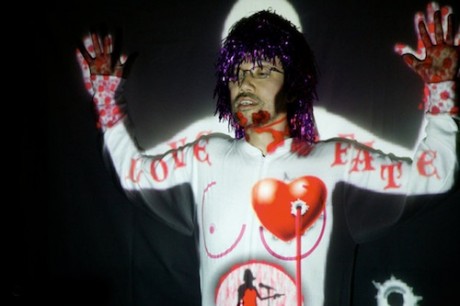
virtual tattoo parlour
(above photo) to making
Manga themed Bento lunch boxes
.
Have a look at the full selection
here
and I’m always happy to
from local artists with ideas that might suit us!
Folk Museum gets a new Director
/ Dr Catherine Morris / Wednesday 6th March
The
Cambridge Folk Museum
, our next door neighbours, have appointed Dr Catherine Morris as their new Director. Here at Kettle’s Yard we want to welcome Catherine and are really look forward to working with her.
Catherine comes to Cambridge from Ireland where she was Cultural Coordinator, working to generate partnership opportunities between the
National Library of Ireland
and
Trinity College Dublin
. She has had a best selling 2012 book and National Library exhibition,
Alice Milligan and the Irish Cultural Revival
which was described by Declan Kiberd as “A profound and moving analysis of one of the greatest inventors of modern Ireland”.
Her main aims as Director are to strengthen local and international partnerships, to interpret the history of Cambridge and to work more closely with the
University’s museums
. It is a great to see her vision for the Cambridge Folk Museum and more widely for cultural life in Cambridge.
It is an exciting time for the Cambridge Folk Museum with a renaming as ‘The Museum of Cambridge’ coming up this year. We look forward to working with them under this new banner in the future.
You can visit their website to find out more information
here.
You can also connect with the Cambridge Folk Museum on
and
.
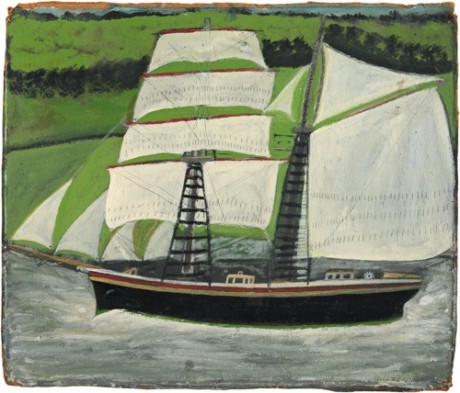
Alfred Wallis: Ships and Boats
/ New catalogue and touring exhibition / Thursday 10th January
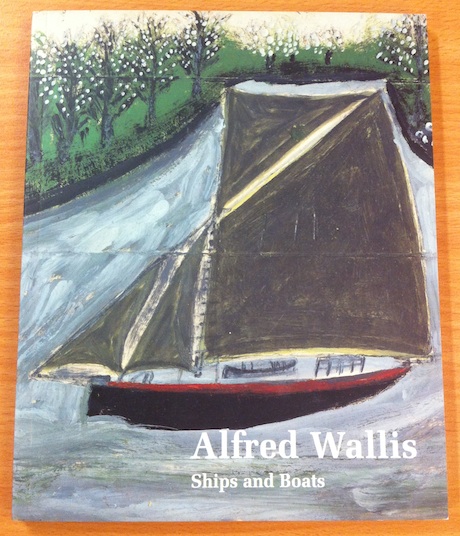
We were very excited this week to get our hands on our new Alfred Wallis catalogue.
With Alfred Wallis being a key figure in Jim Ede’s collection at Kettle’s Yard, the catalogue follows on from our successful exhibition
Alfred Wallis: Ships and Boats
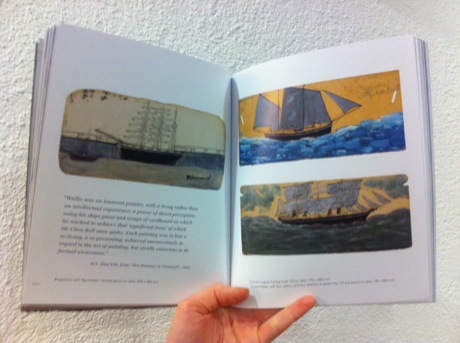
here last year. The book highlights the best works in the collection, including many that are not normally on display, taking a fresh look at Wallis and his relationship to Kettle’s Yard. It reflects the range of Wallis’ subjects as well as the extraordinary diversity of compositional and painterly effects that he created from his basic palette and materials. The book shares with us new and archival material with over 70 illustrations, excerpts from letters and texts by Michael Bird, Ben Nicholson and Jim Ede. You can buy the catalogue in our gallery shop and it will be available
online
soon.
Also this week Guy Haywood, our Exhibitions Assistant, has been at
Art Exchange
, University of Essex, to install
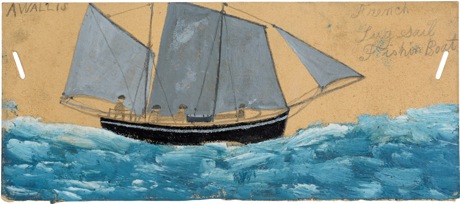
Alfred Wallis
work from our collection. In 1964 Jim Ede donated a number of works, including five paintings by Alfred Wallis, to the newly established University of Essex in affirmation that there “should be a Kettle’s Yard in every University”. This exhibition brings together the Alfred Wallis paintings from our own collection with those from the University of Essex’s Jim Ede Collection. We are really looking forward to seeing the work from our collection alongside these others at the Art Exchange – the exhibition runs from Monday 14 January until Sunday 17 February 2013.
Read
here
a past blog post looking back on the Alfred Wallis exhibition to refresh your memory!
Christmas Tree Festival
/ St Giles' Church / Tuesday 4th December
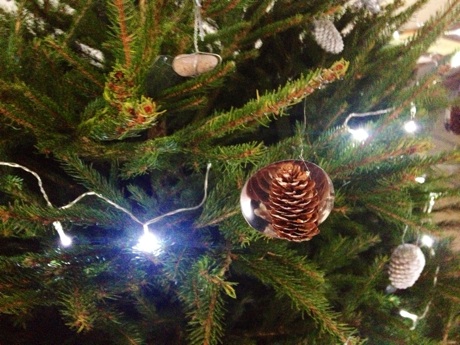
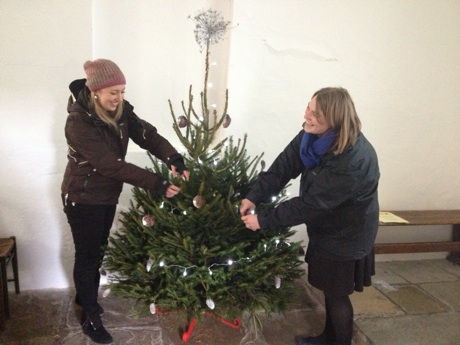
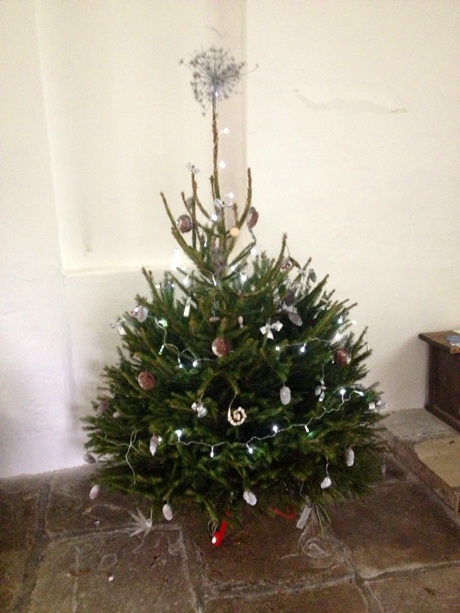
Kettle’s Yard was kindly invited, along with twenty-three other local groups, businesses and schools, to each decorate a real Christmas tree to go on display as part of
St Giles’ Church
Christmas tree festival. With the theme of our tree being
Reflections on Nature
we set to work hand making our decorations using natural materials such as pine cones, shells and pebbles.
You can see our decorated tree on display in St Peter’s Church next door to Kettle’s Yard, with the other Christmas tree’s on show across the street at St Giles’ Church. The festival runs until 9 December 2012, with events and activities happening throughout the week.
Lunchtime Concerts
/ St Giles' Church/ Michaelmas / Tuesday 16th October
The lunchtime recitals for this Michaelmas term havebeen released!The series begins at St Giles' Church on 19 October,with a trombone recital by Newbury Young Musicianof the Year, Mike Buchanan. The following week,flautist Rosie Bowker will perform a recital includingVarèse, Debussy and Schubert. Audiences are in for a treat on 2 November: TheFourier Quartet perform Schubert's epic 'Death and theMaiden'String Quartet in D minor. The next two weeksat St Giles' are reserved for more intimate recitals.Anne Denholm, BBC Young Musician of the Year StringFinalist, presents a harp recital featuring worksby Hindemith and Spohr on the 9 November. Closingthe series on the 16 November, Mark Seow plays aHandel violin sonata on historical instrumentation.
Andy Holden
/ Latitude Festival 2012 / Friday 3rd August
Andy Holden
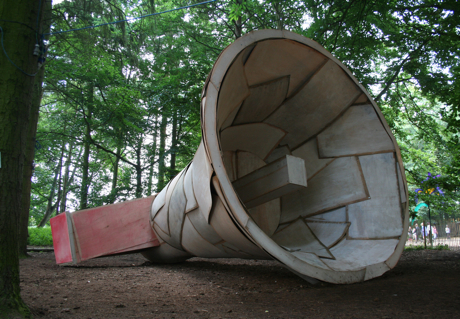
‘s monumental sculpture,
Unquiet Grave,
appeared in the woods at this year’s Latitude music festival in Suffolk as part of
Latitude Contemporary Art
.
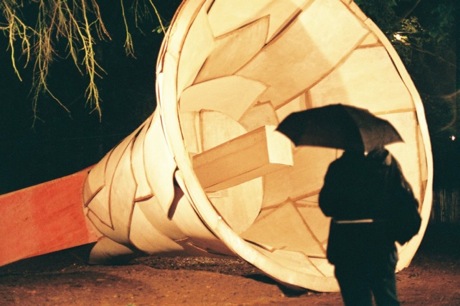
Looming five metres from the ground this huge wooden structure forced the gaze of festival goers upward and into the depth of its cavernous mouth. Painted boards wrapped haphazardly around both the outside and the inside, pinned in a static whirlwind as if trying to summon the energy to cough out one final, resounding word. It was, of course, mute. Touching on ideas surrounding scale, amplification and the obsolete, Holden’s sculpture is a monument to a dying object, the megaphone. At one point a critical tool in the distribution of information and for amplifying the power of the voice, it has been condemned in the age of digitalisation and social networking to become a defunct, soundless form.
Andy Holden’s band The Grubby Mitts also performed twice on the In The Woods stage during the festival. Watch a video of them performing their new single
Standard
live at Latitude below. The single is available on the
Lost Toys Records
website.
GH
–
Andy Holden and David Raymond Conroy’s stage adaptation of David Foster Wallace’s
Brief Interviews with Hideous Men
will be at the ICA from 30-31st August 2012.
Find out more and book tickets on the ICA website.
–
The Grubby Mitts will be performing at Wysing Arts Centre’s
Space Time
music festival on 1st September 2012.
Andy Holden’s exhibition
Chewy Cosmos Thingly Time
was at Kettle’s Yard in 2011.
Offsite events
/ Wysing’s festival of art and music / Tuesday 31st July
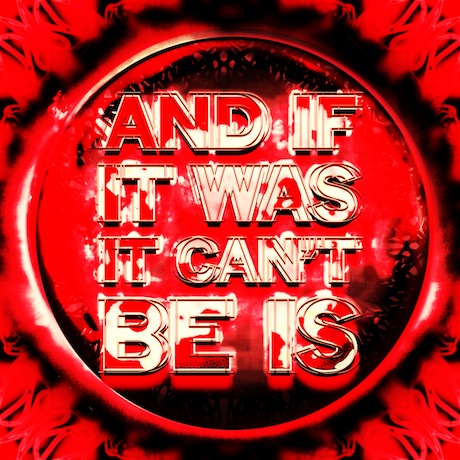
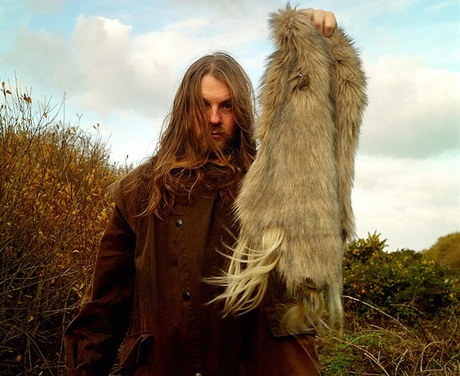
Don’t miss Space-Time: And If It Was It Can’t Be Is, Wysing’s festival of art and music on Saturday 1st September. Titled by artist Mark Titchner, who will play a live set by musician Alexander Tucker, it includes three stages of live music, spoken word performances, film screenings, artists’ stalls and activities for families at Wysing’s beautiful rural site near Bourn.
The line-up includes pioneers from past, present and future including Bruce Lacey (currently exhibiting at Camden Arts Centre), Boyle Family, the influential family collective of artists who also made light projections for Pink Floyd and Soft Machine, and Damo Suzuki, who was part of one of the most influential krautrock bands of the 1970s, Can, and will extend his Damo Suzuki Network to Wysing to play with Andy Holden’s band Grubby Mitts.
Other performers include artists Sue Tompkins, Jamie Shovlin’s band Lustfaust and Anthea Hamilton, plus experimental art and music bands such as Ice Sea Dead People, Maria and The Mirrors, Peepholes, Yola Fatoush and Emptyset.
Date: Saturday, 1 September, 2012
Tickets: from £15
Camping and coaches from St Pancras and Cambridge are available. Find out more
here
.
New Music
/ Lunchtime Concerts / Thursday 28th June
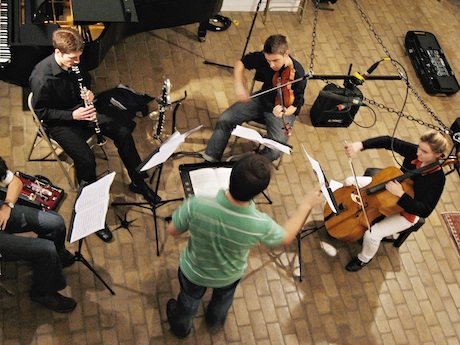
As the end of term approaches, I look back at what has been an extremely successful series of lunchtime concerts. During this exam-term, I rarely left the hermetically-sealed grounds of Girton College, oscillating between the library and my room. However, revision was articulated by my weekly cycle to St Giles’ Church for the Friday lunchtime concert. And each week, I was delighted by the beautiful music performed by students of the University.
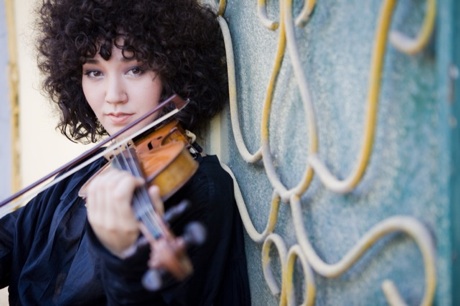
A recital by Fra Rustumji (violin) to a packed-out St Giles’ was particularly exciting. The concert showcased two contemporary works by young composers Laurence Osborn and Kate Whitley, with Kate accompanying on the piano. The works gave a glimpse into New Music today, creating experimental textures and timbres from the age-old couple: the violin and piano. The program was well-structured; by bookmarking the recital with ‘sonatas’, Fra gave us a “backwards” journey from modernity into tradition.
I look forward to this Friday’s concert, which will the last recital of the series. See the Kettle’s Yard
website
for more details.
During the build at Kettle’s Yard, the lunchtime concerts have been taking place across the road at St Giles’ Church. And despite the rain, audiences have flocked to hear performances of Mozart, Beethoven and Schumann. The relocation has allowed even larger audiences, in a celebration of what perhaps has been one of the most successful seasons of lunchtime concerts.
Photograph by Amy Jeffs
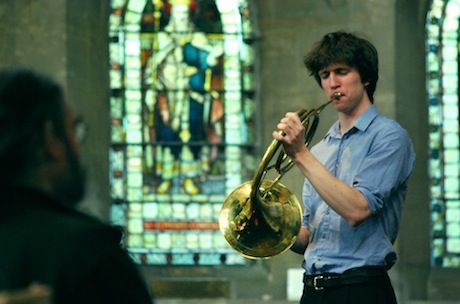
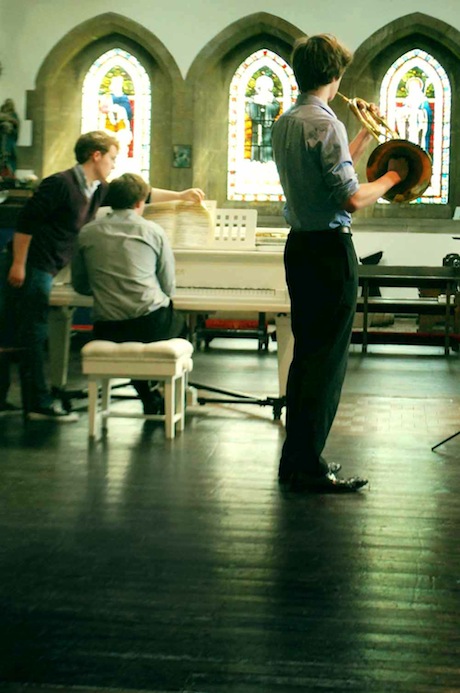
Particular highlights have included a horn extravaganza by Misha Mullov-Abbado (pictured) and Stephen Craigen. The pair provided a varied program on both modern and natural horn, showcasing the instrument’s range of timbres and techniques. Nick Mogg provided a beautifully balanced program, in which he interweaved a Mahler song cycle with lieder by Schubert. The acoustic of the church was particularly suited to his warm baritone range.
The relocation of the lunchtime series has reaffirmed the importance of setting in concerts, and the deliciously close relationship between music and the visual arts. When the concerts took place at Kettle’s Yard, sounds were delineated and crystallised against the white walls, and sometimes even seemed to be in dialogue with the sculptures and paintings. At St Giles’, the music takes on a very different meaning. For example, in Stephen Craigen’s performance of Kirchner’s Tre Poemi which makes use of the synthetic echoes of the piano strings, it became impossible to detangle what was sound, echo or reverberation. The music spoke not only of the horn and the piano, but of the Church’s lofty nave, chancel and stained glass.
Concerts take place on Fridays 1.10-1.50pm, free, donations welcome. See
www.kettlesyard.co.uk/music/lunchtime
for details.
Mark Seow, Cambridge University student programmer of the Friday lunchtime concert series, photos by Amy Jeffs
While the building work is underway we are unable to host our regular free Friday lunchtime concerts. We are delighted that St Giles church, over the road on the corner of Castle Street and Chesterton Street, is hosting these concerts for us. And, the good news is that they can fit more people in there.
The lunchtime concerts are usually performed by musicians from the University of Cambridge and are programmed by a student programmer. They offer a great opportunity to hear some of the musical talent in Cambridge and may of the performers go on to have professional careers in the future.
Concerts are every Friday in Cambridge University term time at 1.10pm, the full programme can be seen on our
main website
.
To hear one of the past performers, pianist Tom Poster, talking about his thoughts about Kettle’s Yard see our
oral history archive
.