Young Carers
/ Summer in 3D / Monday 3rd September
Every year, Kettle’s Yard joins up with Centre 33 Young Carers’ Project and at least two other University of Cambridge museums to deliver a series of workshops to a self-selecting group of young people.
This year, we worked with the Museum of Zoology and the Museum of Archaeology & Anthropology (both veterans of previous young carers’ art projects). Artist Bethany Mitchell led an intensive four days of creative workshops with a dedicated group of budding artists.
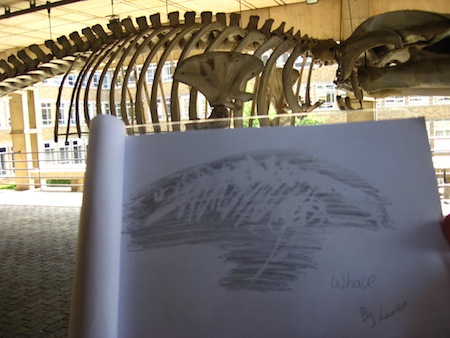
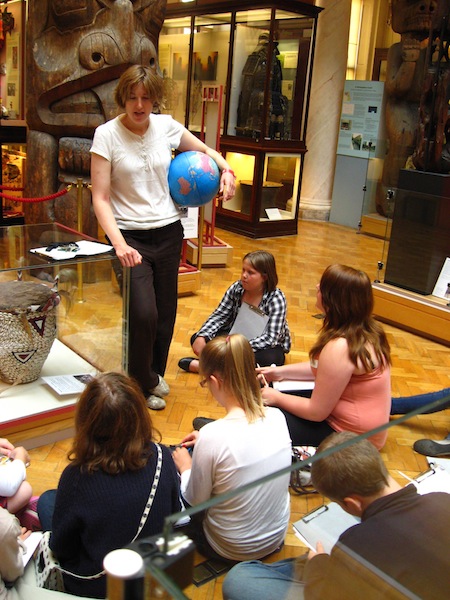
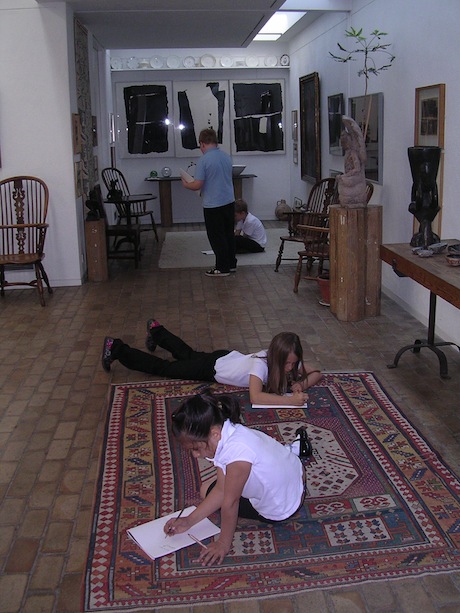
We explored all three collections, getting an introduction from the education staff at each place. The theme of scale was the springboard for a series of making activities – using wire, string, stickers and cellophane. We sketched, took notes and photographed as part of our examination of the selected objects.
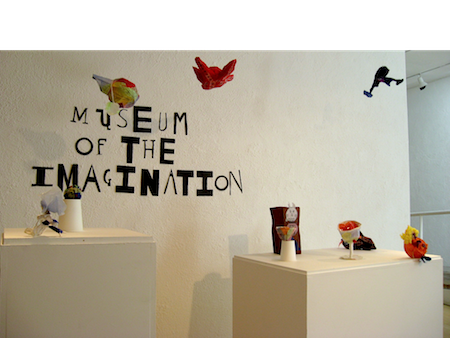
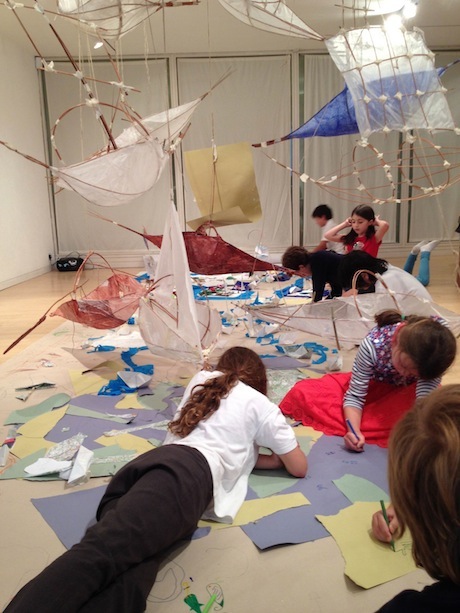
We took our collected notes and ideas into the education room at Kettle’s Yard and created wire and paper sculptures, mashing up what we had seen over the previous couple of days to create a Museum of the Imagination. Everyone wrote an extended label for their artwork, providing an imaginative title, date, location and description. ‘Timmy’, for example, is part-man, part-whale (Homo-orcious) and has been extinct for millions of years. The description for Timmy reads: They had gold 45 million years ago. Went extinct because they were over confident.
The Museum of the Imagination is a surprising, creative, funny exhibition that is touring all three venues – come see it for yourself.
Wednesday Club
/ Film: 'On Becoming' / Friday 10th August
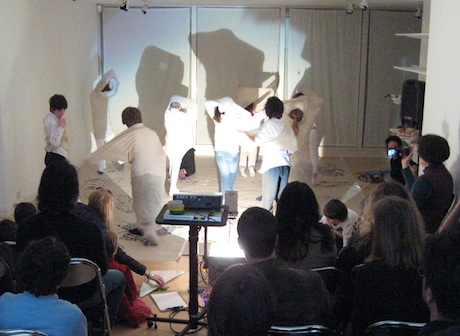
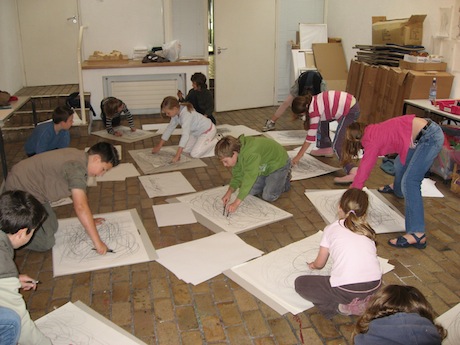
‘On Becoming’ was filmed throughout the 2012 Spring Term of Wednesday Club. The final film provided a backdrop to a live performance for friends and family during the end of term session. The group looked at the sculptures and drawings of Henri Gaudier-Brzeska and took inspiration to make works that transformed people into animals.
A big thank you to artists Alex Hirtzel & Filipa Pereira-Stubbs and all the keen Wednesday Club participants. You can see a short taster version of the film as well as the extended version below.
Space Makers
/ My favourite place at Kettle's Yard / Tuesday 7th August
We are half way through a two-year architecture project with two local schools. A class from St Mary’s Primary School, St Neots, and Comberton Village College are each working with an artist to explore the architecture and collection at Kettle’s Yard, the surrounding built environment and the process of making buildings. This project has been inspired by our site development project and is generously funded by the
Heritage Lottery Fund
.
Janet King, the Year 5 class teacher at St Mary’s, has kindly sent through some wonderful observations written by the pupils as part of a literacy exercise to re-design our What’s On leaflet. We loved their comments and hope you enjoy these excerpts too -
“My favourite place in Kettle’s Yard is the cottage first floor sitting room. When I stand in the middle and look around I see artwork everywhere. Some recognisable, some not. Some new, some old. And some that you wouldn’t realise is art. There’s a cupboard full of beautiful ceramics and two grey armchairs where I imagine Helen and Jim would have sat… This place really makes me think about real art.
”
“My favourite place in Kettle’s Yard is the cottages attic. When I sit here, I can see lots of pictures. This place makes me feel like I’m in heaven.”
“This place makes me feel like I could be an artist and it makes me happy and I like that I can work at Kettle’s Yard.”
“When I sit on the chair near the table, I see a spiral made of pebbles. The pebbles in the middle are huge and they get smaller as they go around. The stones make me feel like I’m spinning round and round. When I’m at the house it makes me feel like I’m at home because of the furniture and all the art work. I could just sit here and feel like home.”
“When you come to Kettle’s Yard you don’t pay a penny. And there are books and pencils, rubbers and leaflets to sell to you. “Everyone is welcome” if you like majestic models and dramatic drawings.”
“I think the best bit of art is a lemon on a silver plate. Just simply simple.”
Wednesday Club
/ Last of the season / Wednesday 18th July
We’ve been celebrating the work of our budding artists at the last Wednesday Club exhibition. The kids have made some fantastic work inspired by our
Alfred Wallis
display. Due to our building project, we will not be running our regular programme of termly workshops from July- December 2012, but we’ll be back and trialling our exciting new programme of activities to launch our new spaces in 2013!
If you’ve participated in any of the education programmes over the years, it would be great to hear from you about your experiences with our workshops and events, what you value in them and how we can make our activities better for you in future. Leave feedback about our kids and families workshops
here
, or our programme for adults
here
.
Jamie Fobert Architects
/ Kettle's Yard model / Wednesday 9th May
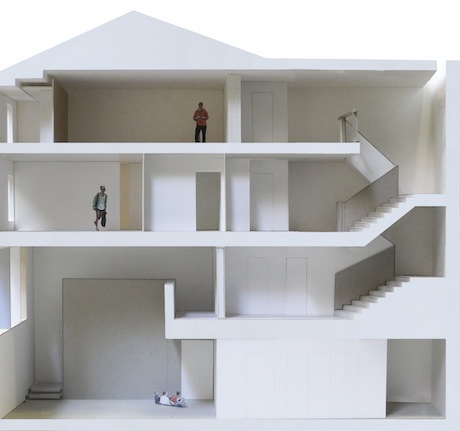
This is one of Jaime’s fantastic models showing the new proposed space for the Education Wing.
To find out more details about the new Education Wing see our main
website
.
Jaime Fobert
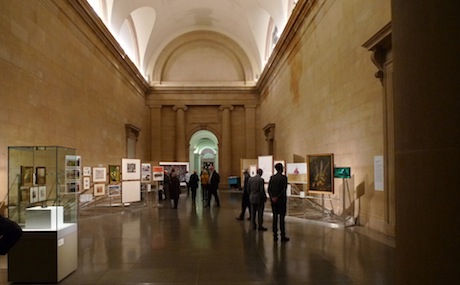
has a lot of experience working with arts organisations. One of their first arts projects was an installation design for the Turbine Hall at Tate Modern during ‘The Upright Figure’ and ‘Constable to Delacroix’ at Tate Britain. Since then JFA has been selected to design our refurbishment and extension at Kettle’s Yard Gallery in Cambridge and also to design a major extension to the Tate in St Ives. The practice designed the space for the Frieze Art Fair in Regent’s Park in 2006 and 2007 and has recently completed an exciting new Centre for Contemporary Culture in Moscow, inserted into a 1929 Melnikov bus garage.
In his work for the Commission, Patrick Keiller explores the Duveen Galleries’ spatial and other possibilities. He comments: “As someone most usually involved with images and the linearity of narrative, I’m delighted by the invitation to devise an exhibit for a sculpture gallery.”
The Robinson Institute
is an exhibition that considers the origins of the current economic crisis. Throughout
The Robinson Institute
, images of landmarks and locations in the English landscape are employed to illustrate the development of capitalism.
Jamie Fobert Architects has created a unique framework, fabricated from raw aluminium, upon which hangs the extraordinary variety of pieces, many from Tate’s own collection, which together comprise
Keiller’s work
.
Jamie Fobert Architects
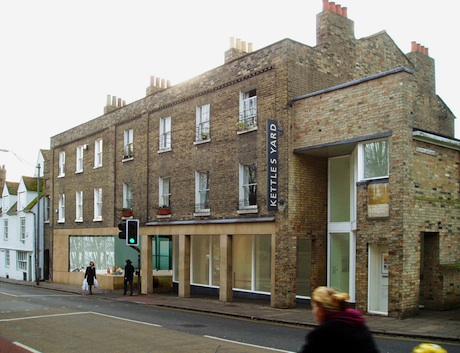
are the architects who have designed the new Education Wing at Kettle’s Yard.
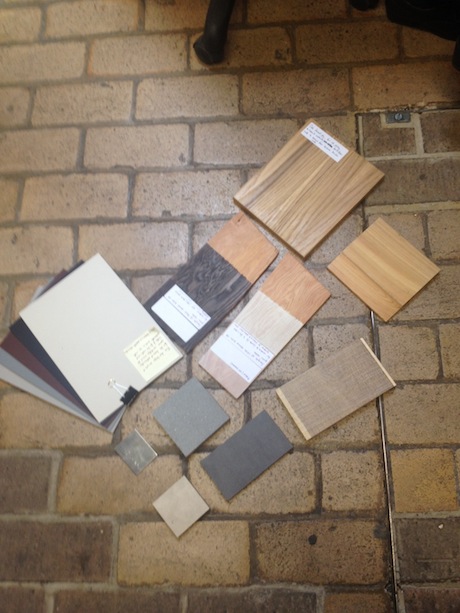
Some of the team have been looking at samples for the new building. There’s so much to think about from flooring to worktops, we’ve done some testing – spilling red wine and paint on flooring samples.
What would you do if you were Director for a day?
/ Wednesday 25th April
This was the question asked at the first meeting of the new user group at Kettle’s Yard. As part of the development project Sarah (the Education Officer) and I have brought together a group of users of Kettle’s Yard. The group includes a range of people who have some involvement with Kettle’s Yard, from concert-goers, those who bring educational groups and people who just enjoy visiting Kettle’s Yard. What unites them all is that they have a relationship with Kettle’s Yard and have visited several times. It’s not a fixed group and we know and expect it to change over the months and possibly years to come. We will use the group to test out ideas and give us feedback on all aspects of Kettle’s Yard and in particular areas that we’ll be developing while we are building the new education wing.
We all met each other for the first time on Wednesday and it was fantastic to hear more about what people think about Kettle’s Yard. As the Marketing Officer, I always want to know what makes people tick!
This really was a getting to know each other session and one of the first questions was ‘What would you do if you were Director for the day?’ In a way, the answers to this were the most revealing aspect of the evening and included:
Having sleep overs in the house
More ‘play’ in the house
Outdoor parties
Better signage from the street
Longer opening hours
More celebration of craft
Unlimited biscuits (for the education team here!)
These are just a few of the answers and there was a fair degree of discussion about most of these. If you’re reading and want to let us know what you’d do if you were Director, please leave a comment. We went on to other playful exercises to find out more about people’s perceptions of Kettle’s Yard.
The first session was a bit of an experiment but we felt it went really well and are now looking forward to meeting again in a couple of months when we think fonts (what’s friendly, what’s not?) and interpretation material will likely be on the menu.
We are often asked about our strange opening hours – only 2-3 hours in the afternoon for the house, but not Mondays, but we are open bank holiday Mondays and the gallery hours are a whole other thing. I appreciate the frustration of visitors who arrive with friends and family, wanting to show them their favourite bit of Cambridge, only to find it closed. For my work as education officer however, we make full use of those hours when the public is not in the house to support a whole range of activities. School and community groups book visits for talks and workshops, we are able to run courses and talks and support people who may not otherwise have the confidence to make a visit. There are a huge number of visits to the house and gallery outside opening hours that may people don’t know about.
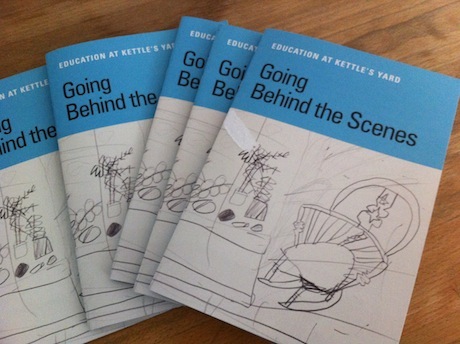
And now the good news! The Heritage Lottery Fund are supporting a range of new projects and resources that will help us prepare for the new education wing. The first resource to be made with this support is ‘Going Behind the Scenes’, a small booklet that shows the broad scope of the education programme and our ambitions for the future. We want more people to know about our work at Kettle’s Yard and get involved. ‘Going behind the Scenes’ is filled with photos of workshops and artworks and I hope it captures something of the energy and creativity that people bring to the place.
Archaeology
/ Roman Rubbish / Wednesday 14th March
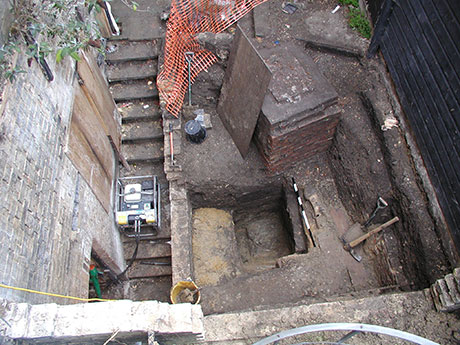
Before the new building works could fully go ahead the Cambridge Archaeological Unit dug a few test pits. This was one of the planning requirements for the new development; it was flagged up because Castle Hill is known to have been important in the Roman period. There was a settlement on the hill with roads linking it to the river and elsewhere. The area was also important during the Saxon and medieval periods. With this knowledge behind us we had to work underneath buildings and in small spaces to see what had happened exactly on the spot of No’s 4-5 Castle Street. Logistically this was challenging and on occasion very wet (with rising ground water) but still provided some interesting results.
Water has always been a feature of the site- even in the Roman period. Between the 2nd- 4th centuries a cobbled surface was created, possibly to try to alleviate the damp ground problem. Changes in the natural geology traps the ground water at this level. This would have caused a line of springs that the Romans could have exploited as their water source, although there is no proof of that at the moment. There are no signs of Roman buildings under 4-5 Castle Street, sensible people- they lived higher up the slopes out of the water.
Archaeologists dig in layers and look for stratigraphy. The test pits that we dug in the yard contained a sequence of soils that looked typical of medieval (and later) back yard activities. This included an oven and layers of garden soil. The remains of a 17th century cellared building was also discovered and must have been pulled down to build the present day buildings!
Artefacts
Several pottery fragments were found, from a number of different objects, and it is these that were primarily used to date the site. Most of the pots had been produced locally although some had come from much further afield, Peterborough and Gaul (France!).
Several animal bones were also found, some with butchery marks and teeth marks from dogs. Most of the bones came from sheep or goats but cattle and pig bones were also found. This is also normal for domestic rubbish, presumably from the settlement up the hill. The Romans were quite like us- they made lots of rubbish and left litter.