What would you do if you were Director for a day?
/ Wednesday 25th April
This was the question asked at the first meeting of the new user group at Kettle’s Yard. As part of the development project Sarah (the Education Officer) and I have brought together a group of users of Kettle’s Yard. The group includes a range of people who have some involvement with Kettle’s Yard, from concert-goers, those who bring educational groups and people who just enjoy visiting Kettle’s Yard. What unites them all is that they have a relationship with Kettle’s Yard and have visited several times. It’s not a fixed group and we know and expect it to change over the months and possibly years to come. We will use the group to test out ideas and give us feedback on all aspects of Kettle’s Yard and in particular areas that we’ll be developing while we are building the new education wing.
We all met each other for the first time on Wednesday and it was fantastic to hear more about what people think about Kettle’s Yard. As the Marketing Officer, I always want to know what makes people tick!
This really was a getting to know each other session and one of the first questions was ‘What would you do if you were Director for the day?’ In a way, the answers to this were the most revealing aspect of the evening and included:
Having sleep overs in the house
More ‘play’ in the house
Outdoor parties
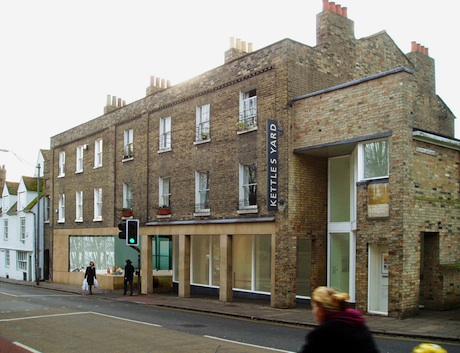
Better signage from the street
Longer opening hours
More celebration of craft
Unlimited biscuits (for the education team here!)
These are just a few of the answers and there was a fair degree of discussion about most of these. If you’re reading and want to let us know what you’d do if you were Director, please leave a comment. We went on to other playful exercises to find out more about people’s perceptions of Kettle’s Yard.
The first session was a bit of an experiment but we felt it went really well and are now looking forward to meeting again in a couple of months when we think fonts (what’s friendly, what’s not?) and interpretation material will likely be on the menu.
We are often asked about our strange opening hours – only 2-3 hours in the afternoon for the house, but not Mondays, but we are open bank holiday Mondays and the gallery hours are a whole other thing. I appreciate the frustration of visitors who arrive with friends and family, wanting to show them their favourite bit of Cambridge, only to find it closed. For my work as education officer however, we make full use of those hours when the public is not in the house to support a whole range of activities. School and community groups book visits for talks and workshops, we are able to run courses and talks and support people who may not otherwise have the confidence to make a visit. There are a huge number of visits to the house and gallery outside opening hours that may people don’t know about.
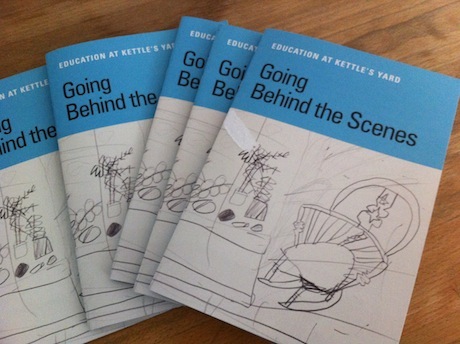
And now the good news! The Heritage Lottery Fund are supporting a range of new projects and resources that will help us prepare for the new education wing. The first resource to be made with this support is ‘Going Behind the Scenes’, a small booklet that shows the broad scope of the education programme and our ambitions for the future. We want more people to know about our work at Kettle’s Yard and get involved. ‘Going behind the Scenes’ is filled with photos of workshops and artworks and I hope it captures something of the energy and creativity that people bring to the place.
Archaeology
/ Roman Rubbish / Wednesday 14th March
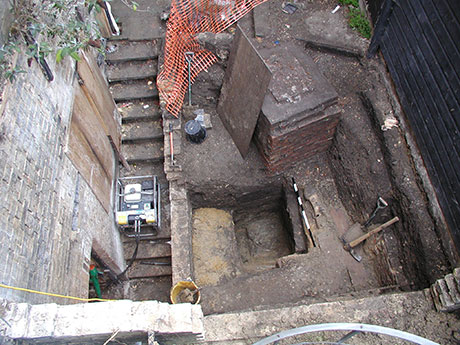
Before the new building works could fully go ahead the Cambridge Archaeological Unit dug a few test pits. This was one of the planning requirements for the new development; it was flagged up because Castle Hill is known to have been important in the Roman period. There was a settlement on the hill with roads linking it to the river and elsewhere. The area was also important during the Saxon and medieval periods. With this knowledge behind us we had to work underneath buildings and in small spaces to see what had happened exactly on the spot of No’s 4-5 Castle Street. Logistically this was challenging and on occasion very wet (with rising ground water) but still provided some interesting results.
Water has always been a feature of the site- even in the Roman period. Between the 2nd- 4th centuries a cobbled surface was created, possibly to try to alleviate the damp ground problem. Changes in the natural geology traps the ground water at this level. This would have caused a line of springs that the Romans could have exploited as their water source, although there is no proof of that at the moment. There are no signs of Roman buildings under 4-5 Castle Street, sensible people- they lived higher up the slopes out of the water.
Archaeologists dig in layers and look for stratigraphy. The test pits that we dug in the yard contained a sequence of soils that looked typical of medieval (and later) back yard activities. This included an oven and layers of garden soil. The remains of a 17th century cellared building was also discovered and must have been pulled down to build the present day buildings!
Artefacts
Several pottery fragments were found, from a number of different objects, and it is these that were primarily used to date the site. Most of the pots had been produced locally although some had come from much further afield, Peterborough and Gaul (France!).
Several animal bones were also found, some with butchery marks and teeth marks from dogs. Most of the bones came from sheep or goats but cattle and pig bones were also found. This is also normal for domestic rubbish, presumably from the settlement up the hill. The Romans were quite like us- they made lots of rubbish and left litter.