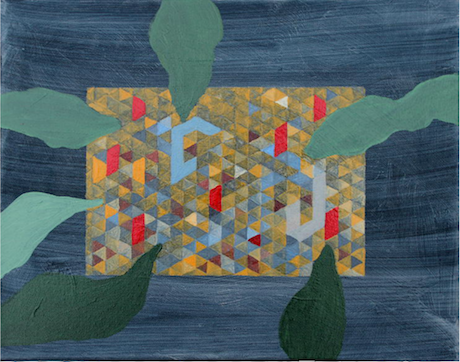
Scintillation: Views within a meteorite
/ Kettle's Yard Recommends / Tuesday 2nd July
In the tranquil setting of 11th century
St Peter’s Church
, next to Kettle’s Yard, a new exhibition of paintings by
Zachary Beer
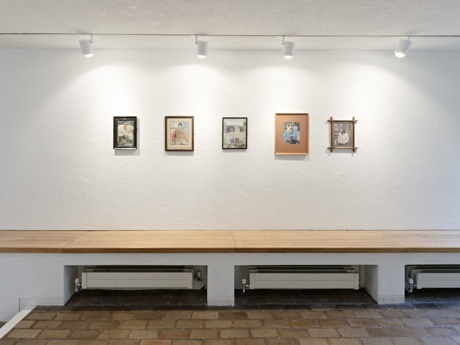
will run from 2-7 July. The paintings featured depict imagery inspired from deep within a meteorite when viewed by a digital microscope. They refer to the Seymchan meteorite found in Russia in the 1960′s and named after a nearby settlement. It is a pallasite meteorite, meaning it has cm-sized peridot translucent crystal structures that refract light beautifully under illumination. The paintings draw on these refracted colours and juxtapose them with green motifs. Beer says,
When meteorites fall they bring with them amino acids that become part of the structure of flora on earth…the paintings hint at or display verdant structures that explore the passage of tight crystalline forms yielding into the flowing forms of flora.
The paintings will be shown alongside the original fragment of meteorite from which the imagery is taken. It is fascinating to see the piece of meteorite with its beautiful crystal structure placed centrally in the church. You can clearly see the influence of the unusual structure in the abstract forms and colour of the paintings.
Previous work by Beer has explored processes and artefacts within molecular biology, homeobox domains, metabolic pathways, hedgerows and flowers lost in the darkness of night. He has recently shown works at Christ’s College Cambridge – The Outside World, Redchurch Street, London – The Royal Academy and The School House Gallery, Wighton.
The show runs from 2 – 7 July, 12.30 – 6pm and will be open until 8pm alongside the private view for Christopher Wood on Friday 6 July.
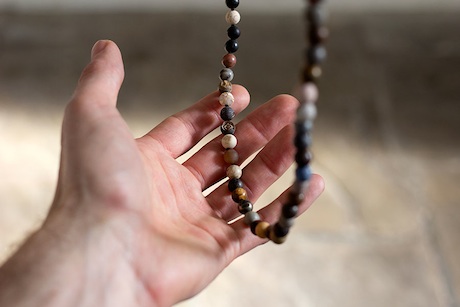
DNA & Fossil Necklace
/ Wellcome Trust Sanger Institute / Sunday 19th May
So it turns out that human presence on Earth has only been for a fraction of the time that the Earth has actually existed. In
Katie Paterson’s
Fossil Necklace
this becomes apparent before our eyes. The necklace features over 170 beads carved from fossils, which bead by bead chart the evolution of life on earth. The fossils that formed the beads come from all over the globe, sourced by Katie from fossil fairs, auctions and even found during a fossil hunt in Scotland.
Fossil Necklace is the culmination of Katie Paterson’s residency at the
Wellcome Trust Sanger Institute
, just outside Cambridge, a residency where she explored the world of genetics, leading her to the project of
Fossil Necklace
.
From fossils scientists can fathom certain information – including information such as what species were around at any particular time of history and anatomical information. With the discovery of DNA scientists are now able connect species (whose DNA was sequenced) by looking for the similarities and differences between their genetic make up.
Dr Chris Tyler-Smith
, Head of Human Evolution, Wellcome Trust Sanger Institute says, ‘Every individual living now, in the past or the future traces their origins (and DNA) back through an unbroken chain of ancestors to the origin of life. There is really a ‘tree of life’ linking every living and extinct species.’
It is this idea that is encapsulated in
Fossil Necklace
, the similarities (but also divergent paths) that makes up the history of our world are made tangible and strung together somewhat like our own DNA. Whilst the whole history of the earth is put into a scale we can discern, our own presence within that history becomes very obviously tiny.
Many of the fossils that are represented as a bead in the work are the ancestors of a species whose DNA has been sequenced by the Sanger Institute. One is the pig, the Sanger Institute having sequenced the DNA of the Duroc breed of the modern domestic pig. Dr Tyler-Smith writes,
The final bead in the Oligocene period comes from a Peccary ‘skunk’ pig that lived 30 million years ago in South Dakota, USA, while we concentrate on the Duroc breed of the modern domestic pig. The DNA sequence shoes just how powerful the sense of smell is in pigs, and how complex the origins of the domestic pigs were.
Fossil Necklace is on show until 23 June as part of Katie Paterson exhibition, with other works on show in the Kettle’s Yard gallery. Find out more
here
.
We rely on the generosity of our supporters to help us maintain and grow our exhibition programme. If you would like to donate to Kettle’s Yard or for further information on how you can support us, please click
here
.
Get Creative with Social Media
/ The Practice Sessions / Friday 17th May
On 24 May, 6-8pm,
IJAD Dance Company
will be hosting one of Kettle’s Yard
Practice Sessions
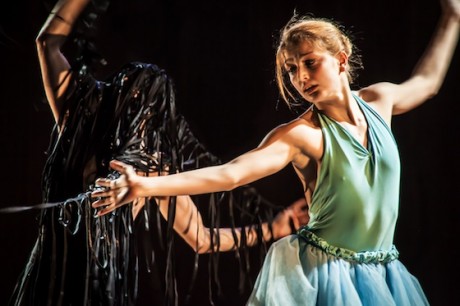
. An informal evening of workshops, talks and performance led by IJAD about their latest project,
In-Finite
. See below for a taster of what you can expect on this exciting evening.
The
In-Finite Project
started in 2010 as an ongoing conversation about the interaction between the public and the private. Take part in the conversation by sharing a secret here anonymously
here
and on the night you can see how these are transformed into creative pieces which can be shared over social media for comment, interpretation, collaboration, devising and performance work. You’re more than welcome to watch, but if you want to take part – wear clothes you can move in!
Also on the night you can witness chapter one of the project – a screening of In-Finite, currently touring and viewed online in 11 countries and counting. It delves into over 150 secrets shared by people just like you. The team behind it will be available to answer all your questions.
Never fear if you don’t know how to use twitter – we’ll take you though it, just make sure your phone’s fully charged!
Don’t miss The Practice Sessions – hosted by IJAD Dance Company – on 24 May
6-8pm.
Admission is £8, pay on the door and includes one free drink.
Follow IJAD on
and don’t forget to share your secret before the evening commences
here.
Lucy Conochie
/ OUTPOST Artist in Focus / Thursday 4th April
Lucy Conochie
is one of the artists currently participating in our
exhibition
with
OUTPOST gallery
at Kettle’s Yard. Here she tells us about her process and the work that features.
I try to do only what is necessary to communicate an idea. If I take everything away that isn’t necessary, everything that is ‘decoration’, then I am left only with important elements that force me to tell the truth about what I have seen, thought or felt. I try always to avoid creating a sense that the work uses a hidden order or secret language in which the viewer is not invited to take part.
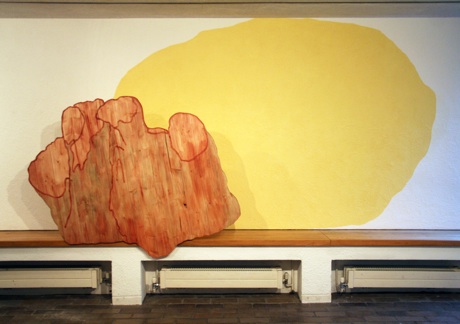
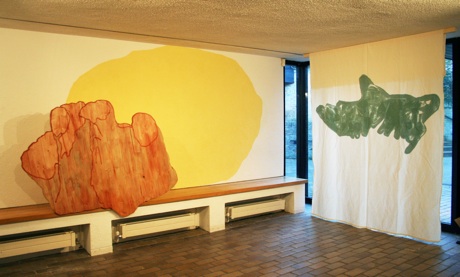
Although I had some works I intended to show for this exhibition, after seeing the exhibiting space at Kettle’s Yard it became clear I needed to make a space-specific work for this show that would be more responsive to the unique architecture of this gallery. The bench area was certainly a spatial challenge but I felt content having come up with the work ‘Treelung (Thing)’ as a solution. This work is a sculpture made from a series of drawings I made of the pneumatophores of the Swamp Cypress. These are essentially ‘breathing roots’ for trees that live by water. They are fascinating and strange and appear as neither one thing nor another: receding yet emerging.
I want the materials and colours I use to be sympathetic to the original forms, and to the space in which they are placed: the wood rises from the bench as if from the same tree; the yellow wall painting reflects other elements in the exhibition. The ‘Apical Drawings’ shown alongside this work were also made solely with Kettle’s Yard in mind, and are a joyful attempt to disrupt some hierarchies of form, and serve as a celebration of nature.
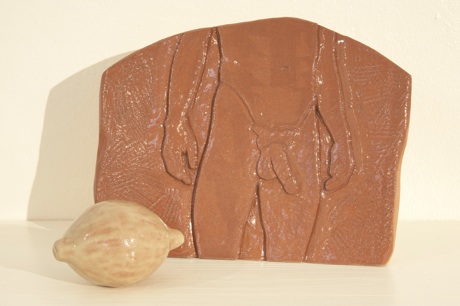
OUTPOST has been very supportive since I first showed there in 2009 and it has been extremely good for me to continue a relationship with such a well respected artist-led space. I was very pleased to be chosen to exhibit at Kettle’s Yard. My work ‘Nude with Lemon’ includes a ceramic lemon that symbolises sensuality and the still-life, but also empathises with the lemon that echoes the
Miro painting
in the House adjacent; the lemon that is continually replaced in order to maintain the collection in the manner in which it was left. I like the idea that during this exhibition this ceramic lemon will be a reflection of reflections.
~ Lucy Conochie
www.lucyconochie.co.uk/
You can see Lucy Conochie’s work at Kettle’s Yard in the OUTPOST show until 14 April. Find out more
here.
Interview with Ian Giles on Clay Meditation [A brief history of time]
/ OUTPOST Artist in Focus / Monday 11th March
Following the forthcoming ‘Art in the East’ panel discussion, taking place on Saturday 16 March, exhibiting artist and
OUTPOST
member
Ian Giles
will be staging a participatory performance in the Kettle’s Yard house. Ian spoke to Amy Budd from the OUTPOST steering committee about the performance entitled
Clay Meditation [A brief history of time]
,
and its wider relationship to his film currently on show in the exhibition.
Amy Budd: Your performance
Clay Meditation [A brief history of time]
at Kettle’s Yard invites participation from members of the public. Can you describe what it will involve?
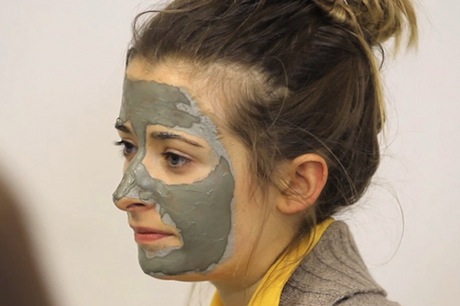
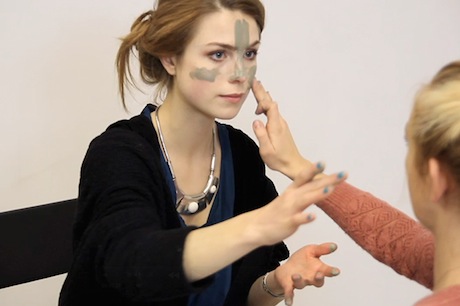
Ian Giles: I’m inviting members of the public to take part in a meditation using clay. They will each be paired up with someone that they don’t know or with someone that they are less familiar with. Not to be provocative, but to invite us to exchange something with someone that we know perhaps less well, or to ask what it means to create a very simple relationship with someone that you don’t know. Once paired up, everyone will be given a small amount of clay and they will be invited to paint each other’s faces with the clay. This will be done in a very relaxed environment within a beautiful room of the Kettle’s Yard house. The meditation will be accompanied by live piano music. After the wet clay has been applied the drying process will lead the meditation, both in terms of using the drying process almost like a clock or a timer. But also this process is something physical to watch, something changing. It’s perhaps a bit like staring at a fire or staring at the ocean, it’s always subtly changing. As the clay dries, paths and cracks appear on the face and perhaps this starts to remind people of a landscape as well thinking about mortality.
AB: What is your specific interest in using clay as a material for the performance?
IG: I think in my practice, I’m interested in things that transform, and materials that have transformed. I made a film and performance in 2011 in the docklands of London, called
A Smaller Sound, A Bigger Crowd
. It was about a huge metal bell that gets melted down over the years and changed into different things. So I think I’m interested in materials that have the ability to change form, for example how clay can go from being a liquid, and then it goes through a drying process and then becomes a solid. So in a way, the material stays the same but its physical properties and its physical appearance changes. To put simply, I guess I’m using that as an analogy for time and existence.
AB: Yes, you describe the transformation of clay in the text you wrote about the performance in terms of mortality and change.
IG: Yes, although I think when you write it down, I think it can seem a bit twee or obvious. But I think it’s about a period of time – so the meditation could be seen as a set time to reflect on things, and it doesn’t have to be about mortality or change. I am interested in what happens when you chose to sit somewhere and focus upon a particular activity. Which I guess in a way relates to what it’s like to be an artist, or a maker. When you’re in the studio working on drawings or making ceramics, there’s that time when you’re using material in an abstract way, and how that use of the material leads to reflection. And certainly, when I’m making my own work, I feel like my mind goes into a kind of wonderland. I use art-making to allow my mind to wander.
AB: Is this the first time one of your performances will involve other people who you don’t know, or haven’t worked with before?
IG: Yes. Which, I’m nervous about.
AB: And how do you expect it will go? I wonder why you decided to create this kind of invitation, and in turn give up a certain amount of control.
IG: I think I’m interested in the idea of opening up performance beyond the spectator and the performer, and seeing what happens when those two things become one. I’m not asking members of the public to become performers. Rather I’m immersing them in an experience. I’ve also been thinking a lot about the language that we use to describe art. So you could describe this work as an interactive piece, but for me I still want to think about it as a performance, rather than calling it interactive. Mainly because as I feel that the term performance suggests something more focused, perhaps? Whereas interaction to me seems to describe the Tate Turbine Hall, and works like Carsten Holler’s slides for example, which were amazing, and do I love this kind of work. But it’s not what I’m trying to do with this piece. Asking the viewer to enter the work is about blending the place where the art is happening. So for me, in this piece, the audience and the performer of the performance are the same thing, they’re in this dual relationship.
AB: Which is why you’ve created a specific set of conditions for the audience watching the performance, as ideally the performers are the audience as well. So the people painting the clay masks will be the audience of the work as well.
IG: Yes, so really there shouldn’t be an external audience to the piece, because it’s what happening inside, and also because it’s happening in silence, or at least without speaking. I feel that it’s very powerful, particularly when you’re paired up with someone you don’t know and you’re sitting opposite them and you’re looking them in the face, and they’re looking you in the face. I feel even if you’re doing that with someone you know really well, it’s still quite intense. And I’m also interested in how I think most of us have an ability to communicate beyond language. Often I feel like you can feel if someone you know is holding back from you, or also we’re quite animal, I think we can sense fear or other emotions.
AB: The Kettle’s Yard house will provide a unique setting for this performance, and you’ll also be using the piano in the space. How do you think this environment, with lots of modernist paintings to look at, or meditate in front of, will inform the experience of the work?
IG: I’m very excited about doing it in this room at Kettle’s Yard. Also going back to the idea of materials transforming, for me it seems very exciting to be presenting my artwork alongside other physical examples of art, particularly the sculptures in those rooms, which feel very relevant to me. Showing a performance alongside those works is kind of suggesting a kinship between art forms, and of this idea that the clay becomes solid on your face, so your face becomes sculpted, so I guess as the performance goes on, everything in the room, including the audience becomes a sculpture or an artwork. So it seems really exciting to me to be in a room full of art, and very relevant.
AB: What is the crossover between the performance and your film
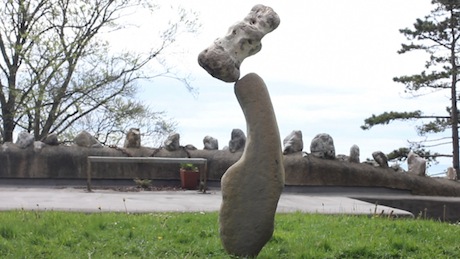
The Stone Balancer
in the exhibition?
IG: I think that the relationship between
The Stone Balancer
and the clay mediation performance is about us exploring very simple materials. Adrian, the stone balancer in the film, is focusing on the task of balancing a stone, and that task is for him kind of a meditative process. The amount of concentration needed to balance one stone on top of another is a lot, but also it’s about calming himself, and finding that centre as well. I guess within all the ideas it’s very easy to drift off into spiritualism, or things like that, and I think it’s important to not to just settle with those ideas because it seems quite simplistic to make everything seem like it’s about that.
AB: So it evokes more than an idea of, or interest in spiritualism and mediation for you?
IG: I guess I was saying that as I feel like that’s a factor of the work, but also for me I’m very interested in the formal side of the work, both this idea of working with materials. And I always say that I’m kind of a frustrated sculptor. And certainly in the way that I work with film and performance, I very much think of film and performance-making as working with materials. Yes, I guess the relationships between the works is this idea of connecting with natural objects, as a way of processing that we are natural earth-bound things.
AB: It’s incredibly essential, really, the way you approach working with the base elements of material culture, to create situations that reveal how we engage with them, and also produce ourselves through them.
IG: I guess for me, I feel such a similarity between myself and those stones. There’s a point in that film when you see the stone being lifted up, and then the female acrobat gets lifted up at the same time. So there is that suggestion that her body is a similar to the body of the stone, and there’s something in me that feels very… I feel that they’re real, I feel like those stones, that they have a personality. I also I find them amazing as they must have seen so much. To think that the stone that Adrian is holding in the video, to think that is probably, or has to be, billons of years old and how amazing to think that it used to be inside a cliff, or also that, I don’t know, that a Velociraptor nibbled it, or a Polar Bear was born on it, and now a guy in Dorset is balancing it and the I’ve come in with my digital SLR and I’m filming it. And what will happen, where will that rock be in 1000 years time. Maybe it will be ground up into gravel and put on a drive, or maybe it will be lodged inside a building. I feel like that rock knows so much more than I’ll ever know.
from
on
.
ART IN THE EAST: A Panel Discussion, Saturday 16 March, 5-8pm, will be followed by Ian Giles’ participatory performance. The event if free to attend but booking is essential, please call . Find out more
here.
Lunch with Jackie Kay
/ Director's blog / Thursday 28th February
As part of
Thresholds
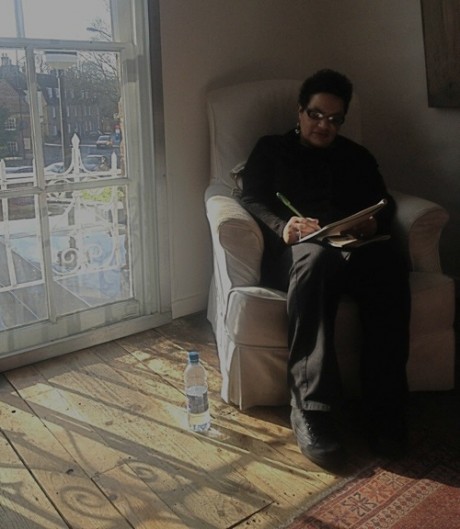
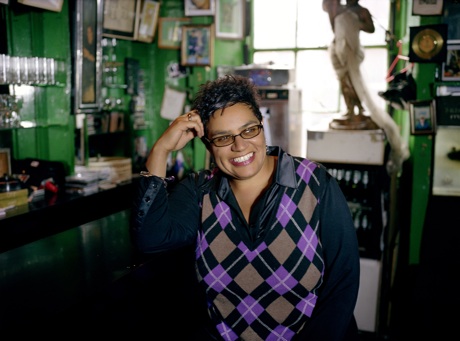
the wonderful poet and writer Jackie Kay has been with us for a week getting to know the House and collection and leading writing workshops with a group of young people. She will be writing a new poem inspired by Kettle’s Yard which will be revealed in early May. A couple of weeks ago we had lunch together at the Punter – the nearest pub to Kettle’s Yard.
I have been reading her most recent poetry collection ‘Fiere’ (Picador Poetry). She put up with me enthusiastically chatting and asking about particular poems. I do think they are very special. They have a human warmth, a way of looking at the world and a beat that catches you and draws you in.
This is an extract from ‘Black River’. Jackie told me she was due to speak at a festival in Jamaica and stayed up to 3am the night before writing the poem. The next day she read it out to 2000 people who gave her a standing ovation as they clapped and cheered. It was a poem about their river.
‘Wherever we were, wherever we came from:
a black river running through our arteries,
a black river putting our hearts at ease,
a black river touching our skin like a lover,
a black river to remind us of our ancestors,
running through the swamps and secret marshes
when freedom was a belief the river rushes
passed along the dark water like a breeze.’
Jackie said she was loving spending time at Kettle’s Yard. ‘It incurs a new way of thinking‘ Even lunch looks different! Plaice with capers and raisins – an unusual combination. She has been sitting in the ‘Dancer Room‘ in the House, noticing the shadows the sculpture casts, reminding her of a Hitchcock movie.
Jackie will be back with us in a few weeks. Her reading is booked up but we will be live streaming the event – so you can still experience the evening, you will be able to find the live stream
here
on 14 March from 8pm. For regular Thresholds updates go to
www.thresholds.org.uk
.
Gemma Melton
/ OUTPOST Artist in Focus / Wednesday 27th February
Outpost, from Norwich, will be the next artist-led space taking over the gallery for ‘Congratulations you are the most recent visitor’, 1 March – 14 April 2013. Gemma Melton is one of the artists who will be in the exhibition and here she tells us more about her work and what we can expect at Kettle’s Yard.
I studied Fine Art at Norwich University College of the Arts (2009-2012) and live and work in Suffolk. I make large installations by arranging material components into numerous and often infinite positions.
I use materials more commonly found on building sites, from bricks, wood, metal, rubber and steel to cardboard and plastic. The materials are used to address architecture in the everyday from construction sites to playgrounds.
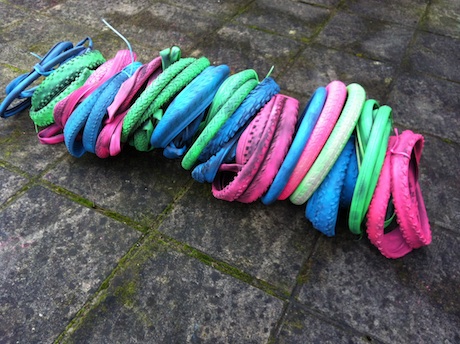
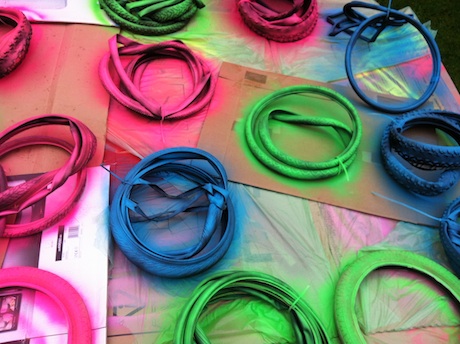
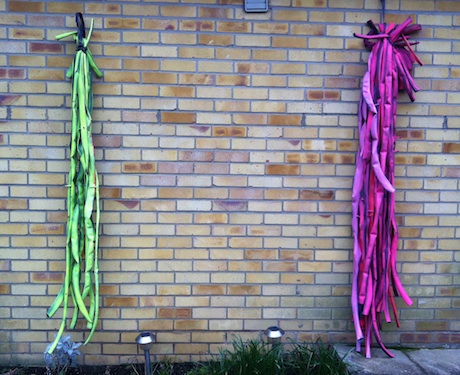
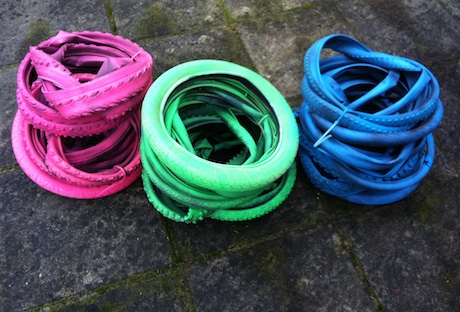
The site-specific work that I am making for Kettle’s Yard uses colour as a form of decoration and disguise. I managed to acquire a huge box of inner tubes and tyres, making reference to the cycling in Cambridge. I then went out to change these using spray paint. Working with rubber is something I am familiar with having cast inner tubes from aluminum and using robust car tyres for a sculpture at
The Forum
in Norwich for Material Worlds, 2011.
For this exhibition I hope to utilize the courtyard space, touch on Cambridge as a location and draw on the house at Kettles Yard and the importance of the light and the arrangement of the furniture and objects within.
It is a privilege to have been asked to participate in this exhibition and I hope that the audience will find my work visually interesting as it is the shapes, materials and forms that I am concerned with. The work will undoubtedly deteriorate being outside for a long time. However this makes the work quite ephemeral and I am interested in this change.
Iain Paxon
/ Temporary Residence Artist in Focus / Monday 25th February
Iain Paxon enthralled and enchanted his audience at the opening of Temporary Residence with his performance of
Prince Volume
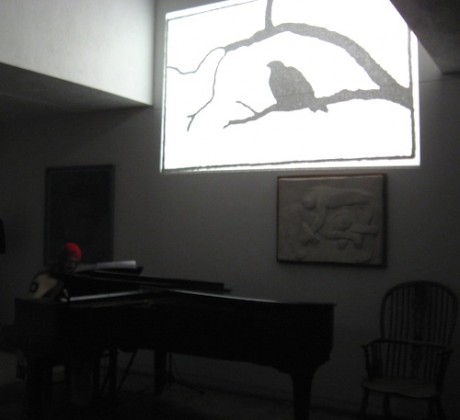
in a packed Kettle’s Yard House. Last Friday Paxon returned again to perform Bird Boy, a fantastic tale of dark magic and misplaced love with musical accompaniment and slide projections, performed as part of
The Practice Sessions
…
Sequences of tiny silhouette drawings are enlarged by the clunky magic of the slide projector, bringing up close the cack-handed, stream-of-consciousness tale-telling of the writer. Accompanied by solo piano, songs and narration, these are two quietly epic stories of lost souls and social misfits: a prince without a palace in search of what might be; and a half-bird/half-boy destined for a life of exclusion. Come and watch for yourselves as they travel up and down the ladders of human emotion, conundrums unfolding, and perhaps learn a lesson from these unfortunate characters.
~ Iain Paxon
The Temporary Residence exhibition has now closed but you can find out more about Aid & Abet
here.
Let us know what you thought of the exhibition as we love to hear from you.
Why not also look back at our other ‘Artist in Focus’ post featuring the Temporary Residence artists.
The next
Practice Sessions
will be hosted by
OUTPOST
, an artist-run space from Norwich, alongside their exhibition ‘Congratulations you are the most recent visitor’, find out more
here.
Rosanna Greaves
/ Temporary Residence Artist in Focus / Thursday 21st February
‘So Few People Look into Darkness and Find its Light’ is a site specific sound installation in the Courtyard outside Kettle’s Yard. Below Roseanna Greaves shares more about the work and highlights the key themes important in her work.
‘So Few People Look into Darkness and Find its Light’ brings together two texts. The first is taken from a government report warning of the potentially detrimental effects of shadow flicker; a common complaint made by people living near wind-farms that at certain times of day the position of the sun behind the turbine creates a flickering shadow. The second text takes extracts from Jim Ede’s writing on the way natural light floods and animates the architecture and objects of Kettle’s Yard House, with the inverse intention that the movement of light and shadow will create a harmonious aesthetic experience for the viewer. Key themes in my work are environmentalism, the deconstruction of language and slippages of meaning. I have been working with sound as the primary medium of my work for many years, considering both its sculptural and narrative potential.
Martyn Cross
/ Temporary Residence Artist in Focus / Wednesday 20th February
Martyn Cross’ work present intriguing and fantastic dystopian portraits made from knitting patterns. The uncanny nature of these collages have struck a chord with the school groups coming for sessions at Kettle’s Yard. They have taken inspiration from his ‘vandalised’ knitting patterns and created there own (you can see the results
here.
) Here are a few words by Martyn himself about his work.
Since 2007, I’ve been producing intricate paintings and collages of unique individuals populating an unnamed, yet strangely recognisable world. This dystopia was first investigated through various acts of vandalism – over-painted or collaging the utopian vision of knitting pattern images so that an alternate world emerged. My birth town of Yate in Gloucestershire has always acted as stimulus to the work: the boredom, the eccentrics and the quest to escape suburbia are all vital in producing an ‘assembly of the damned’.
Richard Proffitt
/ Temporary Residence Artist in Focus / Monday 18th February
Richard Proffitt’s
Louisiana Blues, Anywhere
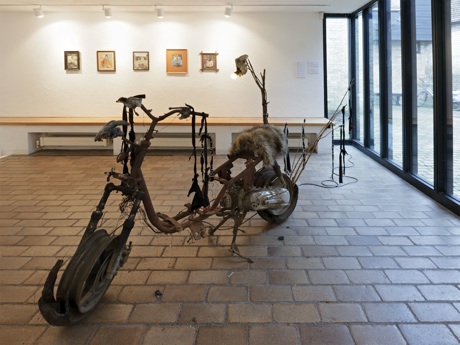
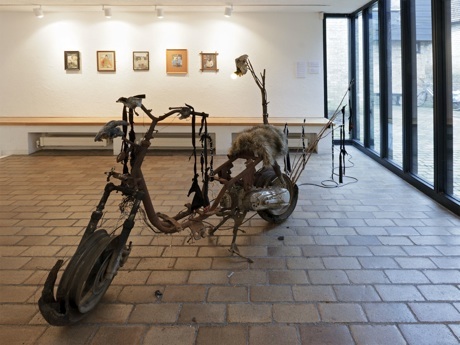
has garnered much interest from visitors to our Temporary Residence exhibition, intrigued by the relic-like carcass of a moped with sheep skulls, branches, light bulbs and burnt cloth. Here Richard explains more about his work.
I am inspired by the histories and fiction that become attached to landscapes, objects and cultures. I am interested in hippie and punk sub-culture, ancient civilisations, wilderness, wastelands and docklands, travellers and drifters, post-apocalyptic fiction, and the art of indigenous people. Within my work, I aim to make connections and find resonance between these disparate subjects. My work is often realised as sculpture and installation, reminiscent of makeshift ceremonial relics and ritualistic hangouts that evoke hybrid cultures and belief systems.
Sean Vicary
/ Temporary Residence Artist in Focus / Sunday 17th February
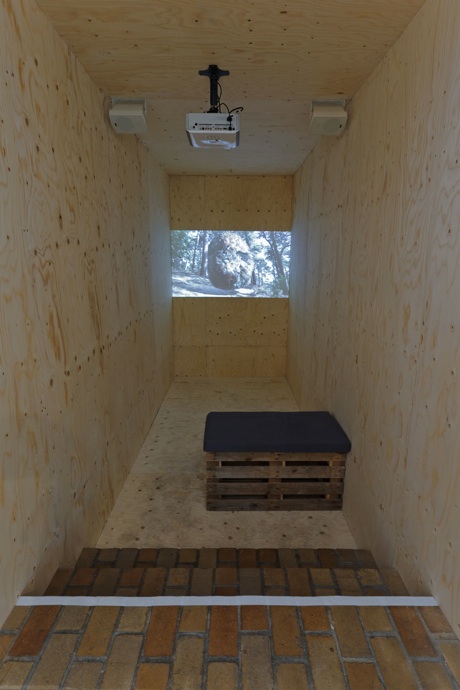
Sean Vicary’s work in the Temporary Residence show sits in a specially made alcove within Kettle’s Yard gallery. Take a moment to sit and watch this beautiful animation unfold through a 7th Century Welsh poem and a selection of found objects. Speaking about memory, language, landscape and belonging the film is really worth seeing in this intimate setting.
‘Lament’ draws on my own subjective experience of landscape, specifically the Wales/Shropshire border where I grew up. It was the death of my Father that prompted a return to my childhood home and a re-evaluation of these surroundings. The film combines bilingual fragments of spoken work, site specific recordings and elements of traditional music to achieve a dynamic synergy between sound and image. The oral source material is taken from sections of the 7th Century Welsh poem cycle, Canu Heledd. This particular lament describes the silence and ruin of Prince Cynddylan’s home after his death. My work is primarily concerned with ideas of internal and external ‘landscape’ and our increasingly politicised interaction with the ‘natural’ world. I use found objects and fragments of detritus to explore this relationship.
~ Sean Vicary
www.seanvicary.com
You can follow Sean on Twitter
You can hear Sean speak wonderfully about ‘Lament’ in an interview given to Flack Magazine at the opening of Temporary Residence. Listen
here.
Annabel Dover
/ Temporary Residence Artist in Focus / Friday 15th February
During the Temporary Residence exhibition Annabel Dover is working in the Kettle’s Yard House every Wednesday from 2-4pm. Annabel explores the social relationships that are mediated through objects. She has spent time in Kettle’s Yard exploring the house, its objects and intriguing stories. Annabel is also keeping a blog to accompany her residency, which you can read
here.
It is really fascinating to discover in her posts the connections and narratives she draws between the stories and objects from Jim and Helen Ede’s time at Kettle’s Yard and her own history and experiences – a really lovely read.
With Annabel often working in silverpoint here is what she says -
Silverpoint is a form of drawing that was popular in the 1400s. A silver stylus marks the gesso surface and creates an image. The drawing darkens as the silver tarnishes. My drawings focus on objects that have personal stories attached to them, real or imagined.
Lisa Wilkens
/ Temporary Residence Artist in Focus / Thursday 7th February
Lisa Wilkens is the second artist our Artist in Focus series, part of the Temporary Residence exhibition with
Aid & Abet
. Find out more about Lisa’s work below.
My work is fundamentally based in drawing with a particular interest in portraiture, its limitations and possibilities. Recently, I have developed a series of ‘prevented portraits’ dealing with the political aspects of recognition and resistance, identification and identity. I draw images on lithographic stones, based on historical photographs that I find online. Using old paper collected over the years, I take prints from these stones.
Kevin Hunt
/ Temporary Residence Artist in Focus / Friday 1st February
Find out more about Kevin Hunt’s sculpture which features in our current exhibition Temporary Residence until 24 February 2013.
I construct sculpture using found, redundant objects that often go unnoticed, particularly furniture that is reconfigured into increasingly minimal works, either balanced or propped precariously. Placed in fragile equilibrium, these structures are further destabilised through transformative processes such as burning and saturating in ink. By irreversibly altering these things and simultaneously raising their status to art, the work attempts to question what it is to be an object in the world and how it comes to exist as sculpture.
Everything’s coming up poetry
/ Thresholds and Walking with Women / Wednesday 23rd January
The last few days have been a feast of poetry for Kettle’s Yard. On Friday, the amazing poet Jackie Kay made her initial visit to us to plan her residency as part of the
Thresholds
project (each University of Cambridge Museum has a poet in residence for two weeks and will be running young people’s workshops and giving talks – go to
www.thresholds.org.uk
for more information). It was a total treat to show Jackie around the house and collection. As you would expect of a poet, her use of language to capture her first responses to the artworks and objects was thrilling. We are very much looking forward to hosting her during the half term in February and for a second week in March – she will be co-leading a young people’s project with artist Filipa Pereira-Stubbs.
On Monday night, I was lucky enough to attend the launch of Walking with Women – an evening of poetry readings by an incredibly talented group of poets. The Walking with Women tour was devised by Shape East’s Learning and Participation Coordinator, Hollie McNish, in association with poetry organisation
Page to Performance
. The tour aims to engage new audiences with the built environment by combining architecture, spoken word, illustration and history and provides an imaginative guide to the often-forgotten female tales locked within the city’s buildings and public spaces. Included in the tour is a fabulous poem about Helen Ede, written by Hollie. For more information click
here
. You will never look at the lemon the same way again…
Temporary Residence
/ First look / Monday 21st January
Temporary Residence opened on Friday 11 January with a packed gallery of visitors eager to get a first look at the exhibition and to see a performance of Prince Volume by artist, Iain Paxon.
The excitement and support in Cambridge for its flourishing art scene was noted by Ruthie Collins in her
article in the Guardian
, and indeed this fantastic opening event really reflected the support in Cambridge for its art spaces and especially toward such collaborative projects. The exhibition runs until 24 February 2013 and we have a great array of events programmed around it. Find out more
here
.
Temporary Residence is accompanied by a wonderful essay, ‘The Power of Artists’ by Chris Brown. You can pick up a copy at the exhibition or read it online
here
, AND for a sneak peek at the show you can see some exhibition shots on our
Flickr
page.
Aid & Abet: an introduction
/ Video / Monday 14th January
Artist and co-founder of Aid & Abet, David Kefford, speaks about the artist run space in Cambridge and about plans for Temporary Residence at Kettle’s Yard.
You can find out more about Aid & Abet by visiting their website
www.aidandabet.co.uk
University of Cambridge Museums
/ Connecting Collections / Friday 11th January
Kettle’s Yard
is delighted to be one of the eight museums that make up the
University of Cambridge Museums
(UCM) which is collectively an
Arts Council England
Major Partner Museum. We are one of sixteen museum services to have successfully bid in open competition for a share of £20m to be used between 1 April 2012 and 31 March 2015. We have called the programme Connecting Collections to reflect the twin aspirations of connecting with our audiences, and connecting with each other across museums. There is a brand new
UCM blog
, with lots of news about Connecting Collections:
http://camunivmuseums.wordpress.com/
We are very excited about two current projects in the Connecting Collections strand. Firstly, we can’t wait to start working with Jackie Kay, the poet assigned to Kettle’s Yard as part of Thresholds. Carol Ann Duffy, Poet Laureate selected poets to work with each of the University of Cambridge Museums. Get to know more about Jackie Kay
here
where you can listen to an interview with her.
Keep up to date with the Thresholds project on the
website
which is growing all the time.
The second project we are developing at the moment is House Guests. The seven Directors of the other university museums have been invited to select a work from their collection in collaboration with Kettle’s Yard Artist Fellow
Jeremy Millar
. The objects will be displayed in the House at Kettle’s Yard from the end of March. As part of this project we are working with students from the Critical Writing Programme at the
Royal College of Arts
.
It’s the first
CASTLE HILL OPEN DAY
! Saturday 22 September, 2012, 12-5pm, all day free event
CAMBRIDGE & COUNTY FOLK MUSEUMCASTLE MOUNDKETTLE’S YARDST GILES’ CHURCH ST PETER’S CHURCH
Highlights include free entry to all attractions, free family friendly talks, tours and activities led by some of the best local experts, music and the unveiling of a blue plaque for Jim Ede, founder of Kettle’s Yard by the Deputy Mayor of Cambridge.
Five historic and cultural venues in the unique Castle Hill area of Cambridge are joining forces to present the first ever Castle Hill Open Day. Packed with activities, talks, tours, music, family drop in activities, refreshments and picnic areas. There is something for everyone to enjoy. The day will culminate in the unveiling of a Blue Plaque for Jim Ede, founder of Kettle’s Yard by Deputy Mayor Councillor Paul Saunders.
All venues will be free to visit for the day including the two unique collections at the Folk Museum (normally has an admission fee) and Kettle’s Yard, the historic church of St Peter’s with an art installation by Lorna Macintyre, St Giles’ Church and Castle Mound.
Andrew Nairne, Director of Kettle’s Yard said
Castle Hill is a beautiful and historic part of Cambridge. We are delighted, alongside our partners at the Folk Museum, St Peter’s and St Giles’ churches and Castle Mound, to present the first ever Castle Hill Open Day. By opening our doors to all we hope to welcome in new visitors as well as old friends. From music to contemporary art and Roman Cambridge to social history there’s a rich variety of attractions and events on offer. We hope whole families will come and spend the day here – bring a picnic (we have a wet weather option!), explore the venues and collections and enjoy everything on offer. We want to celebrate the variety of history, heritage and art in this corner of the city – please come and join us.
History:
The Castle Hill area of Cambridge is where the city began in Roman times. The Roman city of Duroliponte was located in this area and there is even evidence of some pre-Roman activity. The 17th Century timber framedbuilding that contains the wonderful and varied collections of the Folk Museum is next to Kettle’s Yard, itself a beautiful building that houses one of the UK’s most remarkable collections of 20th century art. Opposite Kettle’s Yard is St Peter’s, a simple, tiny church with an elegant spire. Originally built in the 11th Century and with Roman tiles in its walls, it is now cared for by the
Churches Conservation Trust
. On the other side of Castle Street is St Giles’ an active church with a history going back to 1092. A short walk up the road is Castle Mound, the site of Cambridge Castle which played an important role in the Civil War, refortified by Oliver Cromwell in 1642. It is now cared for by Cambridgeshire County Council. Returning to the present day, the Folk Museum and Kettle’s Yard run lively programmes of events relating to social history and to contemporary and modern art.
On the day:
Events will run throughout the day with both timed and drop in activities. The Open Day will begin with an opening prayer in St Peter’s Church by Reverend Dr Janet Bunker and music by Clare Finnimore, principal violist of
Britten Sinfonia
.
Confirmed events include the following.
Allan Brigham
, famous local historian, Blue Badge Guide and former road sweeper will give tours of the area and up Castle Mound. Peter Aiers, Head of Regeneration at the
Churches Conservation Trust
and Honor Ridout, Blue Badge Guide and local historian will speak about
St Peter’s Church
. Roman Cambridge will be explored in talks by Alison Dickens of the
Cambridge Archaeological Unit
, Cambridge University. There will be a variety of drop-in family activities led by artists from Irregular Circle. The archivist at Kettle’s Yard, Dr Claire Daunton will be on hand in the house with a selection of letters from the
archive
for visitors to look at. Artist Lorna Macintyre whose work Nocturne is currently on display in St Peter’s Church will be in conversation with Kettle’s Yard curator Lizzie Fisher.
Editors Notes
In the evening:
Unveiling of a Blue Plaque for Jim Ede, founder of Kettle’s Yard From 5.45pm – short speeches by John Durrant, Chairman of the Cambridge Blue Plaque Committee and Duncan Robinson, Master of Magdalene College, Chairman of the Folk Museum and friend of Jim Ede. Deputy Mayor, Cllr Paul Saunders will unveil the plaque.
The full schedule will be available here: http://www.kettlesyard.co.uk/openday/
The Open Day is supported by
Tees Solicitors
.
For images, to arrange interviews and for further information please contact Susie Biller,
, tel
Watch Associate Artist Matei Bejenaru speak about preparations for his work currently on show at Kettle’s Yard, in the gallery until 23 September, plus plans for future projects.
Matthew Darbyshire speaks about his preparations for the Associate Artists show at Kettle’s Yard. See his work alongside Matei Bejenaru, Lorna Macintyre and Jeremy Millar in the gallery until 23 September 2012.
The
Villa Müller
in Prague was designed by Adolf Loos for Milada and Frantisek Müller, and is now considered one of the foremost examples of domestic Modernist architecture. The villa uses Loos’ original spatial conception, the
Raumplan
, to create a spiraling of rooms, from the public to the private, drawing upon both modern Functionalism and a more classical English style.
For all their obvious differences, the buildings that make up Kettle’s Yard share with
Villa Müller
certain characteristics: the visual joining of different levels; a separation of gendered spaces; perhaps, more than anything else, an attempt to create a domesticated Modernism. Both houses are exceptional examples of such an endeavor.
In an attempt to bring to light the affinities between these two places, a female cone of a
Pinus nigra
was taken from the garden of the Villa Müller in the spring of 2012, to be placed in the house of Kettle’s Yard. The pine-cone’s placement was suggested by the year of the Villa Müller’s completion — 1930 — and so it can now be found beneath an appropriate
nature morte
painting, Christopher Wood’s
Flowers
, which was completed in the same year.
View from St. Peter's church of Kettle's Yard, Lorna Macintyre, 2012
Lorna Macintyre
/ Digital sketchbook / Tuesday 10th July
Check out the
digital sketchbook
Lorna has begun, to document her working process and thoughts in connection with Kettle’s Yard. She will be adding to this regularly over the coming months. You can find out more about our associate artist Lorna Macintyre
here
.
Lorna will have a new show,
Nocturne
, on in St Peter’s Church (next to Kettle’s Yard) from 1 Sept – 23 Sept.
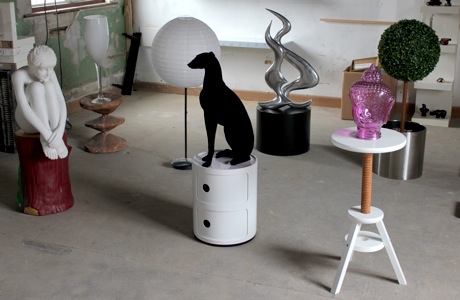
Matthew Darbyshire, selected works in his studio, 2012
Matthew Darbyshire
/ Sneak peek / Tuesday 10th July
Matthew Darbyshire
has just sent us photos of new works just finished in his studio. They’re waiting to be collected for the
show
at Kettle’s Yard which opens on Saturday.
Take a look at a review of the show from the
Frieze Magazine blog
.
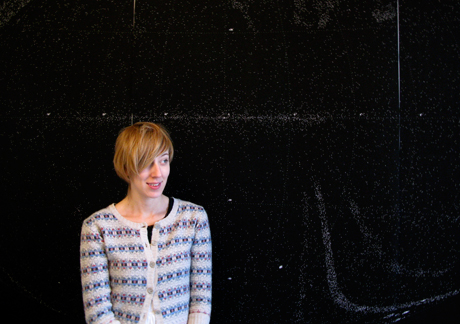
Lorna Macintyre (1977, Glasgow) uses a diverse range of materials and techniques in her work, from ferric ferricyanide crystals or marine coral to sun and moonlight. Her photographs, cyanotypes and installations also draw on a wide range of references, from psychology, surrealism, symbolism and literature, and she often takes literary sources as a departure point. Macintyre’s work could be described as giving concrete form to literary images; previous works have explored the work of authors as diverse as TS Eliot and Apollinaire, from William Carlos Williams, Fernando Pessoa and Jorge Luis Borges to Virginia Woolf. Her intuitive approach combines personal and collective iconography, exploring formal associations or the personification of objects, and allows both chance and design to inform the creative process. Macintyre is currently working on the second part of a collaborative project with Anthea Hamilton and Rallou Panagiotou, entitled One Person’s Materialism Is Another Person’s Romanticism (a title borrowed from the writings of the American sculptor Robert Smithson), to be staged in Glasgow as part of Glasgow International 2012.
Macintyre has taken part in group exhibitions at the Gallery of Modern Art, Glasgow (2011), Museum Ludwig, Cologne, the Austrian Cultural Forum, New York and Talbot Rice Gallery, Edinburgh (all 2010) and Akureyrar Art Museum, Iceland (2007). Recent solo exhibitions include ‘Granite and Rainbow’ at Wiels, Brussels, and at Kunsthaus Baselland, Basel (2010), Nought to Sixty at the Institute of Contemporary Art, London (2008). She has also undertaken artists’ residencies at CCA Andratx, Mallorca (2010), Dumbreck Marsh Art Project (2005) and Cultural Centre De Zeyp, Brussels (2000). She currently lives and works in Glasgow.
Untitled (Self-Portraits), 2008, Two Colour Photographs
Jeremy Millar
/ Kettle's Yard Associate Artist / Monday 2nd July
Some visitors to Kettle’s Yard may recognize Jeremy’s name as he curated the John Cage exhibition in 2010. More information about that show
here.
Jeremy was also involved in this year’s event at Kettle’s Yard for Museums at Night on 17 May, 2012.
Biography
Jeremy Millar (b. 1970, Coventry) changed the landscape of contemporary artistic practice when he organized an exhibition entitled The Institute of Cultural Anxiety at the Institute of Contemporary Art in 1994. Turning curatorial conventions on their heads, he brought together such disparate exhibits as works by Hieronymous Bosch and Jeff Koons and the helmet worn by Donald Campbell on his ill-fated attempt to break the Water Speed Record. In taking on the spaces and conventions of display, he claimed new territory for artists, and inaugurated a new form of artistic practice: curating as art.
The Institute of Cultural Anxiety also set out certain themes and ideas that he has continued to explore since then, through films, photographs, sculpture and installations, writing and exhibitions: the assemblage-like nature of collections; the making of exhibition and other forms of display; the relationship between art and non-art objects; and the creation of imaginary conceits with which to structure a work.
Millar is currently working with the Museum of Barnstaple and North Devon, composer Sophie Sirota, and local young people to create a theatrical event and film work exploring the people, ideas and practices behind Barnstaple’s Literary and Scientific Institute.
Millar’s writings on art have been published widely. He teaches regularly at the Royal College of Art and is a member of the editorial board of the journal
Afterall
. He has been the recipient of fellowships from Nesta, the Arts Foundation, and from 2007 until 2010 was AHRC Research Fellow in the Creative and Performing Arts at the Ruskin School of Drawing and Fine Art, University of Oxford. Millar has exhibited widely in the UK and abroad including Tramway, Glasgow; NGCA, Sunderland; CCA, Vilnius; Rooseum, Malmö and Bloomberg Space, London. A permanent public work was installed in Folkestone in 2006. A monograph on his work, Zugzwang (almost complete), with an essay by Brian Dillon, was published in 2006. He is based in Whitstable, Kent.
Katie Paterson
/ artist in residence at the Wellcome Sanger Institute / Monday 2nd July
“I am an artist often working with scientists in my exploration of time and the evolution of nature and the cosmos by way of moonlight, melting glaciers, and dead stars. I am like a magpie, collecting and piecing together ideas from a multitude of places. The imagination always plays a key role.” Katie Paterson
Katie’s conceptual projects make use of sophisticated technologies and specialist expertise to stage intimate, poetic and philosophical engagements between people and their natural environment. While in residence, she will be exploring genomics research. The outcomes of her residency will include an exhibition at
Kettle’s Yard
in Spring 2013.
Katie Paterson will begin her residency in July 2012.
Scottish artist Katie Paterson (born 1981) is an emerging talent in the world of art. Her conceptual projects make use of sophisticated technologies and specialist expertise to stage intimate, poetic and philosophical engagements between people and their natural environment. Since graduating from the Slade School of Art in 2007 she has gone on to exhibit internationally, from London to New York, Berlin to Seoul, and her works have been included in major group shows at Tate in London, and Vienna’s Kunsthalle. Her artworks are represented in collections such as the Guggenheim New York and SNGMA Edinburgh.
Find out more about Katie from
Katie’s site
You can watch the artist’s ’100 Billion Suns’ video below
Matthew Darbyshire
/ Kettle's Yard Associate Artist / Monday 2nd July
Biography
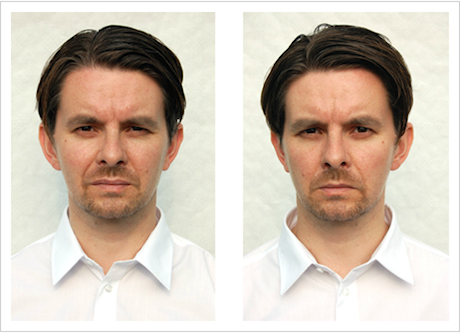
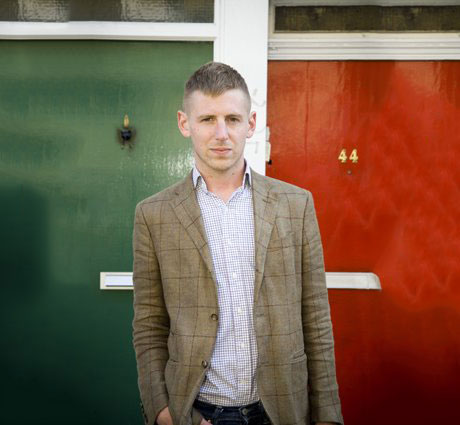
Matthew Darbyshire (1977, Cambridge) studied at the Slade under the acclaimed British sculptor Phyllida Barlow, alongside other rising British talents Spartacus Chetwynd and Pablo Bronstein. Darbyshire is best known for installations that draw heavily on the aesthetic language of today’s commodity culture and the aspirational lifestyles it promotes. He is interested in the fact that bright CMYK dots are the logo for an estate agent and a cinema, as well as a NHS walk-in centre; that Arne Jacobsen egg chairs can be found in London’s Zetter boutique hotel as well as in recently rebranded McDonald’s restaurants. He explores design as a barometer of social change within the complex visual environment of contemporary Britain.
Darbyshire’s work has been included in recent exhibitions at the Miro Foundation in Barcelona, Turner Contemporary in Margate, (both 2011). He was included in The British Art Show 7 and Newspeak at the Saatchi Gallery (both London, 2010), and Altermodern: the Tate Triennial at Tate Britain (London, 2009). Darbyshire has also had a string of solo exhibitions in London in recent years: at Gasworks and as part of the Nought to Sixty programme at the Institute of Contemporary Art (both 2008), Hayward Gallery Project Space (2009) and Frieze Projects (2010). His largest public exhibition to date, T Rooms opened in January 2012 at Tramway in Glasgow.
In 2010-11, Darbyshire was the Stanley Picker Fellow in Fine Art at Kingston University, London. He teaches regularly at the Ruskin School of Art, Oxford and is based in Rochester, Kent.
Matei Bejenaru
/ Kettle's Yard Associate Artist / Monday 2nd July
Biography
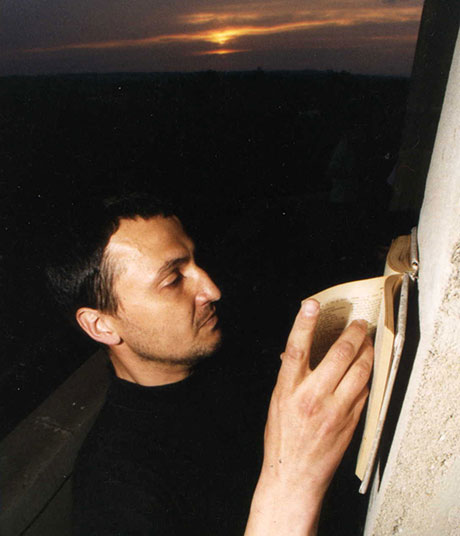
Drawing particularly on his own experience of postcommunist life, Matei Bejenaru (b. 1963, Suceava, Romania) is interested in how historical, socio-political and cultural contexts shape everyday life and dictate the conditions of artistic practice. His poignant and poetic work often brings different artistic languages together; it can take the form of a travel guide to the UK for illegal Romanian immigrants (Travelling Guide, 2005-2007) or a modernist interpretation of choir music. Songs for a Better Future (developed in collaboration with composer Will Dutta and premiered at the Drawing Room and Tate Modern in London in 2010) draws on musical themes from proletarian choir songs to electronic music of the 1970s.
Bejenaru works and exhibits internationally, including recent projects at the Tirana Biennial (2003), Thyssen-Bornemisza Contemporary Art, Vienna (2006), Tate Modern, London (2007), the Taipei Biennial 2 (2008), The Drawing Room, London (2010), Glasgow School of Art and The Western Front, Vancouver (both 2011). He is based in Iasi, Romania, where he established the Periferic Biennial (http://www.periferic.org/) in 1997, initially a performance festival and now an international art event. He is also a founding member of the Vector Association, which promotes contemporary art in local contexts.
Bejenaru teaches photography and video art at the ‘George Enescu’ Art University, Iasi, and is currently Visiting Professor in visual arts at the University of Quebec in Montreal, Canada.
You can watch the artist discuss his travel guide at Tate Modern
here
.