Christopher Wood
/ a Kettle's Yard Publication / Thursday 19th September
For those who enjoyed our
Christopher Wood exhibition
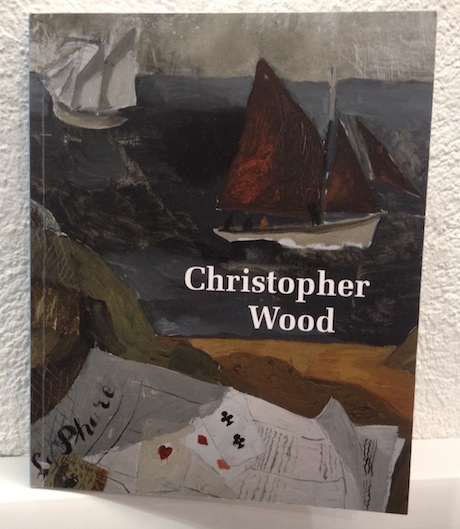
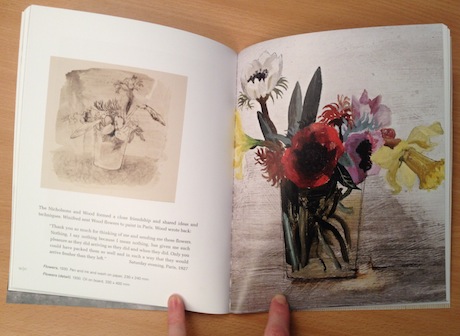
, a new Kettle’s Yard publication telling the story of Wood’s life through his works at Kettle’s Yard is now available in our gallery shop for £12. Research Assistant for the exhibition and publication, Jane Morgans, tells us about the research process and what is was like delving into the Kettle’s Yard and Tate archives to discover more about Wood.
Christopher Wood is an important figure for British art in the 1920s. He rushed off to Paris at the age of 20 and found influence in the avant-garde artists of the day, such as Picasso and Jean Cocteau. It was a busy, chaotic life; his great energy, charismatic personality and fall into opium addiction tell a fascinating story.
To start my research I delved straight into the Kettle’s Yard Archive. Here I found letters from Christopher Wood to Jim Ede, arranging dates to meet in London. There were catalogues of Wood’s exhibitions and newspaper articles, images of his work, as well as some more personal items. These were made up of playing cards (including the ones depicted in
Le Phare
), a monogrammed pocket from a shirt owned by Wood which was even worn by Ede, as well as some stylish calling cards marked KIT WOOD in small, concise lettering. Jim Ede collected these items after Wood’s death in 1930.
Wood met Ben and Winifred Nicholson and Jim Ede in 1926. His letters are housed in the Tate Archive and so this is where my research took me next. The boxes contained not just letters but also
order generic cialis
memoirs of Kit written by his friends, a report from a private detective detailing Wood’s last movements from Paris to England and photographs of Christopher Wood at the Nicholson’s home, Bankshead. Through this material it became clear that Wood is a vital link between Jim Ede, Ben and Winifred Nicholson, Alfred Wallis and Kettle’s Yard.
Lastly through my research, I was asked to find provenance information for Christopher Wood’s works at Kettle’s Yard. It has definitely been a game of deduction. Jim kept very little records of his collection and so I searched through catalogues, diaries and letters to find out more. It is clear that Ede gathered most of the works from Wood’s house, when he assisted to clear his affects, although he was given some works by the artist himself. There was even a mystery painting we now know Jim took with him to Edinburgh when he left here in the 1970s. It was a complex process, and there are still some uncertainties. However when we look at the collection of works, we can see how astute Ede was, leaving Kettle’s Yard with a great array of Wood’s pieces, from his early sketches, through to his later, more complex paintings.
All these fragments piece together to form a journey; a life of a young artist, who proclaimed at the age of 19 that he wanted to be ‘the greatest painter that ever lived’.
~ Jane Morgans, Christopher Wood Exhibition and Publication Research Assistant
The publication is available to buy in our Gallery shop or online for £12 or call us 01223 748100.
On Not Knowing
/ How artists think / Friday 6th September
Lizzie Fisher is taking part in a
panel discussion
alongside Sarah Cole, Rebecca Fortnum, Ian Kiaer and Neal White at the
Whitechapel Gallery
on Sunday 15 September, 2-3pm, as part of the
London Art Book Fair
. The panel will be asking ‘How far does our openness to aesthetic experience and new forms of knowledge depend on our capacity to enter into states of wonder, doubt, ignorance and play?’, exploring how artists use strategies of ‘not knowing’ and discussing whether engaging with the unknown is a critical component of the creative process. The panel discussion is in association with the book
‘On Not Knowing’
edited by Fisher and Fortnum from
Black Dog Publishing
.
You can find out more about the event
here
, with the book available to buy online
here.
There has never been a greater time to give to Kettle’s Yard
/ Donations / Tuesday 13th August
In 2012 we were delighted to be successful applicants to Arts Council England’s Catalyst funding stream.
Catalyst offers an exciting one-off opportunity to boost our fundraising efforts. Throughout the Catalyst period (2013-2015) the Arts Council will match fund donations from individuals.
All gifts large and small really will make a difference. For example a gift of £25 a month for a year (£300) with the addition of the matched funding provided by the Arts Council and gift aid will be worth £675 to Kettle’s Yard. Support at this level could fund two workshop leaders for 6 education sessions with local schools or support the development of family activities related to the House or an exhibition. See what else your donations can
support
.
As part of Catalyst, Kettle’s Yard will also be introducing a new supporters group, named in honour of Jim Ede. We wish to celebrate his extraordinary philanthropy in donating Kettle’s Yard to the University of Cambridge. The Ede Circle recognizes all those who have pledged a regular commitment of £500 (£41.60 a month) or over in a year to any area of Kettle’s Yard’s activity. In recognition of their significant commitment, members of the Ede Circle will be entitled to VIP invitations to events both at Kettle’s Yard and further afield. Find out more
here
.
If you are interested in making a donation to Kettle’s Yard, please click
here
for more information or contact
with any questions.
House Guests
/ a collaboration with students from the Royal College of Art / Friday 19th July
By the end of July our ‘
House Guests’
, objects and artworks from eight
University of Cambridge Museum’s
that have been carefully chosen and placed amongst the objects in the house, will be leaving Kettle’s Yard. If you haven’t been to see them yet, head down to the show before it closes on the 28 July. It has been a wonderful exhibition and we will be sad to see them go back to their respective collections. Alongside the exhibition is a publication created in collaboration between
Jeremy Millar
, Kettle’s Yard Associate Artist, and students from the
Critical Writing in Art and Design programm
e at the R
oyal College of Art
. Here
Jessie Bond
, RCA student, tells us more about the project.
The brief for the House Guests publication was relatively straightforward; eight of us were paired with one of the participating Cambridge University Museums to write a response to their chosen object and an interview with the Director of the museum. Alongside this, two students opted to focus on previous artist interventions in the cottages of Kettle’s Yard.
The project arose through one of our tutors Jeremy Millar, who is currently an Associate Artist at Kettle’s Yard. On the course there is a strong emphasis on finding a place for our writing to exist outside of the classroom. From responding to the initial brief through to working with the editors, taking part in this project was a fantastic opportunity to experience every aspect of writing for a “live” publication.
Photo by Jessie Bond
We visited Kettle’s Yard in February, to be fully briefed on what was expected from our writing by the team working on the project. For those of us who had not visited Kettle’s Yard before this was a chance to experience first hand the unique atmosphere created by the diverse collection of objects and artworks on display. This trip provided inspiration for our texts and enabled us to imagine how the houseguests might sit in their temporary home.
Photo by Jessie Bond
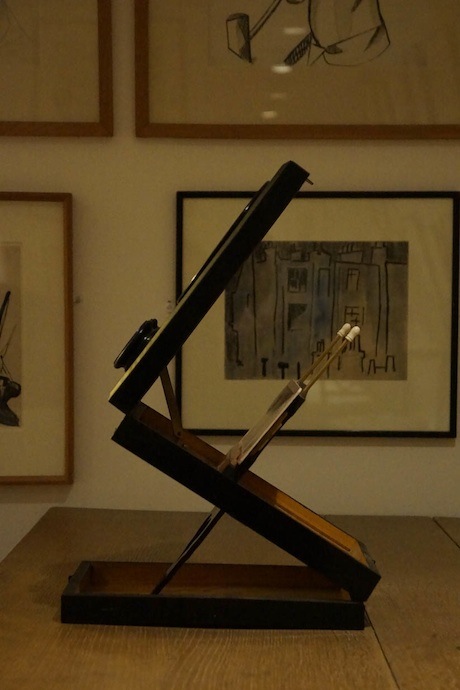
Back at the RCA we discussed potential questions for the interviews and decided upon a uniform format that would improve the readability of the publication. We established that the aim of the interview was to provide contextual information about the selected objects, whereas the shorter texts were a chance for a more personal response. In conversation with Jeremy we decided who would write about each object, based on our individual areas of interest and expertise. For me, it seemed an obvious choice to write about the Stereoscope from the
Whipple Museum
of the History of Science, as I have a particular interest in photography. Recently I have become increasingly interested in writing about visual technologies that alter the way we think about what we see.
Photo by Jeremy Millar
I found the process of interviewing Liba Taub, director of the Whipple Museum very informative; it was great to find out more about the object and their reasons for choosing it for the project. When writing the short text about the stereoscope my aim was to encourage viewers not just to look closely but also to interact with the object, whilst drawing out connections with the history of Kettle’s Yard.
Writing about Kettle’s Yard is a daunting task as the carefully preserved curatorial approach initiated by Jim Ede speaks best for itself. Often the most rewarding visit occurs when you are left to your own devices to explore. As writers the challenge was to provide a context for the interventions in the cottages without being didactic, instead hoping to inspire the visitors to make their own links and discoveries. Throughout the project I felt privileged to join the long tradition of students who have benefitted from Jim Ede’s legacy at Kettle’s Yard.
~ Jessie Bond
Find out more about House Guests
here
. The exhibition runs until 28 July in Kettle’s Yard house, open 1.30 – 4.30pm Tuesday – Sunday.
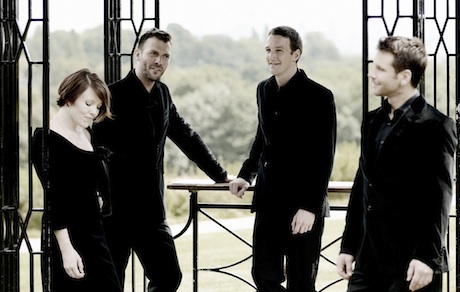
The Heath Quartet
/ Ensemble in Residence 2013/14 / Tuesday 16th July
The
Heath String Quartet
are a talented bunch, most recently being announced as the winners of the 2013
Royal Philharmonic Society
Young Artist award. For our
Chamber Concert Series 2013/14
they will be Ensemble in Residence, performing three times over the year. We interviewed Oliver Heath who told us what we can expect from the ensemble in the coming months.
Kettle’s Yard: When and how did the Heath Quartet form and where did your name come from?
Oliver Heath: Our quartet was formed when Gary, Chris and I were students at the
Royal Northern College of Music
about ten years ago. Gary (the violist) and I were put in a group on our first day by the hugely inspiring Director of Chamber Music, Chris Rowland, who had a knack of putting the right combinations of people together. Chris Murray joined us a couple of years later (we were in the same year at the RNCM), and we were joined by Cerys about four years ago. The name of the quartet is taken from my surname…
KY: Congratulations on being announced as the winners of the 2013 Royal Philharmonic Society Young Artist award. How does it feel to have won?
OH: It is incredible to have been honoured with this award, it still hasn’t really sunk in. There are so many amazing young musicians around at the moment, we feel very lucky to have been singled out by the RPS. And to be the first ensemble to win this award since the
Brentano Quartet
fifteen years ago is particularly nice.
KY: The Heath Quartet are the Kettle’s Yard ensemble in residence 2013/14 are you looking forward to it?
OH: We are extremely excited to be in residence at Kettle’s Yard for the forthcoming season. It is always great to build up a rapport with an audience over several concerts, and hopefully with the programmes we are offering there will be a thread for the audience to follow throughout our performances. And it is such a beautiful space to perform in with such a warm, appreciative audience!
KY: Jacqueline du Pré wrote “To play in a beautiful place where Art is a very treasured thing made a great change from the normal run of halls one plays in and we both felt uplifted by this.” She wrote this in a letter Kettle’s Yard founder Jim Ede after playing at the inaugural concert with Daniel Barenboim in the House Extension at Kettle’s Yard. How does it feel to play in different venues, what effect does it have?
OH: We love the variety we have in our schedule at the moment. We are lucky to perform quite regularly at some of the most beautiful concert halls in Europe, and are very excited to have our
Carnegie Hall
debut coming up next season. But we also enjoy playing in much more intimate places, small churches, rooms in large country houses, and more unique venues like Kettle’s Yard! I think we all thrive off the opportunity to feel a close connection with our audience.
KY: How do you come up with your programme combinations and can you tell us a bit about your programme for Kettle’s Yard?
OH: We are very lucky as a string quartet to have such a huge array of repertoire at our disposal. It feels right to start performances with Haydn, Mozart or early Beethoven – these works are of course no less profound or great than repertoire from later composers, but the clarity and relative simplicity of the textures and themes display the inner workings of a quartet in a way that prepares audiences for the more challenging, dense works that will appear later in the concert. We usually follow this with a less familiar work, often from the twentieth century, something that is a long way away from what has just been happened. The second half is usually filled with a larger scale composition, for our concerts in Kettle’s Yard these are middle-period Beethoven, Mendelssohn and possibly the most famous of all quartets, Schubert’s Quartet in D minor, ‘Death and the Maiden’. We will also be offering three of the five quartets Michael Tippett wrote, and our residency is book-ended by Schubert, which adds a nice symmetry!
KY: You are recording the complete quartets by Michael Tippett can you tell us a bit about his work and any pointers for a someone who may not know his work.
OH: Tippett is a composer like no other. His music is very ambitious in its scope – his main creative impulses always took place away from his manuscript paper. He would try to impart these extra-musical ideas onto paper once a vision for a piece had crystalized in his mind. So his music is full of ideas that appear and disappear with very little thematic development, which seems to lend his music a transient quality. His music is also filled with strikingly beautiful, long-spun melodies and rustic, energetic dance rhythms. Another strong characteristic that runs through his quartets is a slightly mischievous, slightly quirky sense of fun!
KY: What are your plans for future recordings?
OH: Besides our plans for the Tippett release, we will be making a live recording of the complete Bartok quartets. There are another few ideas brewing, but nothing that is yet finalised.
KY: Many thanks for answering our questions! We are really look forward to your first performance, with a selection of works by Schubert, Tippett and Beethoven on Thursday 28 November.
You can hear the Heath Quartet perform as part of our 2013/2014
Chamber Music series
on 28 November 2013 (at Divinity School, St John’s College), 13 February and 22 May 2014 (at Kettle’s Yard). Tickets cost £15 (£5 full time students) or £150 (£50 full time students) for an annual subscription to all 15 concerts, book
online
, or call 01223 748100.
Punching, casting and huge drawings
/ Marston Vale Middle School / Thursday 27th June
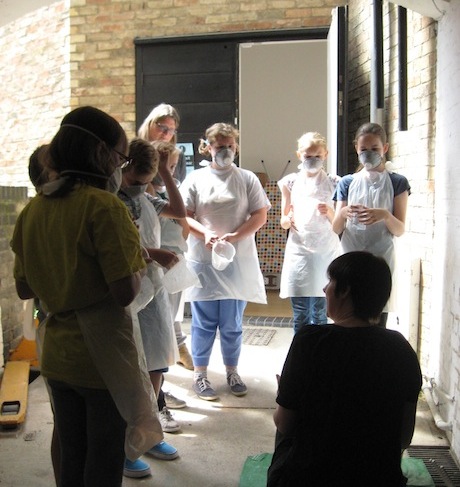
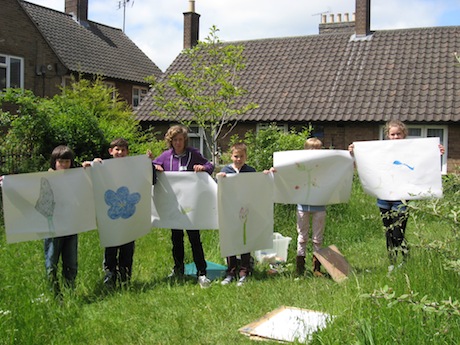
Over the past month we have had Year 7 and 8 students from Marston Vale Middle School come to Kettle’s Yard to take part in four sessions with our Education team and artists from
Irregular Circle
.
Katie Paterson’s exhibition
, currently in the gallery, was taken as inspiration for the students to make their own artwork.
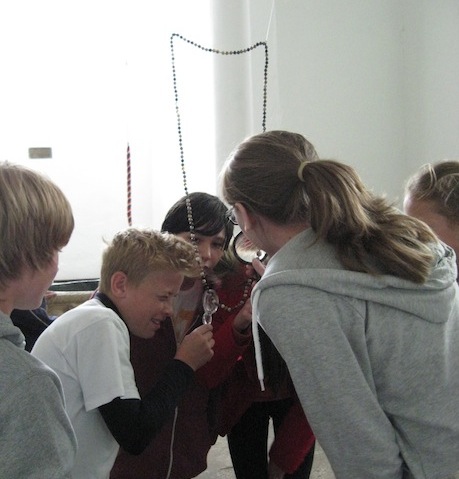
Looking at Katie Paterson’s
Fossil Necklace
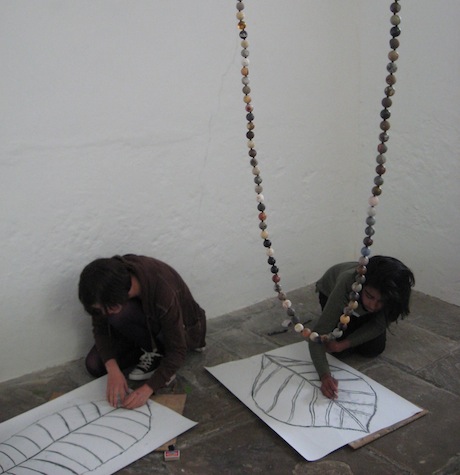
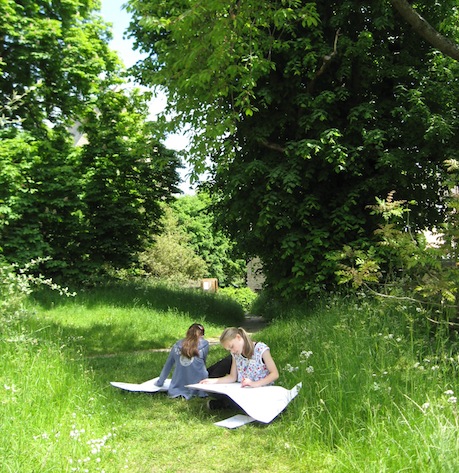
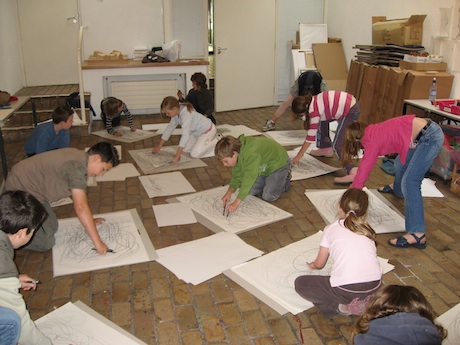
we discussed how each bead could be understood as a tiny trace of a former world, representing huge events in the evolution of life on earth. The students then chose small natural objects from
St Peter’s church
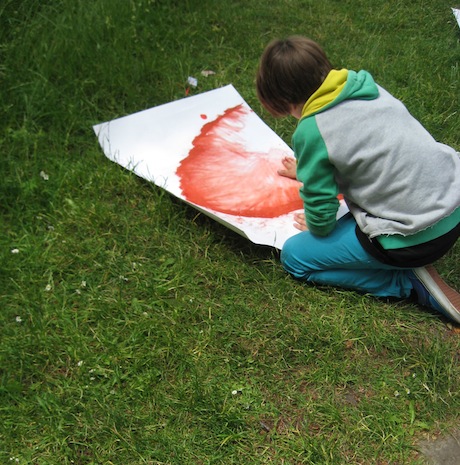
and enlarged them into huge drawings.
The artists from Irregular Circle took two hole punches from each drawing; one hole punch was given to each student, whilst the other was added to a collective tin, representing a trace from each students work and a trace of their own universe.
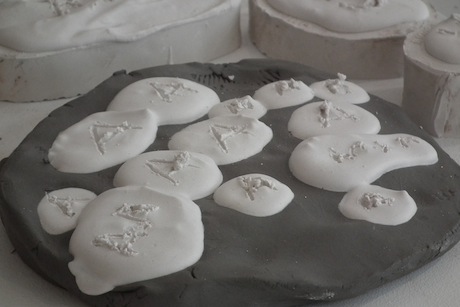
At another visit the students drew inspiration from Paterson’s
Campo del Cielo
, a
, the students learning about the casting process that re-formed the properties of this meteorite and making their own plaster casts from a range of natural objects. This activity stimulated a lively discussion about the artwork, with groups debating whether the meteorite still holds a sense of what it was before.
Below are some more photographs from the workshops – I hope they capture the creativity and intriguing responses of the students from their visits to Kettle’s Yard.
Royal Academy Summer Exhibition
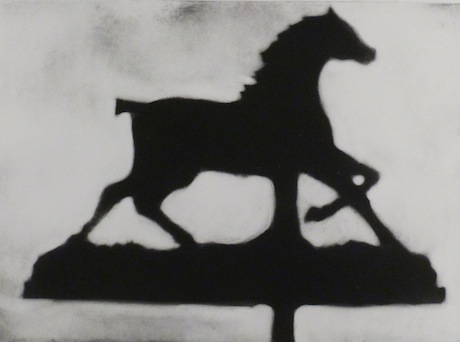
/ Wayfaring: Horse by Jane Waterhouse / Tuesday 25th June
We were delighted to hear that Kettle’s Yard Artist Educator, Jane Waterhouse, had a work selected for the
Royal Academy Summer Exhibition
. The annual exhibition is in its 245th year and holds the title of the world’s largest open-submission exhibition.
See Jane’s work and other work by artists including Grayson Perry, Frank Auerbach, Tom Phillips RA, Michael Craig-Martin RA and Alex Katz until 18 August. Here Jane tells us a bit more about her work and the experience of being one of the selected artists.
I have just completed an MA in Fine Art Printmaking at
ARU
here in Cambridge. The ‘Wayfaring’ series began during this time. This includes an ongoing set of one hundred plus etchings, made and printed in turn by using the same plate or palimpsest, then cased in a fine traveling box for journeys to various locations where they are installed and recorded accordingly. The prints themselves admit a sense of whimsey, a dialogue between nature, us and the objects we have bought to this world and, then again, the conversations those objects have with us. There is also a strong element of Englishness.
With the latter in mind I was really delighted to be included in the
R.A.’s 245th Summer Exhibition
and to be invited to Varnishing Day where we processed down Piccadilly behind the medal bedecked Academicians, Tracey Emin, Peter Blake, Anne Desmet, Norman Ackroyd et al to St. James’s for the annual Service for Artists. This year the Address was given by the very colourful Revd. Malcolm Guite, from Girton College. We then trooped back to the Academy to view the works, with a glass of bubbly in hand, and to meet and talk with old and new friends.
~ Jane Waterhouse
Find out more about the Royal Academy Summer Exhibition
here.
Bridget Riley’s studio
/ Friends of Kettle's Yard / Monday 3rd June
The
Friends of Kettle’s Yard
had the
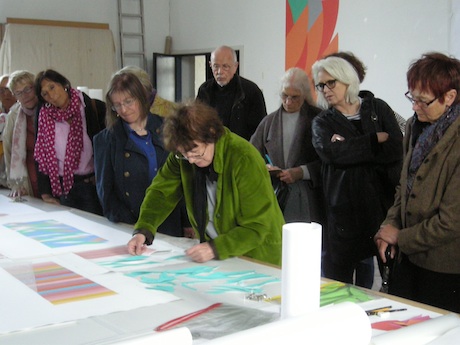
opportunity to be taken round the studio of British op-artist, Bridget Riley, on a personal tour. Here Lindsay Millington, tells us about their visit.
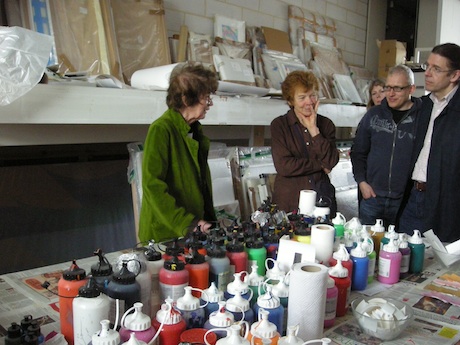
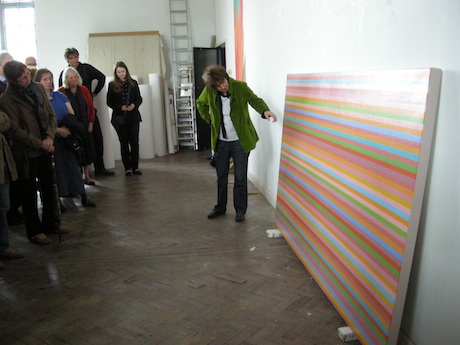
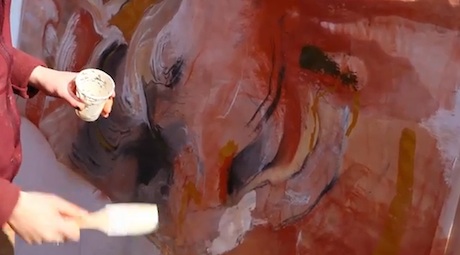
A damp walk over the railway line and through a small park brought us to the converted church hall that has been Bridget Riley’s East London studio since the 1980s. It is a rambling building, tucked at the end of a residential street, that opens on its upper floor into a vast, double-height space flooded with natural light. The artist – full of energy and enthusiasm, and greeting her thirty visitors as if we were all old friends – explained that all her works are made in daylight: ‘winter is hell’, she told us. Bridget Riley works with stripes and curves and with colour relationships. Each of her finished paintings is preceded by preparing multitudes of colour test cards exploring tonal variations hardly discernible by the untutored eye, followed by experimentation, analysis and planning using pre-cut strips of different widths and shapes.
Once chosen, colours must be mixed in sufficient quantity and to just the right consistency, as it is impossible to reproduce them precisely, and we watched a skilled assistant painting carefully prepared cut-paper pieces with extraordinary brush control, applying just the right amount of paint to achieve an absolutely flat surface.
We saw work in progress for a forthcoming exhibition, its rhythms and depths achieved through a single, co-ordinated palette of reds, oranges, greens and grey; saw how a work could be created so that the rows of stripes rise from bottom to top; and how depth might be achieved through modulating colour. Ladders were brought out to move large pieces from the wall so we could view others. Our questions were answered: possibilities emerge from ‘listening to what the colours are saying’ ; the finished works have meaning, ‘but if you can’t identify it, that’s alright’. The range of work we saw equalled the best of exhibitions. The insight and inspiration from talking to the artist herself was very special.
Thank you Bridget!
~ Lindsay Millington
Becoming a Friend
is an excellent way of providing support and developing your own interest in art. The Friends organise a variety of activities including visits to other galleries, private collections and artists’ studios, long weekends to various centres of art within the U.K. and abroad, special talks and an annual party. Find out how to become a Friend of Kettle’s Yard
here
.
Thresholds
/ The finale of a fantastic poetry project / Friday 24th May
Earlier this year we gladly played host to the exuberant Jackie Kay as part of Thresholds, a project curated by Carol Ann Duffy who invited ten UK poets for a residency at each of the University of Cambridge Museum and Collections.
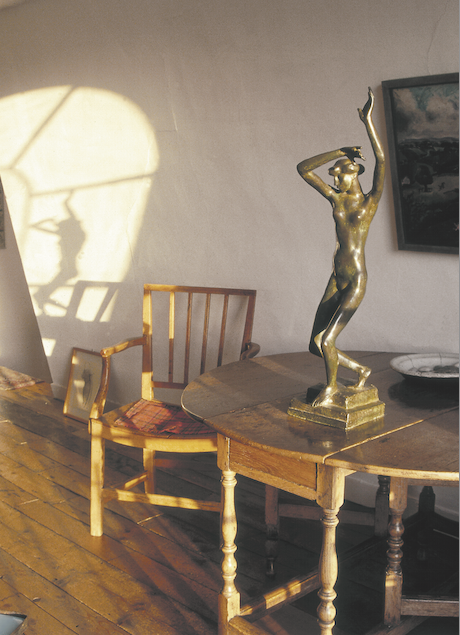
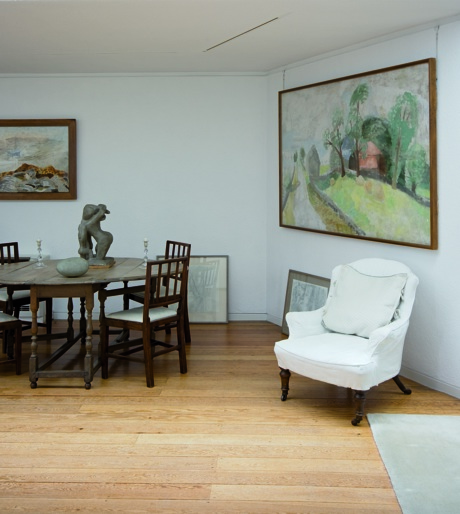
Whilst in residence at Kettle’s Yard, Jackie spent time in the house speaking to the visitors, invigilators and other staff. Everybody enjoyed having Jackie at Kettle’s Yard, we would often find her sat in a favourite white chair in the dancer room, where the shadows cast by Henri Gaudier-Brzeska’s
Dancer
, reminded her of a Hitchcock movie. Jackie also spent time with a group of young people running workshops alongside artist Filipa Pereira-Stubbs writing poems and then transforming these words into site-specific art installations. This culminated in a fantastic end of project show with friends and family.
The Thresholds project ended with a finale at the Fitzwilliam Museum where we heard the poems, performed by their respective poet, for the first time. Lucy Wheeler, Assistant Education Officer, said ‘It was fascinating to hear the poets’ tales of their time spent at their designated museum and the Fitzwilliam Museum was a perfect backdrop to hear each new poem recited.’
Below you can read Jackie’s poem, Helen’s Room, and watch her perform it at the Thresholds Finale (from about 52 minutes in). Perhaps next time you come to Kettle’s Yard you’ll see Helen’s room in a new light?
Helen’s Room – Jackie Kay
Not too late, then, to catch the blessed light through the eyes of The Radar in this winter sun; to see the past and present side by side; to take your hand once again, walk into the bitter biting wind. The key turns on what we don’t understand. Every joy is twinned With an opposite: a hinterland - I’ve been in Helen’s room, A phrase to coin: happiness reframed in the dark afternoon. Not too late to know that as soon As something was here once, it’s gone.
Not too late, in the House of Juxtapositions, where Scotland and England meet, old friends, to remember that last conversation Might last to the nether land. Here, where strangers pair, maps are bilinear; balance acts, echoes matter; stones, pebbles, shells, statues; the great art of fractured crockery; the democracy of light and dark. Not too late to see the beauty in broken things: that cracks can visibly mend; the painted flowers can grow. Love in separate rooms, Single beds, matching spreads.
Not too late to allow Winifred to take you past the daffodils, the Norman window through the canvas, out to the churchyard … the backdoor of Kettle’s Yard, Where Helen and Jim walked the path of the waiting graves; remembering what you knew. The old stones painted by light; the last of the sun on the cobbled path. Not too late to hear the song in your head, that whistles whatever darkness lies ahead. Not too late to hear the music of the blessed.
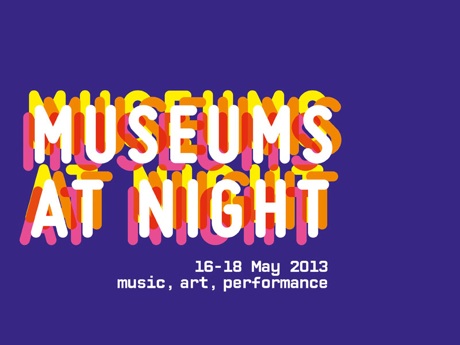
Museums at Night
/ Special after hours evening at Kettle's Yard / Sunday 12th May
With late night events happening around the country, Kettle’s Yard will be hosting a special after hours opening across the house and gallery this Friday (17 May, 6-8.30pm) as part of the
Museums at Night festival
. Museum’s at Night is a fantastic evening where visitors get to spend time after hours in the gallery and house, the perfect evening for art lovers.
Enjoy watching the sunset amongst the artworks and objects in the house and explore our House Guests exhibition where specimens, objects and artworks from eight other University of Cambridge museums and collections take up residence in the house.
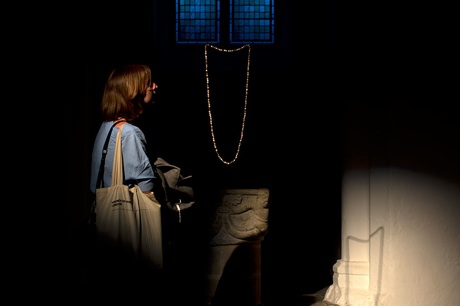
Fossil Necklace by Katie Paterson, Photo by Michael Callahan
In the gallery there will be the chance to see
Katie Paterson’s exhibition
including her new work Fossil Necklace in St Peter’s Church. The necklace comprises over 150 beads carved from fossils that chart the evolution of life on earth. It’s the history of the world in a necklace.
You can enjoy the exhibitions with a drink and take advantage of great discounts in the shop, you can even purchase your own fossil to take home.
An evening of art, anthropology, geology and drinks
/ The Practice Sessions / Thursday 9th May
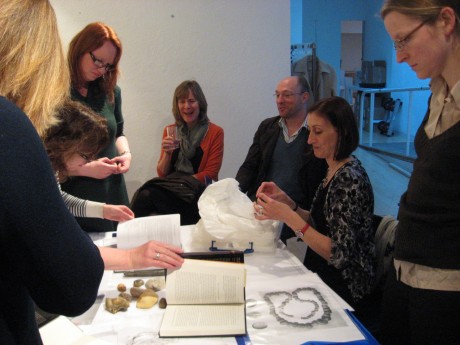
Our fossil themed
Practice Session
last month was a roaring success. One of our dedicated volunteers, Michael Clegg, gives us a run through of the events and talks that were led by Annette Shelford from the
Sedgwick Museum
.
I went along to the Practice Session on 26 April as a volunteer, helping out at the bar and with the general smooth running. The session came just a day after installation of
Katie Paterson’s new show
. It attracted a good crowd, with a mix of groups, couples and individuals, and with everyone soon sharing their enthusiasms, especially after enjoying a drink. Katie Paterson’s big themes and varied media helped support some great contrasts in what we got up to. Annette Shelford from the
Sedgwick Museum
gave two excellent talks. The first talk on Paterson’s Fossil Necklace, in the church, set the work in the (slightly scary) context of deep geological time.
We left suitably awed (and with arm ache – but you really had to be there for that bit). The second picked up on the anthropology of collecting and got a great response, bringing Paterson’s project into the personal and childhood worlds of collecting on the beach or allotment. With all that cerebral energy flowing – and maybe a second drink in some cases – lots of people were ready to try out their creative responses to the ideas in the exhibition, or take the opportunity for some quiet time with the exhibits – the meteorite, Field of Sky, being a favourite.
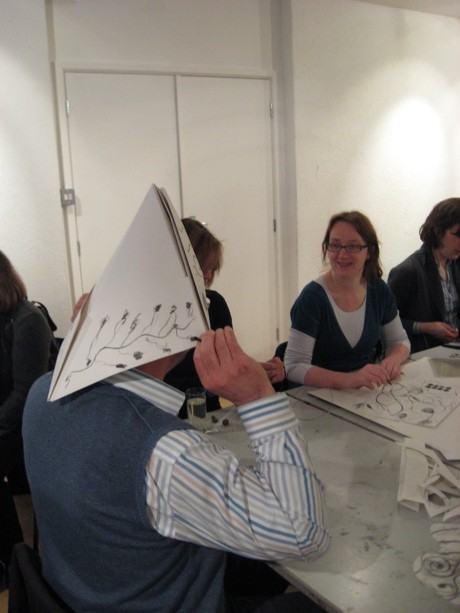
In no time a whole range of necklaces, drawings of fossil sea urchins and maybe one or two party hats had been spirited from the Kettle’s Yard’s inexhaustible supply of materials and odds and ends. Whatever people were going on to, it had already been a full Friday evening!
~ Michael Clegg
The next Practice Session will be hosted by
IJAD Dance Company
, with an intriguing night exploring the world of secrets, on 24 May 6-8pm. Find out more
here.
Alberto Burri
/ The Student Blog / Thursday 18th April
Kettle’s Yard was originally conceived with students in mind. Jim Ede kept ‘open house’ every afternoon of term, personally guiding visitors around his home. Today the house works in a similar fashion with members of the public able to visit every afternoon except on Mondays. Like Jim, we really want to encourage students to come to the house, enjoy the setting and use it as inspiration and a resource for their studies. We hear from Joni, a sixth form student, who was excited to discover that a recent acquisition at Kettle’s Yard was to prove very relevant to her work.
I’m an art student currently studying AS Art at
Hills Road Sixth Form College
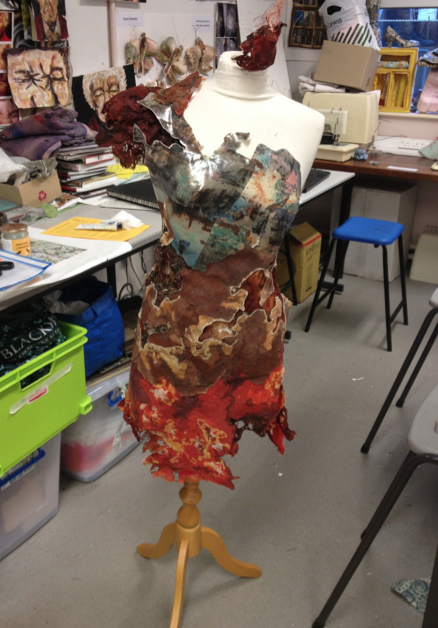
in Cambridge. My latest coursework project was based around the theme voids and spaces which I later developed into a closer study of rusted metal and the shapes that it could form. My final piece was a dress that used the patterns and colours of rust to create a design on the body.
As part of my coursework I had to look to artists to help develop my idea for a final piece. While researching different artists I found Alberto Burri’s work particularly interesting and felt that I could incorporate similar aspects into my own work for the project. A lot of his work was of a similar colour scheme to drawings and photographs I had done and his use of texture was something that I wanted to look at further in my work.
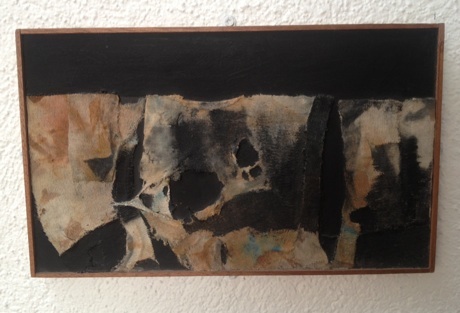
After researching his work online I wanted to look more at Burri’s work to find how I could use it with my own. I then found out that Kettles Yard had recently acquired a piece by him that was going to be displayed in the house. The opportunity to see one of his pieces was really useful for my project allowing me to properly see his use of materials in the work. This visit lead to the idea to cut away parts of the main dress and fill the spaces with textured, burnt looking pieces of fabric, similar to the Burri piece at Kettle’s Yard.
The chance to look at Burri’s work at Kettle’s Yard as part of my project was really great, it helped form my ideas and I found it easier to connect the artist’s work to my own – an important part of the AS course.
~ Joni Mitchell
The
Kettle’s Yard House
is open from 1.30-4.30pm (summer opening times) Tuesday – Sunday.
We’d love to hear about your experiences of Kettle’s Yard. Send your stories to
and you could feature in our blog.
Art in the East
/ A Panel Discussion / Thursday 11th April
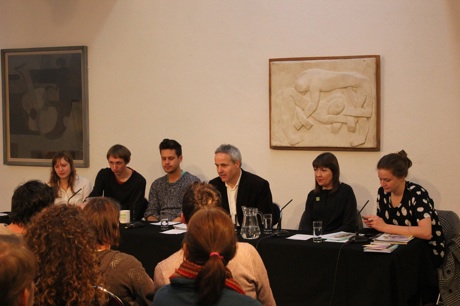
Last month saw Kettle’s Yard host a debate concerning the issue of the support for artists in Cambridge and the Eastern Region. On the panel sat
Kettle’s Yard
Director, Andrew Nairne, Amy Botfield, Arts Council England, Donna Lynas, Director of
Wysing Arts Centre
,
Ian Giles
, London based artist participating in
OUTPOST
‘s
exhibition
and OUTPOST committee members James Epps and Isabel Gyling.
With the Kettle’s Yard house packed with audience members from around the region, the event was also streamed live via the
Kettle’s Yard website
and
This is Tomorrow
.
Questions concerned whether enough is being done to support artists so they can make exciting, innovative art in Cambridge and the Eastern Region. What was already happening and what more could be done. We heard from each of the panelists and then opened the discussion up to the floor for a lively debate. With the argument that there is always more that can be done to support artists in our region, the discussion also highlighted the great work that has been making headway in many areas. Making more readily available the information about the support and opportunities that is out there for artists was just one of the aims and outcomes. You can watch the discussion below.
Keep the discussion going, send us your opinions in the comment section below or via twitter
.
The event was followed by
,
a performance by artist,
Ian Giles
. Audience members were invited to take part in the meditation where they were invited to paint each other’s faces with a small amount of clay in pairs. When all of the wet clay has been applied, each pair could watch each other’s faces dry with the drying process leading the meditation. For this performance meditation is understood as a focused period of calm and reflection. Patterns formed on the participant’s faces as the clay dried, mirroring the aging process and evoking thoughts about time, mortality and change.
The Estate of Victor Skipp
/ Legacy giving / Tuesday 2nd April
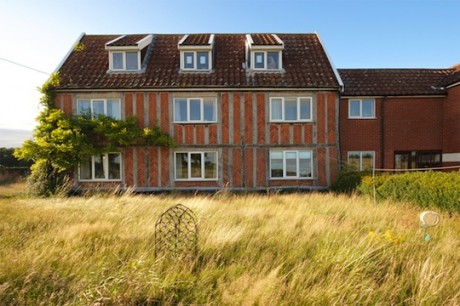
On Christmas Eve 2010 one of our regular visitors, Victor Skipp, died at the age of 85, leaving his estate to Kettle’s Yard. Victor had been a historian of the Industrial Revolution in the West Midlands.
The paintings of Ivon Hitchens were an early passion but at the 1984 British Art Show he came across the work of the English minimalist artist Bob Law and began to form a significant collection of his work. In the 1970s he and his wife Pat bought and extended an old farmhouse in Suffolk, which on their retirement became their permanent home.
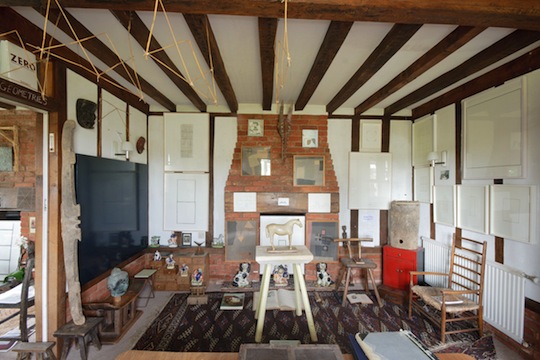
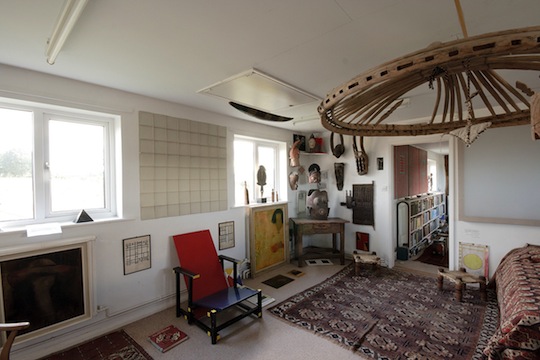
Kettle’s Yard became increasingly influential on Victor’s thinking about art. If Kettle’s Yard is a place of aesthetic connections, Victor’s house became one of philosophical links where minimalist art combined with tribal rugs, African sculpture and a range of artefacts reflecting his interest in pre-industrial societies. Victor was a convinced modernist and his library includes rich holdings of 20th century poetry, literature and literary criticism.
An exhibition will be held at Kettle’s Yard in honour of Victor Skipp in early 2014 and will feature many treasures from his estate. Stay tuned to our blog and website for more details regarding the show.
Gifts in will, like Mr Skipp’s, ensure the future of Kettle’s Yard. They help us to care for the collection, deliver exhibitions, present music and education programmes, commission artists and composers, and encourage everyone to engage in the arts. You can find out more about leaving a legacy to Kettle’s Yard on our
website
or by emailing:
The Museum as Interface
/ A new project at Kettle's Yard / Tuesday 26th March
The first stage of Kettle’s Yard’s first multimedia guide has just started. The domestic setting of Kettle’s Yard house means that there are no labels to identify the works of art or objects. Today’s new generation of iPhones, android phones and tablets offer us the opportunity to extend access to Kettle’s Yard rare and exciting archives which include correspondence between Jim Ede and his artist friends plus other exceptional documents and photographs!
This project, Museum as Interface, is led by
Professor François Penz
(Architecture Department, University of Cambridge) and Andrew Nairne, Director of Kettle’s Yard. It is supported by the Arts and Humanities Research Council under the
Cultural Engagement Fund
. The Research Associate appointed is
Anna Ferrari.
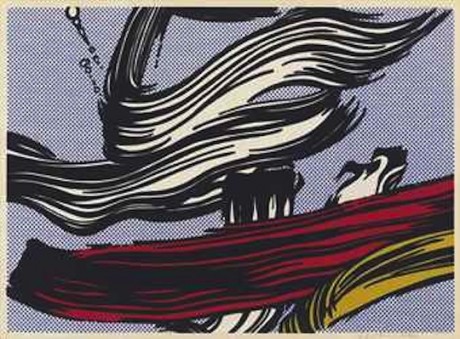
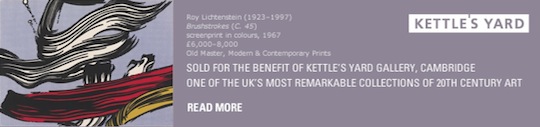
Roy Lichtenstein, Brushstrokes (C. 45) screenprint in colours, 1967
Lichtenstein sale for Kettle’s Yard
/ Charitable gift / Wednesday 13th March
We are thrilled that one of our generous Kettle’s Yard supporters has donated a Roy Lichtenstein screen print which was auctioned for the benefit of Kettle’s Yard on 20 March 2013. We were delighted that the price realized was well above the estimated price, closing at £10,000.
Brushstrokes (C. 45)
screenprint in colours, 1967, was part of the
Old Master, Modern & Contemporary Prints
sale at Christie’s on 20 March 2013 at their King Street location in London.
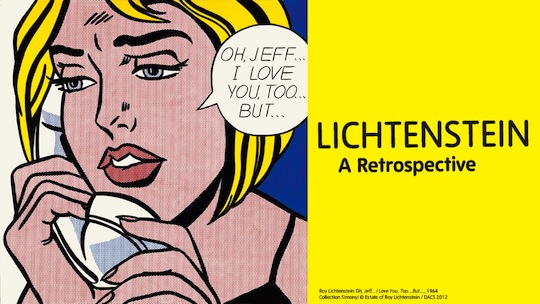
Lichtenstein is renowned for his works based on comic strips and advertising imagery, coloured with his signature hand-painted Benday dots. In the 1960s, Lichtenstein became a leading figure of the new art movement, alongside Andy Warhol. Inspired by advertisements and comic strips, Lichtenstein’s bright, graphic images parodied popular culture.
The timing for the sale could not be better as there is currently a Lichtenstein retrospective at the
Tate Modern
from 21 February – 27 May 2013.
Donations like this are a lovely way to raise money for the Kettle’s Yard house, our exhibition programme and the conservation work that we need to do to keep the house and collection in the best possible condition.
If you would like to
support
Kettle’s Yard please do get in touch with Kathryn or Marisa in our Development Team.
/ 01223748100.
Uncanny workshops
/ St John's College School / Tuesday 5th February
At the end of January, pupils from St John’s College School have worked with artist Alex Hirtzel and the education team at Kettle’s Yard to explore ‘the uncanny’ in our current exhibition,
‘Aid & Abet: Temporary Residence’
, and the permanent collection in the house.
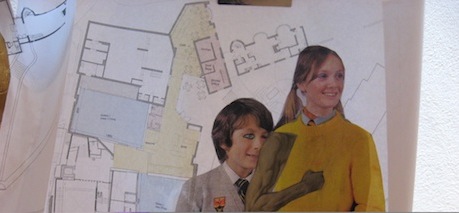
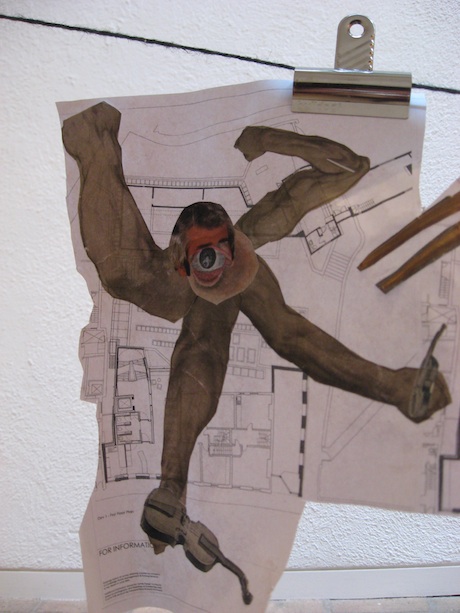
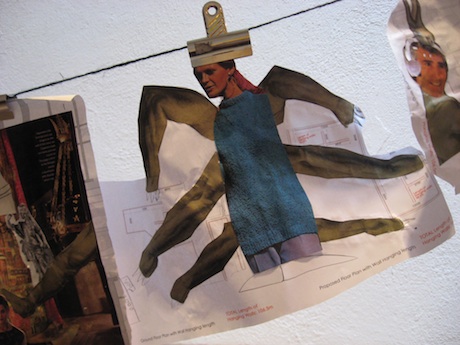
The group sketched in the house, looking for both natural and unhomely connections between objects and artworks, and then explored the exhibition. They took particular inspiration from
Martyn Cross’s
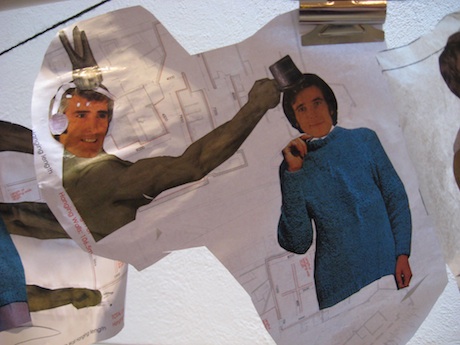
collaged knitting patterns, which he describes as an ‘assembly of the damned’ (go to
yateheads.blogspot.co.uk
to see examples of Martyn’s work.)
As you can see from the photos, the pupils really took the idea and ran with it, creating some fantastically unsettling images. It is reassuring to know that the charity shops of Cambridge still offer such knitting pattern gems.
PropsBox
/ A new fun resource for families / Monday 14th January
Five
PropsBoxes
now live at Kettle’s Yard and are available for families to play with on our new
Studio Sundays
family drop-in workshop. They were developed by artists from
Cambridge Curiosity and Imagination
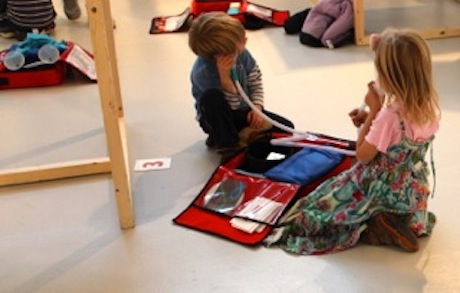
together with local children and families and they combine a collection of unique resources, games and props in an inviting box, easily carried.
This was not the usual approach…it was lively, more fun and there was more stuff to do. Having objects made it different. They created more interactions with the art and encouraged dialogue. It helped you communicate with the work and the artists. Normally you stand and look, so feel separate and distant, but this was like a bridging thing that helps you cross that line.
(
Anna, Mother)
Children can lead their families around the collections and exhibitions with the PropsBox, sharing games, playful conversations and discussions. Everyone is encouraged to come up with ideas and make connections with the artworks and spaces through these activities.
Inventing games helped us with our own imagination. The games that were there already helped us get more ideas. Having something to touch was important. (Adrianna, Mother)
No specialist knowledge or experience is needed and there is no wrong way to play with a PropsBox – families have free reign to explore and enjoy using the PropsBox within the gallery space.
We used the dice to explore and talk about every painting. My daughter wanted to go round all of them and repeat it. We talked in detail and shared really complex conversations. (Mehrdad, Father)
There are also five PropsBoxes for families at
Wysing Arts Centre
so you can go and try them out there too.
Q&A with Andrew Nairne
/ How was 2012 for you? / Tuesday 8th January
A Q&A with our Director, Andrew Nairne, by
a-n News
What kind of year was 2012 for you and Kettle’s Yard?
It was my first full year as Director so I was getting to know Kettle’s Yard and Cambridge again (I was Assistant Curator for a year in the 1980s – my first job). I love Kettle’s Yard, the city and the sense of continuity in the University of Cambridge: remarkable people are still doing remarkable things that have the potential to change the world. In 2012 we presented some very successful exhibitions with Alfred Wallis attracting more than 12,000 visitors.
We also introduced the
Castle Hill Open Day
in September – an opportunity to reveal the heritage, history and culture of this fascinating part of the city. We made a big decision in 2012: to seek to undertake a larger capital project in 2015/16 that will include our planned education wing, rather than build the education wing now. We have a rare opportunity to renew the whole Kettle’s Yard site, with beautiful remodeled galleries and much better services for visitors. I have been grateful all year for much helpful advice, good will and support in moving towards this decision.
What has changed for the better and what, if anything, has changed for the worse?
The Kettle’s Yard house and collection feel like they are becoming more significant as time goes by. When I take visitors round I am especially aware of how radical Kettle’s Yard must have been when it opened in 1957 and how radical it still is. Jim Ede (who created Kettle’s Yard) was friends with the avant-garde artists and writers of his time. They were consciously searching for new artistic languages in an era of war and extreme change. I think this radical current at the heart of Kettle’s Yard continues to be relevant and powerful, especially given we are part of one of the world’s leading research universities.
It has also been good to get to know colleagues across the
other seven university museums
. There are tremendous opportunities to reach new audiences and communities through programmes which cross disciplines and timeframes and exploit new technology. The support of Arts Council England for our Connecting Collections programme will enable us to make changes to how we work together locally, enhancing our collective national and international impact. Has anything changed for the worse? Perhaps Cambridge is a bit of an exception, but it all seems positive, with everyone involved in arts and culture working more closely together than before and with a real sense of the potential.
What do you wish hadn’t happened in 2012?
I wish there was not such a need to be constantly vigilant about Government policy for the arts and culture. I don’t think the issue is about whether ministers ‘get the arts’ – the majority do, including its economic value. The issue is how that is translated into policy whether in relation to schools, at local authority level or in relation to the Arts Council. A confident nation needs to have confidence in its arts and culture – so they are at the heart of learning, contributing to local change, with an Arts Council fully empowered to work with and support artists and cultural leaders.
What do you wish had happened in 2012 but didn’t?
In recognition of the huge success of the Cultural Olympiad, the Government announced a long-term commitment to increasing investment in arts and culture. Instead there has been a cut.
What would you characterise as your/your organisation’s major achievement in 2012?
Becoming a more outward looking and engaged organisation with a renewed vision.
Is there anything you’d like to have done but haven’t?
Of course! But we have plans – especially for creating long-term programmes with young people and local communities.
What would make 2013 a better year than 2012?
If we can continue to innovate, collaborate with new partners, including internationally, and open up Kettle’s Yard to even more people.
Happy New Year!
/ Looking forward to 2013 / Friday 4th January
Happy New Year from all of us at Kettle’s Yard. With the festive period well and truly behind us we are really looking forward to the coming year of exhibitions and events – it is going to be a busy (but exciting!) year. We’ll be keeping you up to date on all the goings on at Kettle’s Yard via this blog – and you can also follow us on
and
.
Looking back on 2012 and forward to the new year our Director, Andrew Nairne, took the opportunity to reflect for
a-n news
on the past year at
Kettle’s Yard
. You can read his thoughts
here
.
Also work is well underway for the installation of our
Aid & Abet
takeover, Temporary Residence, which opens on 12 January. Brush off the cobwebs and come down to find out what is going on with lots of exciting events happening alongside the exhibition itself.
You can visit our
website
for more information about what is coming up.
Artists and their materials in early 20th century British art and design
/ Lunchtime Talk / Thursday 20th December
M.J. Morgan gave a superb talk on artists and their materials in early 20th century British art and design in Kettle’s Yard house. You can listen to it below. Make sure you check out the archive of talks we also have on our
page.
M.J. Morgan is a PhD candidate from the Faculty of Architecture and History of Art, University of Cambridge.
Space Makers
/ Comberton Village College / Thursday 13th December
Comberton Village College
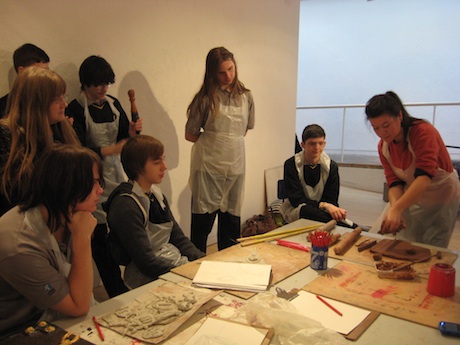
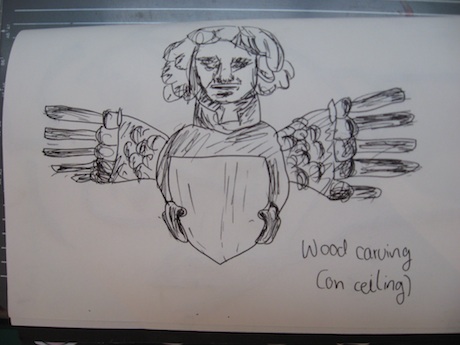
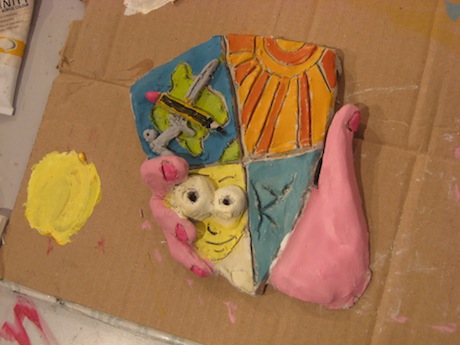
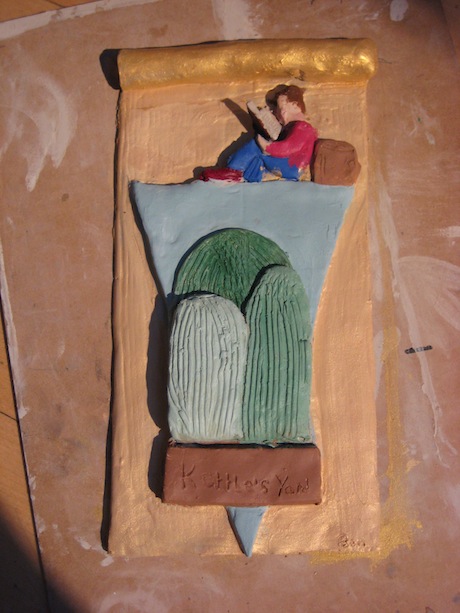
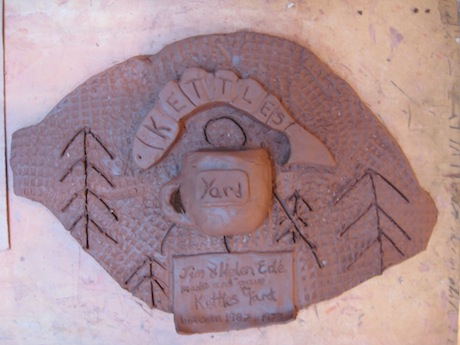
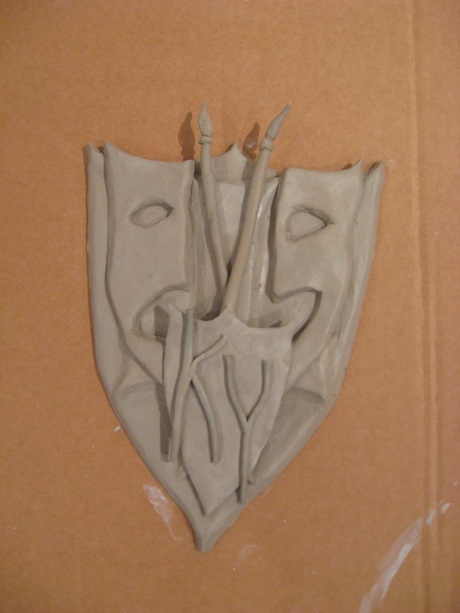
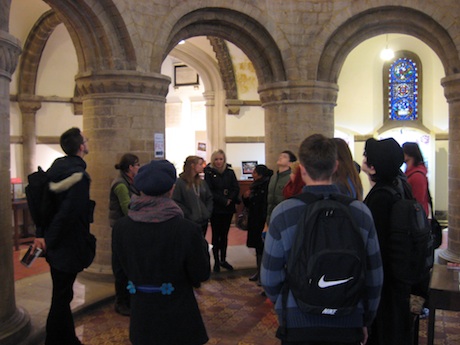
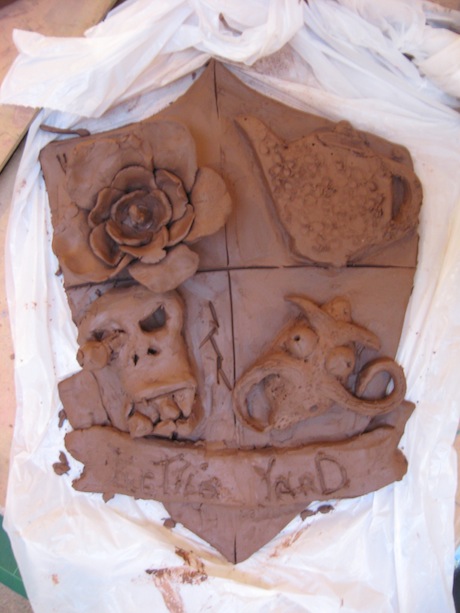
BTEC students are working with us on a two-year built environment project called Space Makers. The group visited both this week and last week. Over the two sessions, we explored the theme of heraldry and the symbolism that is often included in buildings and architectural features. We had a tour of the
Round Church
, the gate to St John’s College, and King’s College Chapel. We then made our own shields and worked in small groups to create a coat of arms for
Kettle’s Yard
.
Below are some photographs from the two workshops – I hope they capture something of the creativity and wonderfully imaginative responses of the students.
Winifred Nicholson: a view from the Kettle’s Yard archives
/ Lunchtime Talk / Friday 7th December
If you missed Anna Ferrari’s lunch time talk on, Winifred Nicholson: a view from the Kettle’s Yard archives, on 15 November you can listen (or listen again!) here -
Anna Ferrari is a PhD candidate, History of Art, Pembroke College, Cambridge.
Threat to Arts Education
/ Education Officer Blog / Thursday 6th December
The Education team at Kettle’s Yard works with about 7,000 people each year. Of that number, about 1,200 are children and young people visiting as part of a primary or secondary school trip. My memories of school are pretty fuzzy (it was, after all, a long time ago) but I can still vividly recall the shark in the ocean diorama at the local museum and the treasure trove of riches in the art gallery located above the museum. Paintings and sculptures from hundreds of years ago and all over the world – it left a lasting impression and now I get to inspire a love of art in others for a living. Similar opportunities for this generation of children and young people is under threat.
If current government plans to implement the English Baccalaureate go ahead, the arts (including Drama, Dance, Art & Design and Design & Technology) will not be core subjects at GCSE level and there are plans to also exclude the arts from revised A levels (the ‘ABacc’). The draft revised primary school curriculum has excluded Drama and is also likely to exclude Dance.
Whether you have kids at school or not, I think this is an issue that will affect all of us – the next generation of filmmakers, architects, designers, musicians, dancers, actors, producers, curators and artists all need to have that spark of artistic passion nurtured from a young age.
As Grayson Perry says:
For so many children, doing art just isn’t something they come across until they are taught it at school. Not everyone’s mother sits down with scissors and paper and makes collages with them or discusses cultural issues over the dinner table. It is the children from poorer homes who will be disproportionately deprived of exposure to culture. The idea that art will somehow look after itself – that society will breed untaught geniuses – is rubbish. We’ll end up with a cultural sector even more skewed towards the privately educated. A bit like what has happened to politics. Enough said.
You can read the rest of his Guardian article
here
.
If you want to find out more – and where to sign an online petition –
click here.
Friends of Kettle’s Yard
/ Waddesdon Manor / Friday 16th November
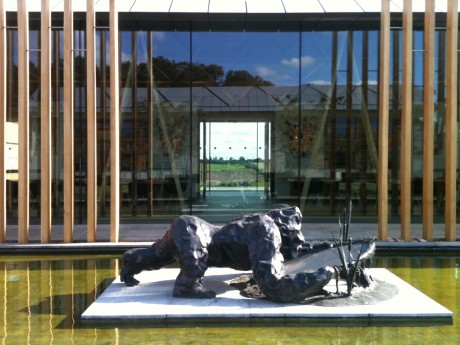
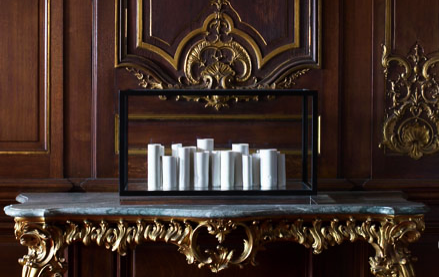
From Edmund de Waal’s beautifully restrained porcelain installations punctuating the 19th century opulence of this great Rothschild palace to Angus Fairhurst’s bronze gorilla,
Waddesdon
in late September was full of visual surprises.
De Waal’s
interventions, artfully placed amongst the collection of French decorative art, haunted the space like visitors from the future.
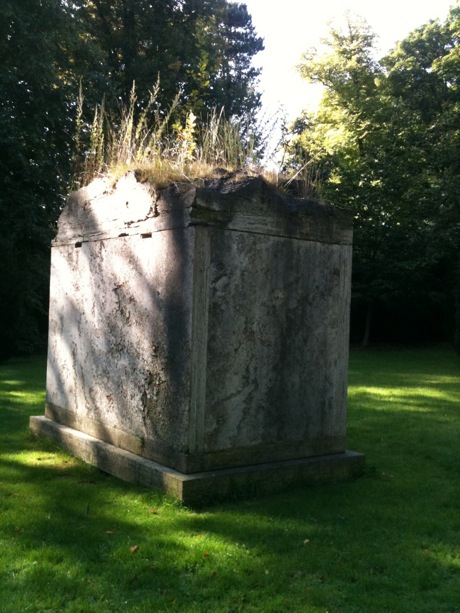
It was almost the last day of summer and Friends were able to wander at will and enjoy a good lunch. In the beautiful grounds were sculptures by Gormley, Kapoor and other leading artists including Stephen Cox. For architect Jane Sanders the highlight of the day was the private visit to the archive building on Windmill Hill designed by Stephen Marshall Architects with its interior of carefully selected furniture and lighting pieces as well as more works of art. The Friends organise stimulating trips such as this throughout the year both in this country and abroad. See
the website
for details of how to join like-minded people who are a passionate about Kettle’s Yard.
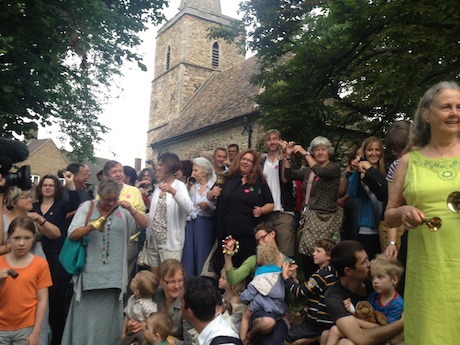
Kettle’s Yard will be participating in Martin Creed’s All the Bells at 8:12 am on Friday 27 July. In participation with the
Churches Conservation Trust
, we will be ringing the church bells at St. Peter’s and St Giles church, as well as here in the house. We welcome everyone to come join us and ring their bicycle bells along with us to celebrate the opening of the Olympic games 2012! There will be free biscuits and coffee and the gallery will be open for the hour.
At 8:12 am on 27th July 2012, thousands of people across the UK will be joining together to ring in the first day of the London 2012 Olympic and Paralympic Games. Everyone across the country is invited to take part.
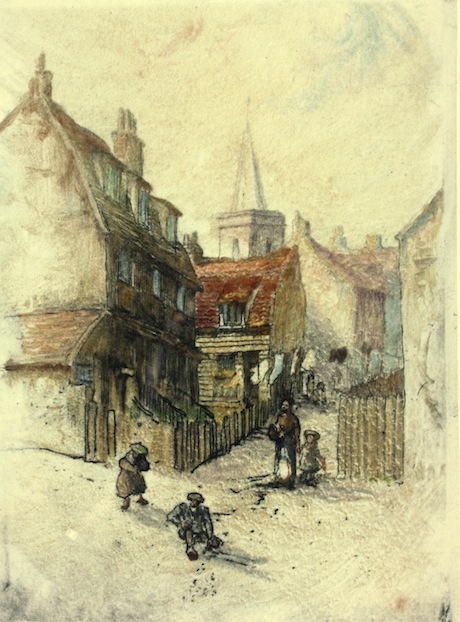
Mary Charlotte Greene (b 1860), lithograph Kettle's Yard
Folk Museum
/ Kettle's Yard History / Monday 16th July
Both the Folk Museum and Kettle’s Yard possess exceptional and distinctive collections which inform and delight their visitors. While very different in their own right, they both share important similarities: a unique and atmospheric setting which is integral to their displays; and a strong relationship with the history of the area.
The
Folk Museum
also holds an interesting collection of paintings. This lithograph of the original Kettle’s Yard is by Mary Charlotte Greene (b 1860) aunt of the novelist Graeme Greene. Mary trained at the Royal Academy and painted many scenes of Cambridge over the years which provide an invaluable record of the inn yards and old streets of the city which were largely demolished during the late 19th and early 20th centuries. The image provides a glimpse of life in the area known as Castle End – an area where the poorest working class residents lived in overcrowded yards and courts. The largest of these was Kettle’s Yard which in 1851 housed 115 people crammed into 26 slum houses.
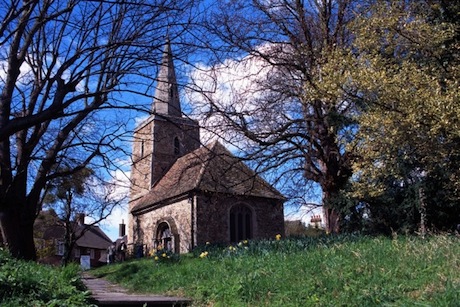
The slums were cleared away in the 20th century but the history of the area continues and is evident in buildings such St. Peter’s church (the visible tower in the background of Mary’s painting); the Folk Museum housed in a 17th century building which remains largely unaltered; and the legacy of Jim Ede who took over the derelict cottages of Kettle’s Yard to create a new vision for the area.
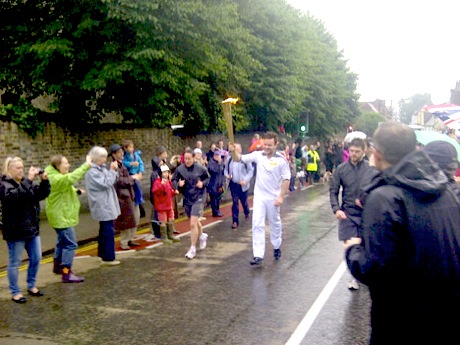
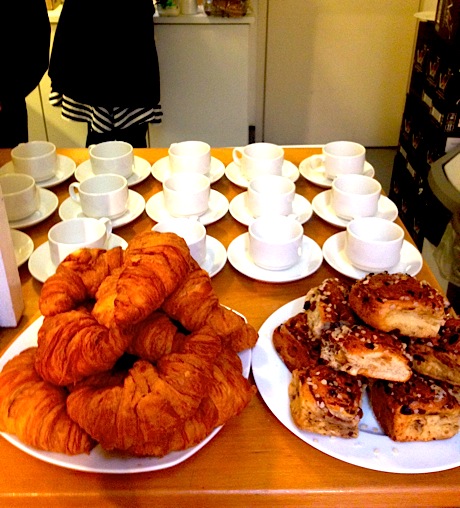
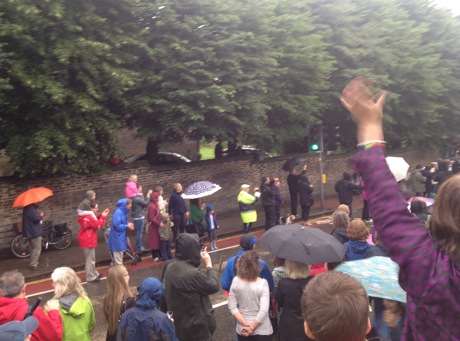
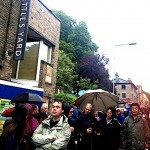
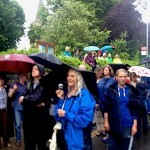
Sunday was a wet and early start at Kettle’s Yard. We wanted to celebrate the Olympic Torch running past the gallery and provide a place for the community to participate in all the excitement. We thought we’d have a casual breakfast of croissants and coffee available in the gallery for whomever was out and about in the early hours to cheer on the Flame.
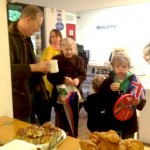
We had a buffet of croissants, chelsea buns, coffee and orange juice. Four lovely volunteers came at 6:30am to help us set up and serve the treats. For a while it was looking like we might be all to attend but suddenly at 6:45am, people starting filing through our door with eager eyes at the sight of coffee and pastries.
Delicious pastries, nicely laid out… they wouldn’t last long!
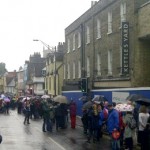
As the party bus approached, out everyone ran to cheer and began wildly screaming as the Torch ran past us. Some were in the street and some up on the church yard, which gave spectators great views of all the action. The rain wasn’t deterring anyone!
Views from the church yard
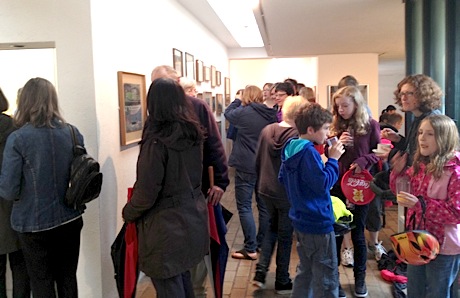
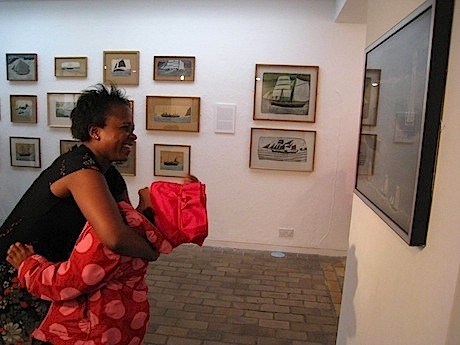
After the Torch went past, everyone piled into the gallery and were all taking advantage of their early morning entrance on the last day of Alfred Wallis: ships and boats. What a great way to finish the show!
Happy children, family and friends in the gallery
All in all, we serverd 80 croissants and 30 chelsea buns as well as an ample supply of biscuits to 4 volunteers, 4 staff members and 300 visitors!! We had a great time!
Alfred Wallis: ships and boats
/ Final week / Wednesday 4th July
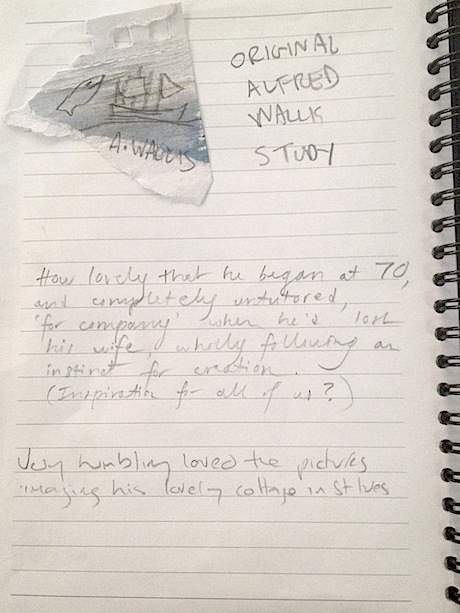
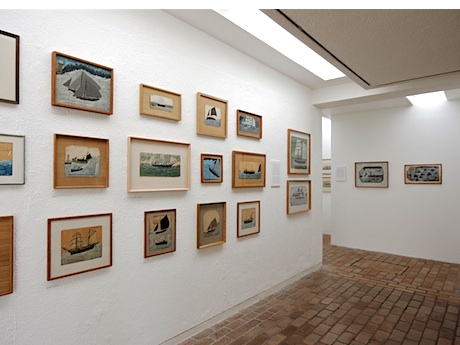
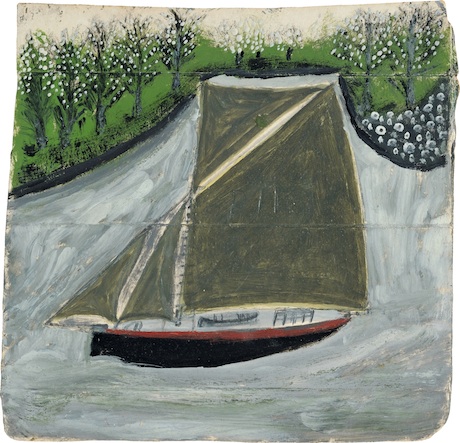
This is the final week of Alfred Wallis: ships and boats. It has been wonderful to see the enthusiastic response to Alfred Wallis’ beautiful paintings.
We’ve had over 10,000 visitors to the Alfred Wallis show since the beginning of April. There have been some great comments left in our comment book:
Kettle’s Yard visitor book, 2012
Among the positive press was a review from Richard Cork of the
Financial Times
, “
Kettle’s Yard in Cambridge has mounted an illuminating survey of his work. The location proves ideal”
. There have also been some lovely blog posts about our Alfred Wallis show. These include
Art Burger
with vivid pictures of Wallis and the house, an interesting account of childrens interpretation of Wallis on the blog
Children Take the Lead
, and a lovely blog about one of the Alfred Wallis lunchtime talks, featuring the historian Ruth Scurr, University of Cambridge, on
Cambridge Commentary
.
If you haven’t made it to the show you have until 5pm on Sunday 8 July! Watch this space for news of the exhibition tour and a new Wallis publication.
For all artists and arts organisations: the Arts Council has produced a series of videos, released monthly, to promote the Grants for the Arts scheme to individual artists. This is funding designated for individual artists and small arts organisations. Take a look and see how some of the artists are using their funding.
Grants for the arts
is for activities carried out over a set period and which engage people in England in arts activities, and help artists and arts organisations in England carry out their work. It is funded by the National Lottery. Perhaps you can watch the videos and get some ideas to apply for your own stream of funding.
This month’s video focuses on visual artist Ben Rivers which you can watch below.
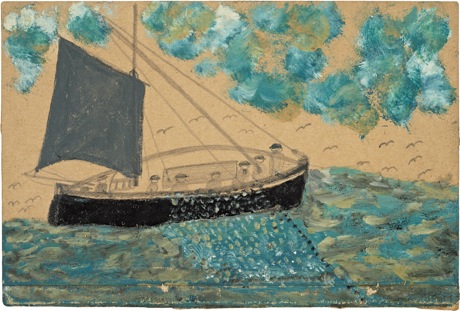
Alfred Wallis, Sailing ship and orchard, 1935-37 (circa)
Poetry inspired by Alfred Wallis
/ Thursday 21st June
On Sunday 10 June poet
Tamar Yoseloff
ran a study day here entitled ‘Wallis and Poetry’ to coincide with the
Alfred Wallis display
in the gallery. We are delighted to be able to share two of the poems that emerged from the day. Tamar also wrote a fascinating post on her blog about Wallis and poetry, see:
http://invectiveagainstswans.tumblr.com/
Please read the poems below.
Cannibalism
In memoriam – Alfred Wallis 1855-1942 – Cornish Mariner and Painter
He knows the roof of the sky
how it can darken in anger
at a penny in a sailor’s pocket
the hint of a whistle
the whiff of a woman
He grew up on tales of Franklin’s fate -
the ships splintered in an arctic grip
the starving men dreaming
of the blue flesh of their own dead
He knows how the land feels
after days, weeks away
how it tilts him and sways him
as if he has defied his God
with the velveteen sweetness of brandy
He wades through the flotsam
of the grocery store
stamping boxes to a flatness
he can fill with his world
seeking nails he can use
to crucify his visions
In the world beyond
the privileged discuss Primitivism
over cups of Darjeeling
taming fears of consuming darkness
by sending forth the sacrament
the word made flesh
In the world beyond
the scholars pick clean
his remains – marvel
at the whiteness of his bones.
Sue Burge June 2012
‘Small Boat in a Rough Sea’ Alfred Wallis, the Cornish painter, spoke of every boat of the fleet having ‘a soul, a beautiful soul, shaped like a fish’
Sure at last that it was his life he was living
he painted the way he read God’s word, daily
and in simple tones, with the sombre shades
of yacht-paint he had to hand: rock-colour,
sand-colour, for ships and cottages, a flock
of enamelled birds, the moon atop a hill.
He’d picture the bowl of sea in Mounts Bay,
its broken crests of wave, the gulls tucked
into its cliff-folds, its tall masts and rigging,
the tide of its breathing like his very own.
What he could never catch was the fog,
the peninsula turned isle wreathed round
by the haunted sound of its fog-horns,
St Anthony’s Head, Longships, Lizard Point,
like souls on their journey or parishes already
in mourning, Trevose Head, Pendeen.
The bodies recovered have not been named.
But in the dawn a shoal of selves, fine and silvery
as pins, will be putting out for Troy and Eldorado,
for whelks or herring or pilchard, pelagic gold:
It’s always been crabbing or fishing with him, he loved it since he was a nipper.
Plymouth, Lundy, Sole.
Porpoises black as bibles ride the turquoise
and the great white sails glide on like ghosts.
Lesley Saunders
(The quote is from an interview given by the mother of one of the missing fishermen from the Purbeck Isle, which went down off the south coast of England on 17 May 2012.)
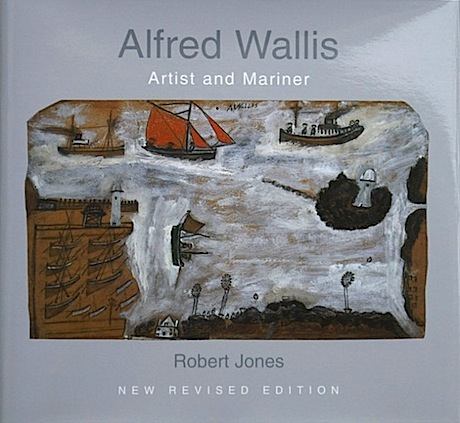
Robert Jones, Alfred Wallis expert, delivered a talk at Kettle’s Yard, 12 June. You can watch the talk here.
The Cornish artist and author
Robert Jones
was born in Newquay, Cornwall. The beaches and cliffs were his childhood playground. He studied at Falmouth College of Art where he was taught by Robert Organ and Francis Hewlett. He continued to paint whilst teaching in various schools including A.S. Neill’s Summerhill School for three years, and for seven further years fishing around the Cornish coast. A period as part time tutor at Penzance and Falmouth Colleges of art, followed by a successful exhibition at Newlyn Orion Art Gallery encouraged him to concentrate on his painting. He was able to reduce his teaching commitments and then to paint full time. He is a prolific artist who has exhibited widely.
In 1995 he began researching the life and work of the artist Alfred Wallis, and in 2000 his book, ‘Alfred Wallis Artist and Mariner’ was published to critical acclaim. Continuing with his fascination with maritime subjects he has completed his next book which is about the pierhead painter Reuben Chappell. The book ‘Reuben Chappell Pierhead Painter’ came out in the spring of 2006.
From December 2011 to May 2012 I was Music Assistant at Kettle’s Yard, working on the Thursday Chamber Subscription Series and the New Music Series. My job has been to make everything run smoothly on concert day, from setting up the room to making the programmes to getting in tea for the musicians, so I’ve definitely been kept busy! I’ve had the opportunity to meet some incredible performers and hear some amazing performances. I’m writing this on my last day, and the last day of the subscription series for the year, so now is a good chance for me to look back on the concerts and on my time here and pick out a few highlights.
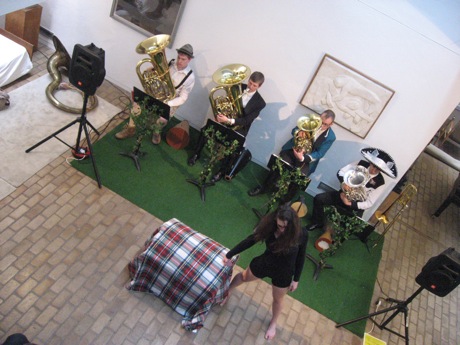
I knew the New Music concerts were going to be a lot of fun when they started with an irrepressible quartet of tuba players in costume and character – Youtuba put on a brilliantly entertaining show which was also musically dazzling.
Two weeks later and I was holding on for dear life page-turning a monster of a piece by Michel Finnissy for Mary Dullea, performing with top contemporary violinist Darragh Morgan, and soon after I was laughing along with the vocal acrobatics of Rebecca Askew and Melanie Pappenheim’s performance of Orlando Gough’s Flam.
On the chamber music side, personal highlights were hearing Ronald Brautigam perform a treat of a programme (all Beethoven – yes please), and the wonderful humour of singers Karen Cargill and Marcus Farnsworth. Marcus, who subbed in at eight hours’ notice (!), ended with one of the funniest encores I’ve ever heard!
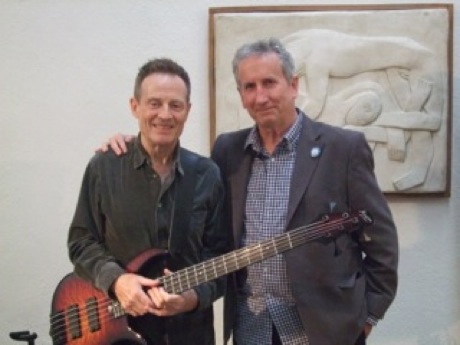
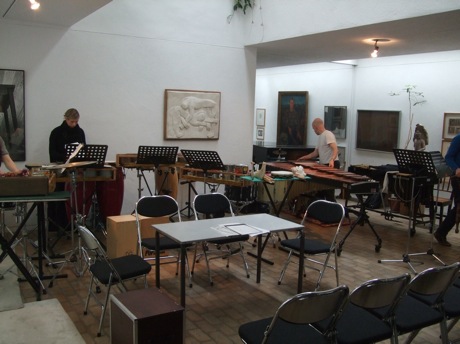
We made a particularly big effort in promoting the visit of top contemporary string group The Smith Quartet, and it was great to see the place filled to the rafters for their performance of George Crumb’s dark masterpiece Black Angels. A week on and we had a van load of percussion (everything including the kitchen sink) for the fabulously fun ensemblebash, but perhaps the highlight was working with John Paul Jones, the bassist with Led Zeppelin. I never thought I would be doing sound for someone of that stature but working here has been full of surprises!
Throughout it all I have had the pleasure of working with some fantastic people. Kettle’s Yard is very fortunate to have such a large community of friendly, interested and loyal concert-goers, and we’ve also been delighted to see our New Music concerts drawing in people who’ve never visited before. The staff and volunteers work really hard to make things happen here and it’s been a pleasure to be a part of things here, even if I’ve been pretty tired at the end of some very long days!
I’d like to thank all the staff and volunteers I’ve worked with but especially Ruth for being totally dependable and generous with her time and Lara for somehow managing to juggle about three jobs and still come out smiling.
I’m delighted to be moving on to a role with the Creative Learning department of the Britten Sinfonia, and I have no doubt I’ll be coming back to Kettle’s Yard soon, but maybe next time as an audience member!


 Two weeks later and I was holding on for dear life page-turning a monster of a piece by Michel Finnissy for Mary Dullea, performing with top contemporary violinist Darragh Morgan, and soon after I was laughing along with the vocal acrobatics of Rebecca Askew and Melanie Pappenheim’s performance of Orlando Gough’s Flam.