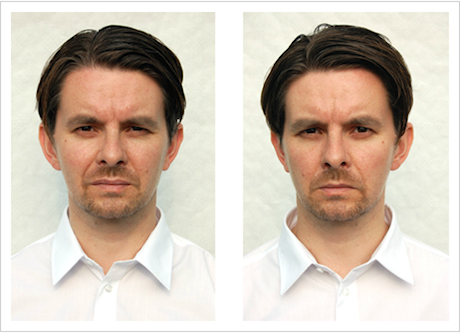
Untitled (Self-Portraits), 2008, Two Colour Photographs
Jeremy Millar
/ Kettle's Yard Associate Artist / Monday 2nd July
Some visitors to Kettle’s Yard may recognize Jeremy’s name as he curated the John Cage exhibition in 2010. More information about that show
here.
Jeremy was also involved in this year’s event at Kettle’s Yard for Museums at Night on 17 May, 2012.
Biography
Jeremy Millar (b. 1970, Coventry) changed the landscape of contemporary artistic practice when he organized an exhibition entitled The Institute of Cultural Anxiety at the Institute of Contemporary Art in 1994. Turning curatorial conventions on their heads, he brought together such disparate exhibits as works by Hieronymous Bosch and Jeff Koons and the helmet worn by Donald Campbell on his ill-fated attempt to break the Water Speed Record. In taking on the spaces and conventions of display, he claimed new territory for artists, and inaugurated a new form of artistic practice: curating as art.
The Institute of Cultural Anxiety also set out certain themes and ideas that he has continued to explore since then, through films, photographs, sculpture and installations, writing and exhibitions: the assemblage-like nature of collections; the making of exhibition and other forms of display; the relationship between art and non-art objects; and the creation of imaginary conceits with which to structure a work.
Millar is currently working with the Museum of Barnstaple and North Devon, composer Sophie Sirota, and local young people to create a theatrical event and film work exploring the people, ideas and practices behind Barnstaple’s Literary and Scientific Institute.
Millar’s writings on art have been published widely. He teaches regularly at the Royal College of Art and is a member of the editorial board of the journal
Afterall
. He has been the recipient of fellowships from Nesta, the Arts Foundation, and from 2007 until 2010 was AHRC Research Fellow in the Creative and Performing Arts at the Ruskin School of Drawing and Fine Art, University of Oxford. Millar has exhibited widely in the UK and abroad including Tramway, Glasgow; NGCA, Sunderland; CCA, Vilnius; Rooseum, Malmö and Bloomberg Space, London. A permanent public work was installed in Folkestone in 2006. A monograph on his work, Zugzwang (almost complete), with an essay by Brian Dillon, was published in 2006. He is based in Whitstable, Kent.
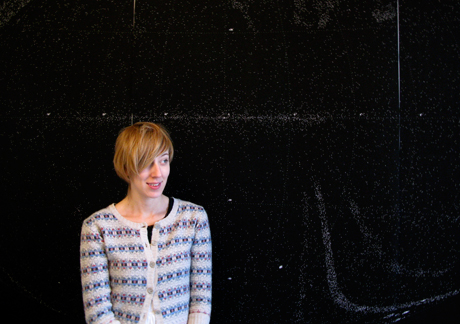
Katie Paterson
/ artist in residence at the Wellcome Sanger Institute / Monday 2nd July
“I am an artist often working with scientists in my exploration of time and the evolution of nature and the cosmos by way of moonlight, melting glaciers, and dead stars. I am like a magpie, collecting and piecing together ideas from a multitude of places. The imagination always plays a key role.” Katie Paterson
Katie’s conceptual projects make use of sophisticated technologies and specialist expertise to stage intimate, poetic and philosophical engagements between people and their natural environment. While in residence, she will be exploring genomics research. The outcomes of her residency will include an exhibition at
Kettle’s Yard
in Spring 2013.
Katie Paterson will begin her residency in July 2012.
Scottish artist Katie Paterson (born 1981) is an emerging talent in the world of art. Her conceptual projects make use of sophisticated technologies and specialist expertise to stage intimate, poetic and philosophical engagements between people and their natural environment. Since graduating from the Slade School of Art in 2007 she has gone on to exhibit internationally, from London to New York, Berlin to Seoul, and her works have been included in major group shows at Tate in London, and Vienna’s Kunsthalle. Her artworks are represented in collections such as the Guggenheim New York and SNGMA Edinburgh.
Find out more about Katie from
Katie’s site
You can watch the artist’s ’100 Billion Suns’ video below
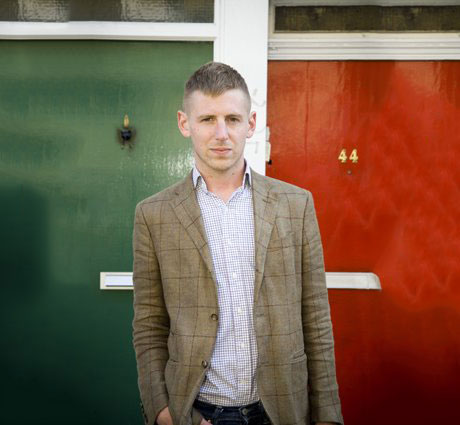
Matthew Darbyshire
/ Kettle's Yard Associate Artist / Monday 2nd July
Biography
Matthew Darbyshire (1977, Cambridge) studied at the Slade under the acclaimed British sculptor Phyllida Barlow, alongside other rising British talents Spartacus Chetwynd and Pablo Bronstein. Darbyshire is best known for installations that draw heavily on the aesthetic language of today’s commodity culture and the aspirational lifestyles it promotes. He is interested in the fact that bright CMYK dots are the logo for an estate agent and a cinema, as well as a NHS walk-in centre; that Arne Jacobsen egg chairs can be found in London’s Zetter boutique hotel as well as in recently rebranded McDonald’s restaurants. He explores design as a barometer of social change within the complex visual environment of contemporary Britain.
Darbyshire’s work has been included in recent exhibitions at the Miro Foundation in Barcelona, Turner Contemporary in Margate, (both 2011). He was included in The British Art Show 7 and Newspeak at the Saatchi Gallery (both London, 2010), and Altermodern: the Tate Triennial at Tate Britain (London, 2009). Darbyshire has also had a string of solo exhibitions in London in recent years: at Gasworks and as part of the Nought to Sixty programme at the Institute of Contemporary Art (both 2008), Hayward Gallery Project Space (2009) and Frieze Projects (2010). His largest public exhibition to date, T Rooms opened in January 2012 at Tramway in Glasgow.
In 2010-11, Darbyshire was the Stanley Picker Fellow in Fine Art at Kingston University, London. He teaches regularly at the Ruskin School of Art, Oxford and is based in Rochester, Kent.
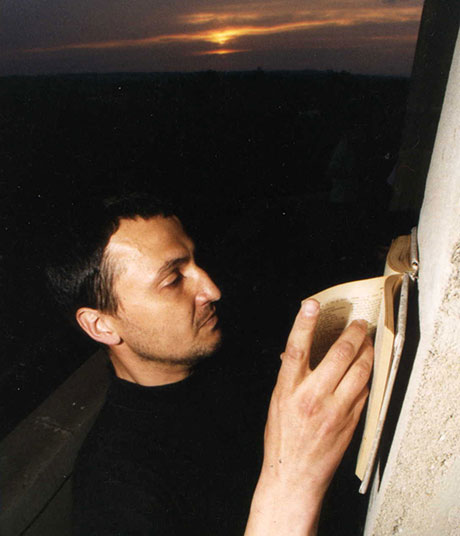
Matei Bejenaru
/ Kettle's Yard Associate Artist / Monday 2nd July
Biography
Drawing particularly on his own experience of postcommunist life, Matei Bejenaru (b. 1963, Suceava, Romania) is interested in how historical, socio-political and cultural contexts shape everyday life and dictate the conditions of artistic practice. His poignant and poetic work often brings different artistic languages together; it can take the form of a travel guide to the UK for illegal Romanian immigrants (Travelling Guide, 2005-2007) or a modernist interpretation of choir music. Songs for a Better Future (developed in collaboration with composer Will Dutta and premiered at the Drawing Room and Tate Modern in London in 2010) draws on musical themes from proletarian choir songs to electronic music of the 1970s.
Bejenaru works and exhibits internationally, including recent projects at the Tirana Biennial (2003), Thyssen-Bornemisza Contemporary Art, Vienna (2006), Tate Modern, London (2007), the Taipei Biennial 2 (2008), The Drawing Room, London (2010), Glasgow School of Art and The Western Front, Vancouver (both 2011). He is based in Iasi, Romania, where he established the Periferic Biennial (http://www.periferic.org/) in 1997, initially a performance festival and now an international art event. He is also a founding member of the Vector Association, which promotes contemporary art in local contexts.
Bejenaru teaches photography and video art at the ‘George Enescu’ Art University, Iasi, and is currently Visiting Professor in visual arts at the University of Quebec in Montreal, Canada.
You can watch the artist discuss his travel guide at Tate Modern
here
.